Health and Biosecurity

The Health and Biosecurity Programme assists members to reduce the risks of aquatic animal disease impacting the livelihoods of farmers, national economies, trade, environment and human health by:

  • Improving regional cooperation in aquatic animal health and welfare.
  • Developing and implementing national strategies on aquatic animal health.
  • Improving surveillance, reporting and response to disease emergencies.
  • Promoting harmonisation of diagnostic procedures and risk assessment.
  • Widespread promotion of better aquatic animal health management practices at the farm level.

Key activities

Key activities of the programme include:

  • Convening the annual meeting of the Asia Regional Advisory Group on Aquatic Animal Health, coordinating the Quarterly Aquatic Animal Disease Report and bringing regional issues to the attention of global standard setting bodies such as the Office International des Epizooties.
  • Establishment and expansion of a three-tier shared resource in aquatic animal health.
  • Development of farm-level health management tools for key aquaculture commodities.
  • Supporting regional disease surveillance and reporting.
  • Strengthening aquatic animal health and biosecurity in the region.
  • Facilitating harmonisation in disease diagnostic techniques.
  • Developing resource material in support of diagnosis and surveillance.

Contacts

Creative Commons Attribution.
Related

Subject tags

A collection of subject tags relating to technical matters.

In this collection

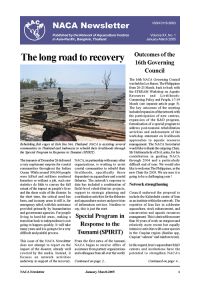
NACA Newsletter Volume XIX, No. 4, October-December 2004

In this issue:

Kasetsart University and NACA sign MOU on genetics. Village shrimp health management project in Andhra Pradesh. A committee to manage fish health in Viet Nam. China to promote healthy shrimp farming. Father of China's shrimp aquaculture. NACA collaboration can extend to west and central Asia, Iran mission suggests. STREAM conducts monitoring & evaluation workshop. STREAM to support aquaculture in western Orissa.

Akoya oyster disease: Disease card

Akoya oyster disease is of concern to the region and was included in the Regional NACA/FAO/OIE quarterly aquatic animal disease (QAAD) reporting list, effective first quarter of 2003, to assist in the collection of occurrence data. This disease card will support the surveillance programs of countries in the Asia-Pacific region.

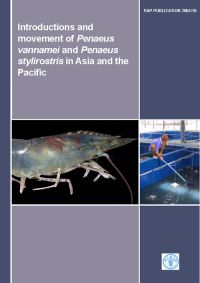
Introductions and movement of Penaeus vannamei and Penaeus stylirostris in Asia and the Pacific

This report has attempted to gather all of the currently available data on the extent of P. vannamei and P. stylirostris importation and culture in Asia, its potential problems and benefits, to provide a source document from which to investigate further the means by which control over this issue might be re-established. Recommendations aimed at controlling the importation, testing and culture of these species have been made for all levels and are included in this report.

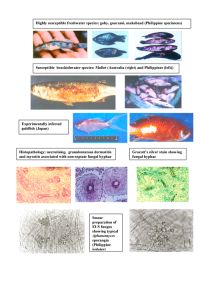
Epizootic ulcerative syndrome: Disease card

Epizootic ulcerative syndrome (EUS) is a seasonal epizootic condition of wild and farmed, fresh and brackishwater fish. Of complex infectious aetiology, it is characterised by the presence of invasive Aphanomyces infection and necrotising ulcerative lesions typically producing a granulomatous response. The disease is now endemic in South-east and south Asia, and has recently extended to West Asia. EUS is indistinguishable from red spot disease of eastern Australia and mycotic granulomatosis of Japan.

Infection with koi herpes virus: Disease card

Koi herpes virus (KHV) outbreaks in the region have significant trade implications for the high value ornamental koi carp industry, and the important food fish common carp. Active trade in ornamental fish poses a potential risk for spread of KHV. Recognising the significance, "infection with koi herpesvirus" has been listed under "diseases prevalent in the region" in the NACA/FAO/OIE regional quarterly aquatic animal disease (QAAD) list, effective for reporting from first quarter of 2004.

Slow growth syndrome in Penaeus monodon - an emerging problem: Disease card

This information sheet on slow growth syndrome in Penaeus monodon provides some background information on the possible aetiology and a working case definition. This will be useful for surveillance and epidemiological purposes to collate more information about this syndrome in the region.

Quarterly Aquatic Animal Disease Report, July-September 2004

This report, the 25th in the series, contains information about the aquatic animal health status of fifteen states in the Asia-Pacific region. The foreword discusses the outcomes of the third meeting of the Asia Regional Advisory Group on Aquatic Animal Health.

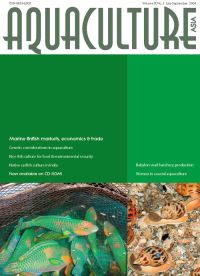
Aquaculture Asia Magazine, July-September 2004

In this issue:

Genetic considerations in fisheries and aquaculture with regards to biodiversity. Rice-fish culture for food and environmental security. Land-based aquaculture of spotted babylon Babylonia areolata in Thailand: Hatchery-based seedling operation. Shrimp health question and answer. Women in coastal aquaculture. Insights into live marine food fish markets in Asia. Farming practices, market chains and prices of marine finfish in Malaysia, Indonesia and Hong Kong.

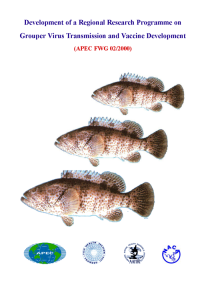
Development of a Regional Research Programme on Grouper Virus Transmission and Vaccine Development

These are the proceedings of a workshop, funded by the APEC Fisheries Working Group Project 02/2000. The project developed a framework with nine major research components: Health and production at hatcheries, regional collaborative disease resource centers, regional disease monitoring and surveillance, improving regional diagnostic capabilities, responsible trans-boundary movement, farm health management, vaccines and vaccination, funding mechanisms and establishment of an ad-hoc working group.

Quarterly Aquatic Animal Disease Report, April-June 2004

This report, the 24th in the series, contains information about the aquatic animal health status of seventeen states in the Asia-Pacific region. The foreword discusses capacity building to prevent, prepare for an respond to aquatic animal health emergencies.

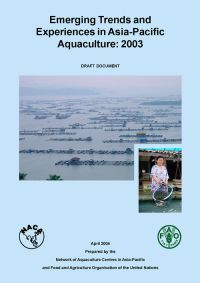
Emerging Trends and Experiences in Asia-Pacific Aquaculture: 2003

This document provides an overview of topical issues in Asian aquaculture for 2003, including a review of its status, progress in research and development, major issues and experiences, together with suggestions on actions for addressing opportunities and constraints. The document was prepared by NACA and FAO to facilitate discussions at the 15th NACA Governing Council meeting, hosted by the Government of Sri Lanka on 21st-25th April 2004.

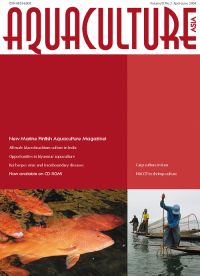
Aquaculture Asia Magazine, April-June 2004

In this issue:

Genetic impacts of translocation on aquatic biodiversity in Asia. Carp culture in Iran. Opportunities and challenges in Myanmar aquaculture. Impacts of monosex Macrobrachium culture on seed availability in India. Use of new technology and skills for eco-friendly production of tiger shrimp Penaeus monodon. Larval rearing and spat production of the windowpane shell Placuna placenta. HACCP in shrimp farming. First breeding success of Napoleon wrasse Cheilinus undulatus and coral trout Plectropomus leopardus.

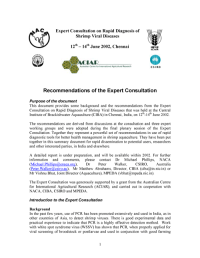
Recommendations of the Expert Consultation on Rapid Diagnosis of Shrimp Viral Diseases, Chennai 2002

The recommendations are derived from discussions at the consultation and three expert working groups and were adopted during the final plenary session of the Expert Consultation. Together they represent a powerful set of recommendations in use of rapid diagnostic tools for better health management in shrimp aquaculture. They have been put together in this summary document for rapid dissemination to potential users, researchers and other interested parties, in India and elsewhere.

Chemical and biological amendments used in shrimp farming (abstract)

This article compares the use of chemical and biological amendments in shrimp farming in Asia and the Americas. The information comes mainly from the author’s experience in Thailand and Ecuador, as well as from the literature. The amendments are discussed according to three major categories: (1) water and soil quality management products, (2) biocides, and (3) feed additives. Certain agents, while necessary to successful shrimp farming, should be used only when needed and in a safe and responsible manner. 

Basic overview of the regulatory procedures for authorisation of veterinary medicines with emphasis on residues in food animal species

This report presents a précis of the regulatory procedures for authorisation of veterinary medicines in Europe and the USA. In particular it concentrates upon the requirements for consumer safety in regard to presence of residues of veterinary medicines in the edible tissues of food animal species. In both Europe and the USA the regulations in regard to veterinary residues and consumer safety require that countries wishing to export into those markets demonstrate equivalent standards to the domestic requirements.

Report of the Emergency Disease Control Task Force on a Serious Disease of Koi and Common Carps in Indonesia, June 2002

An Emergency Disease Control Task Force on a Serious Disease of Koi and Common Carps in Indonesia was organised by NACA in June 2002. The Task Force conducted an emergency assessment of the disease situation in July through field and laboratory examinations of collected samples. The Task Force collected information about the disease occurrence. Koi herpes virus was detected from all case samples which indicates that it may have played a role in the observed mortalities.

Quarterly Aquatic Animal Disease Report, January-March 2004

This report, the 23rd in the series, contains information about the aquatic animal health status of twenty states in the Asia-Pacific region. The foreword discusses a project on Capacity and Awareness Building on Import Risk Analysis for Aquatic Animals, funded by the APEC Fisheries Working Group.

Aquaculture Asia Magazine, January-March 2004

In this issue:

Aquaculture and food security in Iraq. Natural breeding in captivity - conservation of the threatened freshwater featherback Notopterus notopterus. Culture of Penaeus japonicus. Enzymes for sustainable aquaculture. Review of global tilapia farming practices. Fish culture in Yucatan, Mexico. Shrimp farm project planning, preparation and implementation. Coping with low shrimp prices. Efficiencies in barramundi culture. The innovative contributions of women in aquaculture. Marine finfish section. What's new on the web. Aquaculture calendar.

NACA Newsletter Volume XIX, No. 1-2, January-June 2004

In this issue:

Outcomes of the 15th Governing Council. Aquaculture seminar. Council Chair for 2004-2005. Shrimp disease and coastal management - four years. New Import Risk Analysis publications. Reducing the risk of shrimp disease outbreaks in Vietnam. Network of Aquaculture Centres in Central and Eastern Europe. OASIS: The One Stop Aqua Shop Information Service. Other recent STREAM activities. New faces at NACA.

Report of the second meeting of the Asia Regional Advisory Group on Aquatic Animal Health, 10-12 November 2003

The Asia Regional Advisory Group on Aquatic Animal Health meets annually to discuss regional health issues including emerging disease threats. This report includes a review of regional disease status circa 2003, global and regional disease reporting arrangements, global issues and standards, progress in implementation of the the Regional Technical Guidelines on Health management for the Responsible Movement of Live Aquatic Animals, identification and designation of regional aquatic animal health resources and regional and international cooperation.