Health and Biosecurity

The Health and Biosecurity Programme assists members to reduce the risks of aquatic animal disease impacting the livelihoods of farmers, national economies, trade, environment and human health by:

  • Improving regional cooperation in aquatic animal health and welfare.
  • Developing and implementing national strategies on aquatic animal health.
  • Improving surveillance, reporting and response to disease emergencies.
  • Promoting harmonisation of diagnostic procedures and risk assessment.
  • Widespread promotion of better aquatic animal health management practices at the farm level.

Key activities

Key activities of the programme include:

  • Convening the annual meeting of the Asia Regional Advisory Group on Aquatic Animal Health, coordinating the Quarterly Aquatic Animal Disease Report and bringing regional issues to the attention of global standard setting bodies such as the Office International des Epizooties.
  • Establishment and expansion of a three-tier shared resource in aquatic animal health.
  • Development of farm-level health management tools for key aquaculture commodities.
  • Supporting regional disease surveillance and reporting.
  • Strengthening aquatic animal health and biosecurity in the region.
  • Facilitating harmonisation in disease diagnostic techniques.
  • Developing resource material in support of diagnosis and surveillance.

Contacts

Creative Commons Attribution.
Related

Subject tags

A collection of subject tags relating to technical matters.

In this collection

NACA Newsletter, Vol. XXXVIII, January-March 2023

In this issue:

High-level meeting on aquaculture transformation in the Asia-Pacific region; Developing a regional strategy for aquatic organism health: Progressive management pathways; Job opportunity - health management and husbandry researcher; 2022 China-ASEAN International Forum on Sustainable Development of Fisheries and Aquaculture Under the Blue Transformation Strategy; A new progressive management pathway for improving seaweed biosecurity; Indian delegates visit Thailand for training and industry exposure; PhD scholarships: Shanghai Ocean University PhD Programme 2023; Reported aquatic animal diseases in the Asia-Pacific region during the second quarter of 2022.

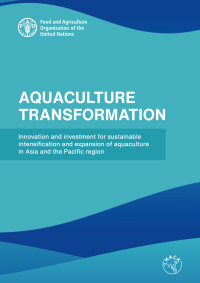
Aquaculture transformation: Innovation and investment for sustainable intensification and expansion of aquaculture in Asia and the Pacific region

The document provides an overall vision and framework intended to accelerate aquaculture transformation in Asia and the Pacific region through innovations and investment, and to provide guidance to partners from the public, private and development communities to actively engage with the region in transforming aquaculture to more efficient, inclusive, resilient and sustainable food systems. The document served as background information for discussion in the High-Level Meeting on Aquaculture Transformation in Asia and the Pacific Region, 22–23 November 2022, organised by the FAO Regional Office for Asia and the Pacific and the Network of Aquaculture Centres in Asia-Pacific. The document is broadly aligned with FAO’s Blue Transformation Roadmap, paying specific attention to the context and needs of aquaculture within Asia and the Pacific region. The Paper translates the Roadmap into a vision and priority actions for aquaculture transformation in the region by 2030.

A new progressive management pathway for improving seaweed biosecurity

A new paper in Nature Communications by Cottier Cook et al. describes the need for a new progressive management pathway to improve seaweed biosecurity. The seaweed aquaculture industry has rapidly expanded to 35 million tonnes per annum, a production that represents 51% of global coastal aquaculture by volume. Rising seawater temperatures and coastal eutrophication have led to an increase in infectious diseases and pest outbreaks. The paper describes a process for developing and implementing locally-adapted progressive management pathways to address seaweed disease and pest issues.

Job opportunity - fish health management and husbandry researcher (three years)

The Norwegian Veterinary Institute has a vacant three-year position as a researcher in the expanding area of sustainable aquaculture development internationally, with a desired start-up as soon as possible. This is an exciting opportunity for competent candidates with interest and experience from working internationally with farmed aquatic animal health management and husbandry. The right candidate will be joining our team of experts in epidemiology, biosecurity, diagnostics and applied health management. All nationalities eligible.

FAO/NACA workshop to developing a regional strategy for aquatic organism health using progressive management pathways

On 28-29 November FAO and NACA collaborated on a virtual workshop to develop a regional strategy for aquatic organism health, using a progressive management pathway for improving aquaculture biosecurity. The workshop was held under the auspices of the project “Responsible use of fisheries and aquaculture resources for sustainable development component 3: Biosecurity and health management”. The workshop involved 31 experts from 16 countries, including national focal points, FAO and NACA. The objectives of the workshop were to: Present and analyse country responses to a self-assessment survey on biosecurity and health management capacity and performance; to provide guuidance to country participants on conducting a SWOT analysis; and to prepare a detailed plan for Phase II of the initiative.

High-level meeting on aquaculture transformation in Asia and the Pacific region

As a follow on from the September FAO/NACA workshop on aquaculture transformation, FAO and NACA convened a high-level meeting to discuss the issue and the outcome of the previous consultation with policy makers. The meeting was held virtually from 22-23 November and was attended by 79 senior officials from 25 countries and international organisations, with observers from industry and international NGOs. Specific objectives of the high-level meeting were to: Engage senior policy makers and business leaders in the process of defining regional targets, action areas and initiatives for aquaculture transformation in the region by 2030, identify strategies and mechanisms to stimulate innovation and investment, and to recommend follow up actions and commitments.

Reported Aquatic Animal Diseases in the Asia-Pacific Region during the Second Quarter of 2022

With the implementation of the new aquatic animal disease reporting in the Asia Pacific region from January 2021, and in lieu of the published QAAD Reports (last issue published was 4th quarter of 2020), NACA is publishing reported aquatic animal diseases submitted by countries in the Asia-Pacific region.  This report covers the second quarter of 2022 and the original and updated reports can be accessed at the QAAD page

Free registration: 2022 China-ASEAN International Forum on "Sustainable Development of Fisheries and Aquaculture Under the Blue Transformation Strategy”

Ocean University of China and partners will convene the forum from 20 to 22 November 2022. The forum will cover the following: Topic 1: International talent cultivation and training;Topic 2: Science and technology innovation; Topic 3: Industrial synergy. The forum will host discussions about the implementation of the “Blue Transformation” strategy, further expansion of the space for fisheries and aquaculture, and ways of improving the production capacity of aquatic products, with the purpose of facilitating the achievement of the UN Sustainable Development Goals. Participation is free but registration is required. Registration closes on 22 October.

NACA Newsletter, Vol. XXXVII, October-December 2022

In this issue:

Training Course on Mariculture Technologies in Asia-Pacific; FAO/NACA Virtual Workshop on Aquaculture Transformation in Asia and the Pacific Region; Belt & Road Forum for International Freshwater Fishery Industry Innovation; 8th Global Conference on Gender in Aquaculture and Fisheries, 21-23 November; Reported Aquatic Animal Diseases in the Asia-Pacific Region during the First Quarter of 2022; International Training Course on Biology and Pathology of the Penaeid Shrimp 2022; Angkasa Putra inaugurated as first President of the South-East Asian Fisheries and Aquaculture Student Association; Artemia webinars: Video recordings of technical presentations available.

Aquaculture Asia Magazine, July-September 2022

In this issue:

Dynamics of small-scale aquaculture development in India: A review; Green water technology as an essential support to larval rearing of hilsa shad; Collection of freshwater molluscs and sale of meat by women in Purba Medinipur, West Bengal, India; A success story of ornamental fish farming as a tool for alternative livelihood of tribal women in Keonjhar District, Odisha, India; Recent trends in seed production of stinging catfish, Heteropneustes fossilis, in India; NACA Newsletter.

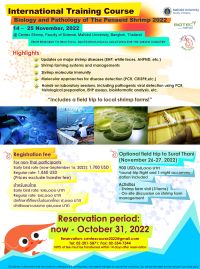
International Training Course on Biology and Pathology of the Penaeid Shrimp 2022, 14-25 November 2022, Thailand

Highlights of the course include: Updates on major shrimp diseases including EHP, white faeces, and AHPND; shrimp farming systems and management; Shrimp molecular immunity; molecular approaches for disease detection including PCR and CRISPR; hands-on laboratory sessions, including pathogenic viral detection using PCR, histological preparations, EHP assays and bioinformatic analysis, and an optional field trip to local shrimp farms in Surat Thani.

The course will be held at Centex Shrimp, Faculty of Science, Mahidol University in Bangkok, Thailand. This is a paid training course. Reservations will close on 31 October. For more information, please download the flyer.

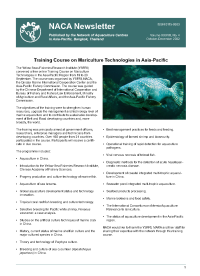
Register now: Free Training Course on Mariculture Technologies in Asia-Pacific

The Yellow Seas Fisheries Research Institute (YSFRI) will convene a free online Training Course on Mariculture Technologies in the Asia-Pacific Region from 19 to 23 September (please note the change of date). The course is organised by YSFRI, NACA, the Qindao Marine International Cooperation Center and the Asia-Pacific Fishery Commission. The training course will cover: Theory and technology for producing high-quality seed; New mariculture modes and technology; Nutrient regulation and feeding technology; Disease prevention and control technologies; Product processing and utilisation technologies. Applications close 5 September.

Reported Aquatic Animal Diseases in the Asia-Pacific Region during the First Quarter of 2022

With the implementation of the new aquatic animal disease reporting in the Asia Pacific region from January 2021, and in lieu of the published QAAD Reports (last issue published was 4th quarter of 2020), NACA is publishing reported aquatic animal diseases submitted by countries in the Asia-Pacific region.  This report covers the fourth quarter of 2021 and the original and updated reports can be accessed from the QAAD page.

NACA Newsletter, Vol. XXXVII, July-September 2022

In this issue:

  • NACA to host the International Artemia Aquaculture Consortium
  • Wenzhou virus 8 (WZV8) diagnosis by unique inclusions in shrimp hepatopancreatic E-cells and a molecular detection method
  • Report on the Webinar on Management of Artemia Resources of the Great Salt Lake, 5 May 2022
  • Twentieth Meeting of the Asia Regional Advisory Group on Aquatic Animal Health

Aquaculture Asia Magazine, April-June 2022

In this issue:

  • Ornamental Aquaculture Field School: A new extension approach
  • State of the art of carp spawn production and transportation at Ramsagar, Bankura District, West Bengal, India
  • Seahorse aquaculture: A new paradigm of commercial activity
  • Mixed infections in tropical freshwater fish culture systems: A potential emerging threat for successful aquaculture
  • NACA Newsletter

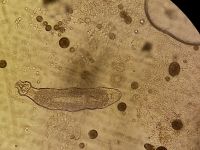
Mixed infections in tropical freshwater fish culture systems: A potential emerging threat for successful aquaculture

The aquatic environment contains many opportunistic pathogens and fish are frequently infected by a range of parasites, bacteria, viruses, and fungi. In most incidences of disease, the involvement of two or more pathogens are often seen, which in turn complicates diagnosis and treatment. Here we present a few case studies on mixed infections in aquaculture systems, which may become more common in future due to changing climatic patterns and associated adverse impacts on water quality. Mixed infections seem to be a big challenge to diagnostic laboratories and health specialists in terms of providing a correct diagnosis and treatment.

Wenzhou virus 8 (WZV8) diagnosis by unique inclusions in shrimp hepatopancreatic E-cells and a molecular detection method

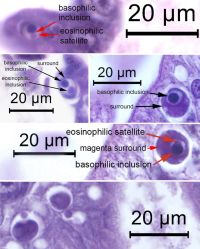
To assist shrimp pathologists worldwide we are providing here photomicrographs of unique basophilic inclusions that are produced by Wenzhou shrimp virus 8 (WZV8),  discovered in 2015 by Li et. al. We designed PCR primers and in situ hybridization probes for detection of WZV8. Subsequent ISH assays with shrimp RT-PCR positive for WZV8 samples indicate unique inclusions described herein as linked to WZV8 in H&E stained tissues. Going back over our previous histological reports and archived slides, we have found the unique WZV8 inclusions in E-cells of normal shrimp samples from several shrimp farming countries in Austral-Asia since at least 2008, and more recently in samples of P. vannamei from the Americas. We urge shrimp pathologists to review their records and specimens for the presence of WZV8 E-cell inclusions described herein to provide data on the global prevalence and impact of WZV8-like infections.

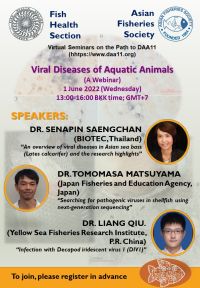
Free FHS Webinar: Viral Diseases of Aquatic Animals

The Fish Health Section of the Asian Fisheries Society is inviting you to a Zoom Webinar on Viral Diseases of Aquatic Animals, 1 June at 13:00 Bangkok time (GMT +7).

Participation is free but advance registration is required.

Reported Aquatic Animal Diseases in the Asia-Pacific Region During the Fourth Quarter of 2021

With the implementation of the new aquatic animal disease reporting in the Asia Pacific region from January 2021, and in lieu of the published QAAD Reports (last issue published was 4th quarter of 2020), NACA is publishing reported aquatic animal diseases submitted by countries in the Asia-Pacific region.  This report covers the fourth quarter of 2021 and the original and updated reports can be accessed from the QAAD page.

Twentieth Meeting of the Asia Regional Advisory Group on Aquatic Animal Health

This report summaries the proceedings of the 20th meeting of the Regional Advisory Group on Aquatic Animal Health, held 4-5 November 2021. The meeting discussed: Progress on NACA’s Asia Regional Aquatic Animal Health Program; updates from the OIE Aquatic Animal Health Standards Commission; aquaculture biosecurity; Progressive Management Pathway for Improving Aquaculture Biosecurity activities relevant to Asia; a systematic approach for quantifying biosecurity measures in aquaculture; aquatic animal health strategy; updates on the OIE Regional Collaboration Framework on Aquatic Animal Health; and updates on the QAAD Reporting and Disease List.