Inland aquaculture

Information relating to inland aquaculture practices.

Creative Commons Attribution.

Related

Subject tags

A collection of subject tags relating to technical matters.

In this collection

The cryptic domain of gut microbiota in composite culture of Indian major carps

The digestive tract of all vertebrates including fish is known to harbour a complex microbial ecosystem with a large, diverse and dynamic collection of microorganisms. These microbes become an integral component of the host animal with intimate host-microbe associations. In the following study, we employed both bacterial enumeration and culture independent DNA fingerprinting approach to examine the presence of host-specific gut microbiota in Indian major carps related to their occupancy of distinct ecological niches.

Integrated rice-fish farming in hilly terraces of the Apatani Plateau, Arunachal Pradesh

Rice-fish farming is a popular activity amongst the Apatani tribe of the Ziro valley, conducted in their wet rice terraces. The strains of fish cultured include mirror carp Cyprinus carpio specularis, scale carp C. carpio communis and leather carp C. carpio nudus, cultivated synchronously with local rice cultivars (Oryza sativa), viz. eamo, ampu, mipya, pyapu, pyaping and eylang. This article describes the integrated farming practices and socio-economic circumstances of the Apatani in the Yachuli, Hapoli, Hong, Hari, Hija, Bula, Dutta and Old Ziro villages.
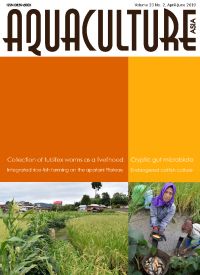
Aquaculture Asia Magazine, January-March 2019

In this issue:

Current status of freshwater cage aquaculture in India; Fattening of mud crab Scylla serrata in estuarine region of south-eastern West Bengal; Aquaponics - sustainable farming method in the fight against hunger; aquatic invasive apple snails (Pomacea spp.) in Timore-Leste - current status, spread and management in rice fields; NACA Newsletter.

Current status of freshwater cage aquaculture in India: Towards blue revolution

Initial attempts to develop freshwater cage aquaculture in India focussed on air breathing catfish and Indian major carps in the Yamuna and Ganga rivers, with later efforts in several large reservoirs. Cage-based aquaculture in inland waters is currently being promoted by some state governments with a view to enhancing fish production. This article examines the history of cage aquaculture in India and some of the factors to be considered in cage design and site selection.

Expert Consultation on Invasive Alien Fish Species, 19 December, New Delhi

An Expert Consultation on Invasive Alien Fish Species: Need for a Risk Benefit Assessment and Management Framework for Healthy Freshwater Systems will be organised on 19 December 2018 in New Delhi, India. The consultation will flag the need for an equilibrium between access to non-native germplasm and the minimisation of risk to ecosystems and native fish diversity from such introductions. As a major outcome, an objective tool is expected to be developed, which can be used to evaluate prospective introductions and support decision making.

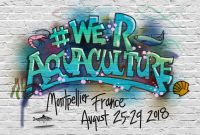
Aqua 2018 – #WeRAquaculture

Aquaculture has seen spectacular growth in recent years, and Aqua 2018 celebrated aquaculture’s role as one of the most important food industries worldwide. Held 25-29 August in Montpellier, France, Aqua 2018 brought together scientists, practitioners, students, industry and civil society to highlight the latest global developments in aquaculture research and innovation.

Aquaculture: A new trend and big opportunity in Sindh, Pakistan

The Sindh Province of Pakistan is very rich in aquatic resources and has a strong irrigation network. Farmers, after facing immense agricultural problems, now are considering aquaculture as an alternate option and converting their properties for aquaculture production. Commercial pond-based carp culture has significantly expanded and is now widely practiced in Sindh. Carp farmers have been making good profits and achieving high yields. Although aquaculture presently plays a modest role in the national economy of Pakistan its future prospects are bright.

A review of fresh water integrated multi-trophic aquaculture: Catching up on the dream of a blue revolution in India

Integrated multi-trophic aquaculture is a flexible concept, on which many variations can be developed and should not be viewed as confined to open-water, marine systems. Freshwater integrated multi-trophic aquaculture, perhaps better known as aquaponics, applies the same principles as those used in marine integrated multi-trophic systems. In particular, using plants to reduce phosphorus (and other nutrient) levels in effluents can help farmers meet water quality guidelines and prevent eutrophication in the environment.

Video lectures: Regional Training Course on Culture-based Fisheries in Inland Waters

This collection contains video recordings of the lectures from the Regional Training Course on Culture-based Fisheries in Inland Waters, held at Nha Trang University, Vietnam. The objective of the course was to provide participants with the skills to assist local communities to plan and manage culture-based fisheries; a relatively simple and low cost technology that can deliver nutritional and economic benefits to rural communities with few livelihood options. The course was sponsored by the United Nations University Fisheries Training Programme.

First training course on culture-based fisheries held in Nha Trang, Vietnam

The first ever Regional Training Course on Culture-based Fisheries in Inland Waters was held at Nha Trang University from 30 October to 8 November. The objective of the course was to provide participants with the skills to assist local communities to plan and manage culture-based fisheries. These practices are an example of a relatively simple and low cost technology that can deliver nutritional and economic benefits to rural communities, which often have few livelihood options.

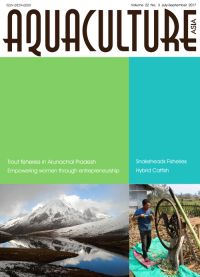
Aquaculture Asia Magazine, July-September 2017

In this issue:

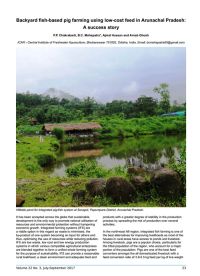
Regional network on culture-based fisheries and stock enhancement; trout fisheries in the uplands of Arunachal Pradesh - resources and opportunities; empowering young Indian women through entrepreneurship development - opportunities and constraints; a view on murrel (snakehead) fisheries in India; hybrid catfish Clarias batrachus x Heteropneustes fossilis produced by farmers in West Bengal, India; Backyard fish based pig farming using low-cost feed in Arunachal Pradesh - a success story; NACA Newsletter.

Backyard fish-based pig farming using low-cost feed in Arunachal Pradesh: A success story

In the north-east hill region of India, integrated fish farming is one of the best alternatives for improving livelihoods as most of the houses in rural areas have access to ponds and livestock. Among livestock, pigs are a popular choice, particularly for the tribal population of the region, who account for a major portion of the population. Pigs can fit into diverse systems of management, and can be reared on a wide variety of waste materials.

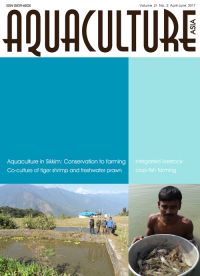
Aquaculture Asia Magazine, April-June 2017

In this issue:

Inspiring story of aquaculture in Sikkim - a journey from conservation to farming; farming of scampi and tiger shrimp together - a case study from West Bengal; Labeo pangusia - a candidate for diversification of hill aquaculture; sustainability of an integrated livestock-fish-crop farming system as a small scale enterprise; sustainable coastal aquaculture in India; potential scope and prospects of domestic fish market in Chhattisgarh.

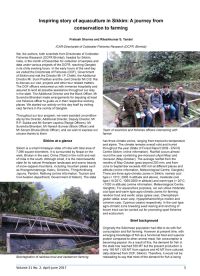
Inspiring story of aquaculture in Sikkim: A journey from conservation to farming

Sikkim is a small Himalayan state of India with three climatic zones ranging from tropical to temperate to alpine. The moderate-cool and warm agro-climatic zones are suitable for farming rainbow trout and exotic carp species, while brown trout hatchery and ranching can be conducted in the alpine areas. We report on the status of exotic carp and trout farming in Sikkim including farming practices, constraints faced by local farmers and possible solutions.

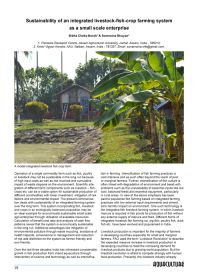
Sustainability of an integrated livestock-fish-crop farming system as a small-scale enterprise

We examined the sustainability and economic viability of a model integrated livestock-fish-crop farming system developed by the Fisheries Research Centre, Assam Agricultural University, over an extended period of 13 years. The system was developed as an ecologically sustainable alternative technology for small and margin farmers. It incorporates two livestock components, pig and poultry, with horticulture and carp polyculture. Analysis of cash flow and benefit-cost ration revealed the system to be economically sustainable over the long term.

Fact sheet: Tilapia lake virus (TiLV): What to know and do?

Tilapia lake virus is a newly emerging virus that is associated with significant mortalities in farmed tilapia. This fact sheet describes the threat to industry, clinical signs, diagnosis, risk factors, prevention and control options and actions that must be taken to minimise the impact of this disease on the global tilapia aquaculture industry. All countries with a tilapia industry must be vigilant and act quickly to investigate cases of mortalities in farms.

Disease advisory: Tilapia lake virus - an emerging threat to farmed tilapia in the Asia-Pacific region

Tilapia lake virus (TiLV) is an emerging disease of cultured tilapia in the Asia-Pacific region. Originally observed and reported in Israel, Ecuador, Colombia and Egypt, TiLV is now confirmed in cultured tilapia in Thailand causing mass mortalities. At risk is here is the US$7.5 billion global industry per annum, especially among the top tilapia-producing countries in the region including China, the Philippines, Thailand, Indonesia, Lao PDR and Bangladesh. This advisory describes signs of the disease and PCR detection methods.

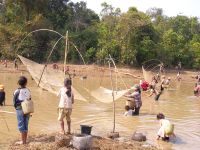
What are culture-based fisheries?

Culture-based fisheries (CBF) are often conducted in small water bodies, perennial and or seasonal, that retain water for at least six to eight months of the year. CBF are stock enhancement practices in water bodies that are generally incapable of supporting sustainable fisheries through self-recruiting fish populations, and where the stock is managed and owned, either individually and or collectively. Feed is rarely added and the stock are left to forage on natural foods.

Giant Prawn 2017

The fourth major international event on giant freshwater prawns was organised by the Asian Institute of Technology from 20-24 March 2007. The conference, organised by Salin Krishna and Michael New, built on a series of highly successful events that trace back to the very beginnings of the industry. The first conference, Giant Prawn 1980 brought together all those involved in freshwater prawn research and farming for the first time and set many priorities for future research and development.

Bangana dero: A potential indigenous fish species for diversification of carp culture in north east India for sustainable aquaculture

Bangana dero is one of the most popular indigenous minor carps in the north eastern states of India, fetching triple the market prices of Indian major carps. B. dero is a bottom feeder and feeds on insect larvae, molluscs, algae, zooplankton and detritus. Over the last two decades the occurrence of wild juveniles of this fish in Indian rivers has fallen drastically. A protocol for induced breeding, larviculture, nursery rearing and growout including polyculture of B. dero is described.