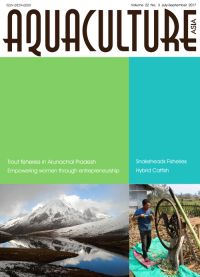
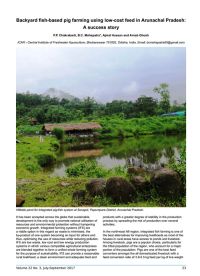
Regional network on culture-based fisheries and stock enhancement; trout fisheries in the uplands of Arunachal Pradesh - resources and opportunities; empowering young Indian women through entrepreneurship development - opportunities and constraints; a view on murrel (snakehead) fisheries in India; hybrid catfish Clarias batrachus x Heteropneustes fossilis produced by farmers in West Bengal, India; Backyard fish based pig farming using low-cost feed in Arunachal Pradesh - a success story; NACA Newsletter.
In the north-east hill region of India, integrated fish farming is one of the best alternatives for improving livelihoods as most of the houses in rural areas have access to ponds and livestock. Among livestock, pigs are a popular choice, particularly for the tribal population of the region, who account for a major portion of the population. Pigs can fit into diverse systems of management, and can be reared on a wide variety of waste materials.
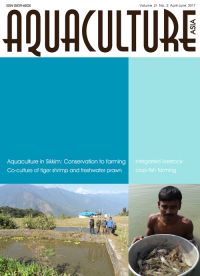
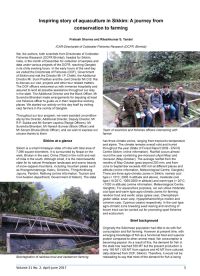
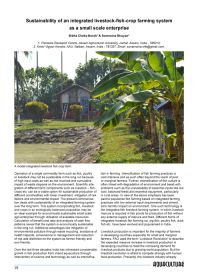
Inspiring story of aquaculture in Sikkim - a journey from conservation to farming; farming of scampi and tiger shrimp together - a case study from West Bengal; Labeo pangusia - a candidate for diversification of hill aquaculture; sustainability of an integrated livestock-fish-crop farming system as a small scale enterprise; sustainable coastal aquaculture in India; potential scope and prospects of domestic fish market in Chhattisgarh.
7 June 2017 | Prakash Sharma and Riteshkumar S. Tandel | 2685 Downloads | .pdf | 5.38 MB
Sikkim is a small Himalayan state of India with three climatic zones ranging from tropical to temperate to alpine. The moderate-cool and warm agro-climatic zones are suitable for farming rainbow trout and exotic carp species, while brown trout hatchery and ranching can be conducted in the alpine areas. We report on the status of exotic carp and trout farming in Sikkim including farming practices, constraints faced by local farmers and possible solutions.
7 June 2017 | Bibha Chetia Borah and Sonmoina Bhuyan | 3127 Downloads | .pdf | 1.82 MB
We examined the sustainability and economic viability of a model integrated livestock-fish-crop farming system developed by the Fisheries Research Centre, Assam Agricultural University, over an extended period of 13 years. The system was developed as an ecologically sustainable alternative technology for small and margin farmers. It incorporates two livestock components, pig and poultry, with horticulture and carp polyculture. Analysis of cash flow and benefit-cost ration revealed the system to be economically sustainable over the long term.
26 May 2017 | CGIAR Research Program on Fish Agri-food Systems | 5662 Downloads | .pdf | 218.9 KB
Tilapia lake virus is a newly emerging virus that is associated with significant mortalities in farmed tilapia. This fact sheet describes the threat to industry, clinical signs, diagnosis, risk factors, prevention and control options and actions that must be taken to minimise the impact of this disease on the global tilapia aquaculture industry. All countries with a tilapia industry must be vigilant and act quickly to investigate cases of mortalities in farms.
Tilapia lake virus (TiLV) is an emerging disease of cultured tilapia in the Asia-Pacific region. Originally observed and reported in Israel, Ecuador, Colombia and Egypt, TiLV is now confirmed in cultured tilapia in Thailand causing mass mortalities. At risk is here is the US$7.5 billion global industry per annum, especially among the top tilapia-producing countries in the region including China, the Philippines, Thailand, Indonesia, Lao PDR and Bangladesh. This advisory describes signs of the disease and PCR detection methods.
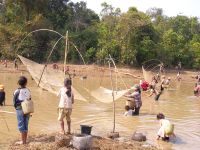
Culture-based fisheries (CBF) are often conducted in small water bodies, perennial and or seasonal, that retain water for at least six to eight months of the year. CBF are stock enhancement practices in water bodies that are generally incapable of supporting sustainable fisheries through self-recruiting fish populations, and where the stock is managed and owned, either individually and or collectively. Feed is rarely added and the stock are left to forage on natural foods.
The fourth major international event on giant freshwater prawns was organised by the Asian Institute of Technology from 20-24 March 2007. The conference, organised by Salin Krishna and Michael New, built on a series of highly successful events that trace back to the very beginnings of the industry. The first conference, Giant Prawn 1980 brought together all those involved in freshwater prawn research and farming for the first time and set many priorities for future research and development.
18 March 2017 | Ch. Basudha, N. Sobita Devi and Sinthoileima, Ch. | 2909 Downloads | .pdf | 3.63 MB
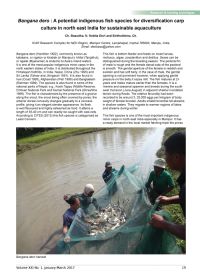
Bangana dero is one of the most popular indigenous minor carps in the north eastern states of India, fetching triple the market prices of Indian major carps. B. dero is a bottom feeder and feeds on insect larvae, molluscs, algae, zooplankton and detritus. Over the last two decades the occurrence of wild juveniles of this fish in Indian rivers has fallen drastically. A protocol for induced breeding, larviculture, nursery rearing and growout including polyculture of B. dero is described.
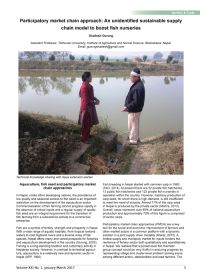
In Nepal, low quality and seasonal access to fish seed is an important restriction on the development of the aquaculture sector. Commercialisation of fish farming cannot progress rapidly in the absence of critical inputs and a regular supply of quality fish seed is an integral requirement for the transition of fish farming from a subsistence activity to a commercial enterprise. Participatory market chain approaches are a key tool for the social and economic improvement of farmers and market participants.
19 January 2017 | Cherdsak Virapat, Simon Wilkinson and Doris Soto | 4284 Downloads | .pdf | 1.68 MB
These are the proceedings of a consultation on the existence and effectiveness of environmental monitoring systems for fisheries and aquaculture in the Lower Mekong basin. The document provides a baseline assessment of environmental monitoring systems in Cambodia, Thailand and Vietnam and the report of a workshop to discuss the assessments findings and future steps towards an improved environmental monitoring and early warning system that will contribute to climate change adaptation in fisheries and aquaculture in the area.
The 15th meeting was held from 21-23 November 2016, in Bangkok, Thailand. A special session was held on addressing the use of anti-microbial substances in aquaculture and the development of anti-microbial resistance. This is an issue of global concern for both human and animal health, and it had been addressed by a resolution at FAO’s Thirty-ninth Conference in June 2015. The meeting reviewed in detail the status of aquatic animal disease in the region.
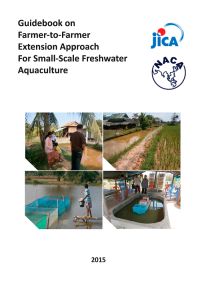
The objectives of this project were to i) develop a guidebook in English on "Farmer-to-farmer extension approaches for small-scale aquaculture" and ii) to translate the developed guidebook into selected local dialects in Asia-Pacific and other regions (e.g. Africa). The project made use of the significant results from the JICA projects in Cambodia, Benin and other countries on farmer-to-farmer extension approaches on technology extension for small-scale farmers. The book is available in eleven languages (English, Arabic, Bahasa Indonesia, Burmese, French, Khmer, Loatian, Malay, Nepali, Thai and Vietnamese.
Culture-based fisheries (CBF) are a useful development strategy for improving the income and food security of rural communities. CBF requires minimal capital outlay, mobilising farming communities to make use of existing small dams and reservoirs for the secondary purpose of foodfish production. The objective of this project is to introduce community-based CBF to Cambodia, and to consolidate the gains of communities that have adopted CBF in Lao PDR.
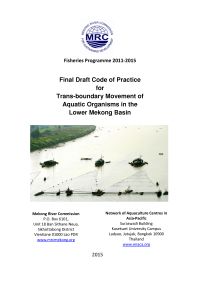
The objective of this project was to develop an agreed code of practice for the transboundary movement of aquatic organisms that feeds into the fisheries management strategy for the lower Mekong basin. The code of practice provides guidance on risk management and mitigation measures be taken into account for live aquatic animal imports or other transfers that are part of the established commercial practice, or those related to scientific study at research facilities.
The success stories of many small-scale farmers in both Asian and African countries have brought insights on the effectiveness and self-sustaining mechanism of the farmer-to-farmer approach of aquaculture extension. This document will only serve as a guide on how to implement farmer-to-farmer approaches on small-scale freshwater aquaculture extension. Translations of the guidebook are available in Arabic, Bahasa Indonesia, Burmese, English, French, Khmer, Lao, Malay, Nepali and Thai.
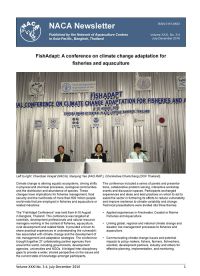
FishAdapt: A conference on climate change adaptation for fisheries and aquaculture. 11th Asian Fisheries and Aquaculture Forum convened in Bangkok. A new and improved PCR detection method for Enterocytozoon hepatopenaei (EHP) based on a gene encoding a spore wall protein. Radio interview on NACA's mission and role in regional food security. Quarterly Aquatic Animal Disease Report, Q1 2016. Guidebook on farmer-to-farmer extension approach for small-scale freshwater aquaculture. New NACA website in the works.
This Code of Practice is prepared to promote or ensure compliance to World Trade Organisation-Sanitary and Phytosanitary measures for the movement of live aquatic organisms in the Lower Mekong Basin. The goals of the Code are to achieve environmental protection and management, biodiversity conservation as well as prevention of spread of disease epizootics. Most of the points listed in this Code are based on the inputs of MRC Member Countries.
NACA conducts workshops on white spot disease and shrimp health management in I.R. Iran. Don’t forget to register for the 11th Asian Fisheries and Aquaculture Forum! NACA pays tribute to Professor H.P.C. Shetty – Patron of the Pillay Aquaculture Foundation. EHP: Shrimp industry survey. 3rd International Conference on Fisheries and Aquaculture, 24-25 August, Negombo, Sri Lanka. Special Session on the Status of Aquatic Genetic Resources for Food and Agriculture. Second International Technical Workshop on Acute Hepatopancreatic Necrosis Disease (AHPND). Guidebook on Farmer-to-Farmer Extension Approach for Small-Scale Freshwater Aquaculture. Sustainable intensification of aquaculture in the Asia-Pacific region.