Livelihoods, gender and social issues

Aquaculture livelihoods and social issues in rural communities.

Creative Commons Attribution.

Related

Subject tags

A collection of subject tags relating to technical matters.

In this collection

Report of the Second STREAM Regional Conference, Tagaytay City, the Philippines, 8-10 June 2003

The Second STREAM Regional Conference was held in Tagaytay City, Philippines, from 8-10 June 2003 with the participation of 23 people from Australia, Cambodia, India, Nepal, Philippines, Thailand, Vietnam and Yunnan Province of China. Following a regional overview of STREAM’s themes, country partners, donors and funding, and activities, participants visited four “stations” on the themes of livelihoods, institutions, policy development, and communications, working in groups representing National Coordinators, Communications Hub Managers, and Partners. STREAM operations were discussed.
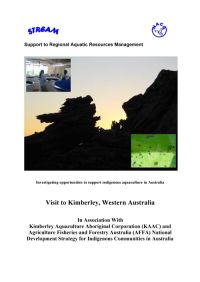
Investigating opportunities to support indigenous aquaculture in Australia

The NACA STREAM Initiative has been working with issues relating to livelihoods, policy and institutional development and communications throughout Asia-Pacific. Recently this has included work in India with indigenous communities supporting people to have a voice in policy making processes. There appear to be some parallels between this work and the objectives of Kimberley Aquaculture Aboriginal Corporation and also the Agriculture Fisheries and Forestry Australia Indigenous Aquaculture Unit, National Aquaculture Development Strategy for Indigenous Communities in Australia.

STREAM Journal Volume 2, No. 2, April-June 2003

In this issue: Livelihoods and languages - a SPARK-STREAM learning and communications process. Towards broader contextual understandings of livelihoods. Using tools to build shared understandings, using a sustainable livelihoods framework to learn. Learning about rattan as a livelihood. Meanings of "community-managed area". Lessons learnt about processes for learning and communicating. About the STREAM Journal. About STREAM. This edition is also available in Bahasa (Indonesia), Ilonggo, Vietnamese, Bengali and Oriya.

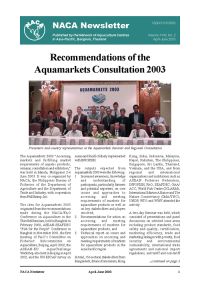
NACA Newsletter Volume XVIII, No. 2, April-June 2003

In this issue:

Recommendations of the Aquamarkets Consultation 2003. EC-funded project targets seafood trade and poverty. Shrimp disease control and coastal management. Fisheries and Adaptive Learning project. Shrimp aquaculture certification: Request for information & advice on a new web site. Workshop on control and responsible use of alien species. MPEDA/NACA Technical Assistance on Shrimp Health and Coastal Management. Changes to the regional list of aquatic animal diseases. STREAM SAPA Stakeholder Workshop in Hanoi. Regional Training Course on Grouper Hatchery Production. Review on low food chain species for marine fish culture. NACA/Deakin University to visit Indonesia 2-7 April 2003.

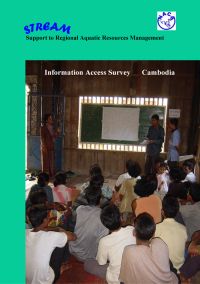
Cambodia information access survey

The aim of this report is to identify and recommend methods of communication that are appropriate to aquatic resources management stakeholders, focusing in particular on poor rural communities in Cambodia. As the Cambodian government begins to work more closely with local aquatic resources managers from poor rural communities, increased attention is being paid to the use of communication strategies and tools, in particular by the newly established Community Fisheries Development Office of the Department of Fisheries.

STREAM Journal Volume 2, No. 1, January-March 2003

In this issue: Learning insights from the Fisheries Resource Management Project. An orientation on the SIAD approach and participatory local development planning. Group-building, production success and the struggle to prevent capture of the resource. Urban agriculture, water reuse and local economies: Case study of coastal riverine settlements of Ondo State, Nigeria. Livelihoods analysis: Actual experience from using PRA. A sustainable livelihoods approach to fisheries development for poverty alleviation in southeastern Vietnam. About the STREAM Journal. About STREAM.

NACA Newsletter Volume XVIII, No. 1, January-March 2003

In this issue:

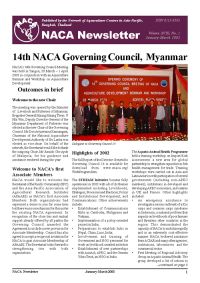
14th NACA Governing Council, Myanmar. Welcome to NACA's first Associate Member. NACA Alumni notes - U Minn Thame. Australian Youth Ambassador. Assisting in the Development of Recirculating Shrimp Farm Technologies. Nepal to join STREAM Initiative. NACA Joins Thai IT for Agriculture Forum. Indigenous Australian aquaculture group visits Thailand. Bangladesh Fisheries Training and Extension Project tour. Ugandan farmers train on catfish breeding and culture.

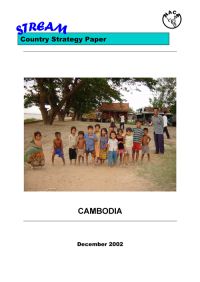
Cambodia country strategy paper

Cambodia is one of the poorest countries in the world; much of its population live in rural areas and many live below the local poverty line. The management of common property aquatic resources is of over-riding importance to food security and sustainable rural development in Cambodia. The key groups of poor people who use aquatic resources as part of their diverse livelihoods portfolios are subsistence fishers, small-scale aquaculture practitioners and aquatic resources collectors.

STREAM Journal Volume 1, No. 4, October-December 2002

In this issue: Hon Mun MPA Pilot Project on Community-based Natural Resources Management. An experience with participatory research in Tam Giang Lagoon, Thua Thien-Hue. Experiences and benefits of livelihoods analysis. Lessons learnt in implementing PRA in livelihoods analysis. Lessons learnt from livelihoods analysis and PRA in the Trao Reef Marine Reserve. Using the findings from a participatory poverty assessment in Tra Vinh Province. About the STREAM Journal. About STREAM. This edition is also available in Ilonggo, Khmer, Nepali and Vietnamese.

Report on sustainable livelihoods study of farmers and fishers in Kaoh Chbar Village, Kratie Province, Cambodia

This study of the livelihood of farmers and fishermen is based on the information provided by the villagers representing 142 households in the village. There had been some changes that impacted on the livelihood of villagers, especially in natural resources. The population is constantly growing which leads to an increase in natural resource utilisation and ultimately their degradation. The villagers usually suffer from diseases such as malaria, fever and dengue fever.

A livelihoods study of farmers and fishers in Saob Leu Village, Kratie Province, Cambodia

This is the report of a livelihoods study team working together with villagers from Saob Leu Village in Kratie Province, Cambodia from 10-15 July 2002. The team worked with 1530 villagers who volunteered to participate and represented the 177 households in the village. The villagers rely mainly on farming, with dry season rice being the most important crop. Most villagers are involved in small-scale fishing, with some having other skills.

A livelihoods study of farmers and fishers in Trorbek Pork Village, Kandal Province, Cambodia

This is the report of a livelihoods study team working together with villagers from Trorbek Pork in Kandal Province, Cambodia. In Trorbek Pork Village there are 140 families and a total population of 700 persons. The primary occupation of villagers was farming dry season rice on 47 ha, and in addition cultivating vegetables such as corn, mung bean, wax gourd, chilli and sesame on 15 ha. Secondary occupations included fishing, garment making, singing, laboring and repairing machines.

Report on sustainable livelihoods study of farmers and fishers in Dong Kom Village, Kandal Province, Cambodia

This study was based on the population census (1998) and key informant interviews (10 to 50 villagers voluntarily represented the 253 families of Dong Kom Village). There were 253 families with a total population of 1,192 persons. The primary occupation of villagers was farming, growing dry season rice on 1,900 ha, besides that they grow other vegetables such as corn, pumpkin and other vegetables on 200 ha. Secondary occupations were fisher, teachers, traditional medical practitioner, barber and other services.

A livelihoods study of farmers and fishers in Dang Tong Village, Kampong Chhnang Province, Cambodia

This is the report of a livelihoods study team working together with villagers from Dang Tong Village in Kampong Chhnang Province, Cambodia. In general, villagers are skilled in farming and mat weaving, but some villagers also have individual skills such as carpentry, boat making, hairdressing and fixing machines. Although this village is in the Tonle Sap (Great Lake) area, which has the most plentiful supply of fresh fish in the country, the villagers are subsistence fishers.

Report on sustainable livelihoods study of farmers and fishers in Koh Reusey Village, Kampong Chhnang Province, Cambodia

The main objective of the study is to understand the villagers’ standard of living, hardship, external impact, present and future demand. The team interviewed with 15 to 60 villagers including men, women, young and old villagers, represented 135 families in the village. The main occupations of the villagers are farmers cultivating rice on 299 hectares of seasonal rice and 61.8 hectares dry season rice and fishers. Beside that, they have other occupations such as repairers, making thatch.

STREAM Journal Volume 1, No. 3, July-September 2002

In this issue: From resource user to resource manager: A significant change story. Significant change with Cambodian provincial livelihoods study teams. The Community Fisheries Development Office: One year on. CFDO open for business! Stakeholders and institutional involvement in aquaculture management and development. Fish seed production for aquaculture in Southeast Cambodia: Decentralisation - the way to go? About the STREAM Journal. About STREAM. This edition is also available in Ilonggo, Khmer, Nepali and Vietnamese.

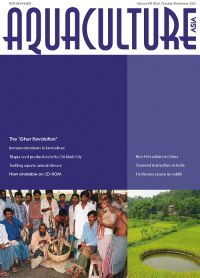
Aquaculture Asia Magazine, July-September 2002

In this issue:

Aquaculture for poverty alleviation and food security. Shrimp pond waste management. Properties of liming materials. Seed production of mud crab Scylla spp. The dilemmas of strain selection. Seed production of the crucifix crab Charybdis feriatus. A general approach to disease treatment and control. Breeding and seed production of mangrove snapper Lutjanus argentimaculatus. Responsible use of antibiotics in shrimp farming. Health management for cultured marine fishes. Molecular methods for rapid detection of pathogens in seafood.

Report of the workshop on process monitoring and significant change, 26-28 June 2002

The aim of this workshop was to formulate an approach which would enable participants to start detailed work on a process monitoring system, building on current activities and using already existing skills in Cambodia, Nepal, Philippines, Thailand and Vietnam. Objectives were to familiarise participants with recent developments in process monitoring and significant change, and to develop an action plan for each country and a set of guiding principles for a monitoring system to underpin work in all countries.

Report of the First STREAM Regional Conference, Bangkok, Thailand, 19-21 June 2002

This is the report of the First Regional STREAM Regional Conference, held 19-21 June 2002 in Bangkok, Thailand. The conference was the first opportunity for participants in the STREAM Initiative, launched on 1 December 2001, to come together to discuss the programme. The conference discussed the main activities of STREAM, ways of working, communications strategies, feedback from participating countries and issues to follow up.

Report of the Rural Aquaculture Service Recipients and Implementers Workshop, 9-10 May 2002, Jharkhand

The “Rural Aquaculture Service Recipients and Implementers Workshop” was held from 9-10 May 2002 in Ranchi, Jharkand. It was among the first activities of the DFID NRSP Research Project R8100 entitled “Investigating Improved Policy on Aquaculture Service Provision to Poor People”. The workshop provided the first opportunity for feedback on the project design from people who live and work in tribal communities in the three states of Jharkhand, Orissa and West Bengal.