Livelihoods, gender and social issues

Aquaculture livelihoods and social issues in rural communities.

Creative Commons Attribution.

Related

Subject tags

A collection of subject tags relating to technical matters.

In this collection

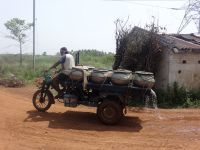
State of the art of carp spawn production and transportation at Ramsagar, Bankura District, West Bengal, India

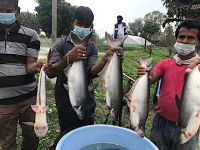
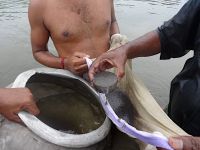
For the last five decades or so, West Bengal has been the leading state in India for the production of production and supply of major carp fry, underpinning the success of freshwater fish culture. This article describes the structure of the hatchery industry in Ramsagar, West Bengal, production practices and systems, packing, transport and links to major seed markets both within the state and elsewhere in India. Market price, broodstock management and natural breeding methods are also discussed.

Ornamental Aquaculture Field School: A new extension approach

The Farmer Field School approach is promoted by FAO as an alternative technology dissemination mechanism to the top-down extension methods in south-east Asian countries. In order to utilise the potential of the farmer field school approach for aquaculture, ICAR-CIFA has piloted Aquaculture Field Schools (AFS) in several states in India. AFS are schools without walls to improve the decision-making capacity of the farmers and facilitate cross-learning opportunities. It is a participatory extension methodology whereby fish farmers are allowed to choose the methods of aquaculture production through discovery-based approaches. 

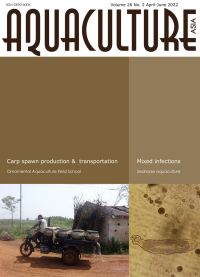
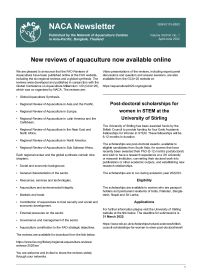
NACA Newsletter, Vol. XXXVII, April-June 2022

In this issue:

New reviews of aquaculture now available online; Post-doctoral scholarships for women in STEM at the University of Stirling; Research breakthrough seen to curb shortage of "poor man's fish"; Free online aquaculture courses; Fishing for life 2022: South and South-East Asian Conference on Small Scale Fisheries and Aquaculture; Reported Aquatic Animal Diseases in the Asia-Pacific Region during the Third Quarter of 2021; Shrimp 2022: INFOFISH World Shrimp Trade Conference and Exhibition; Tuskfish CMS v2.0.3 available.

FAO Reviews of Aquaculture now available online

We are pleased to announce that the FAO Reviews of Aquaculture have been published online at the FAO website, including the six Regional Reviews and a Global Synthesis, which were developed and published in conjunction with the Global Conference on Aquaculture Millennium +20 (GCA+20). The publications are linked below. Video presentations of the reviews, including expert panel discussions and question and answer sessions, are also available from the GCA+20 website.

Aquaculture Asia Magazine, January-March 2022

In this issue:

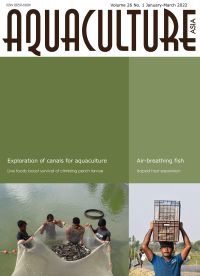
Exploration of canal resources as a potential source for fish production in the Indian Sundarbans; Expansion of new host range of isopod Tachaea spongillicola infestation to fish species could pose a risk to aquaculture food industry in southeast Asian countries; Aspects of air-breathing fish farming practiced at Mathurapur-II Block, West Bengal, India; Magical role of live foods in boosting spawn survival of climbing perch: A success in the farmer’s field; NACA Newsletter.

Exploration of canal resources as a potential source for fish production in the Indian Sundarbans

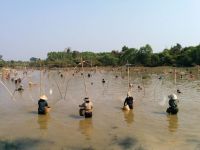
Fisheries is next to agriculture in offering employment opportunities for poor rural communities in Sundarbans. With around 17 million hectares of canals in India, there is considerable potential to generate jobs and improve the food security of rural populations if canals can be used for aquaculture production. This study explored the feasibility of aquaculture as a secondary use of canal infrastructure through use of net barrier partitions, installed and managed by local communities.

Aquaculture Asia Magazine, July-September 2021

In this issue:

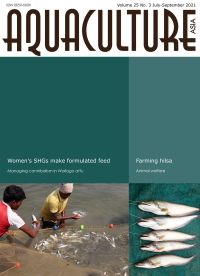
Opinion: Benefits of animal welfare in Indian aquaculture; Imparting skill on formulated fish feed preparation to women’s self-help groups in villages – an experience; Farming of the anadromous shad, Tenualosa ilisha: Signs of taking off in India; Some facts on cannibalism in Wallago attu and its management during captive seed production; NACA Newsletter.

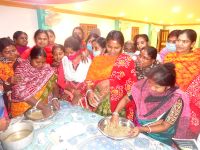
Imparting skill on formulated fish feed preparation to women’s self-help groups in villages – an experience

Preparation of locally made floating pelleted fish feed can be a profitable and sustainable income generating entrepreneurial activity for women's self-help groups in rural areas. Using such feed can also help small-scale marginal fish farmers to improve production and reduce their operating costs. This article describes initiatives to train women's self-help groups in formulated feed production in West Bengal, India.

Global Conference on Aquaculture Millennium +20

The GCA +20 was successfully held as a hybrid event from 22-25 September, with physical participation at the venue in Shanghai, China, and international participation via video conference. A total of 1,728 people participated in the event, of which 500 were physically present in Shanghai. A key output from the GCA +20, the Shanghai Declaration is a call to action that highlights the principles and strategic pathways to maximise the contribution of sustainable aquaculture in achieving the Sustainable Development Goals, with a special focus on “Leaving no one behind”.

Videos from the webinar on Culture-based fisheries for rural development

Video recordings of technical presentations from the webinar on Culture-based fisheries for rural development (31 May 2021) are now available on Youtube. Presentations cover technical constraints, the socio-economic and impact on communities, micro-nutrient security, monitoring and evaluation, improving water quality through stocking selected species, biodiversity considerations, and success stories.

Please visit NACA's Youtube channel to access the videos. Our Youtube channel is brand new, please consider subscribing for more technical aquaculture videos!

Aquaculture for livelihoods and food security in North-western India

In the north-western states of India there is great scope for aquaculture to generate employment opportunities, improve the socio-economic status of farming communities, furnish additional food and nutritional security and boost the national economy. This article describes the present state of Indian aquaculture and prospects for increasing production through diversification, use of village/community ponds and inland saline aquaculture of shrimp and other species, along with major concerns and action plans.

Aquaculture field schools supporting mangroves for climate change adaptation of Indonesian milkfish-shrimp farmers

Over the last five decades, over 30 million people along Java’s north coast have experienced subsidence and subsequent soil erosion. In 2015, Building with Nature Indonesia (BwNI-Demak) started a coastal protection project in 10 communities of nine coastal villages of Demak regency. The protection measures introduced included the use of permeable structures (dams) that successfully capture sediment and support natural recovery of mangroves, and aquaculture field schools, to train small-scale farmers on good aquaculture practices such as low external inputs sustainable aquaculture, associated mangrove aquaculture and multi-trophic srhimp aquaculture.

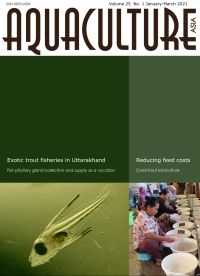
Aquaculture Asia Magazine, January-March 2021

In this issue:

Exotic trout fisheries resources and potentialities in Uttarakhand; Scenario of captive production of Clarias magur in India; Strategies to reduce feed cost by improving gut health and nutrient utilisation of fish in aquaculture; Fish pituitary gland collection and supply as a vocation in West Bengal, India; Coral trout Plectropomus leopardus aquaculture research and fingerling production in Indonesia; Smartphone app improving smallholder shrimp farming practices in Bangladesh; NACA Newsletter.

Fish pituitary gland collection and supply as a vocation in West Bengal, India

In retail fish markets in Kolkata city proper, suburbs and neighbouring districts, pituitary glands are collected as a profession from the heads of mature fish. The preserved glands are used to induce breeding via hypophysation in carp hatcheries throughout West Bengal, playing an important role in the availability of carp seed to support aquaculture operations. This article describes the livelihoods of pituitary gland collectors and traders in West Bengal, India.

Exotic trout fisheries resources and potentialities in Uttarakhand

Commercial trout farming in Uttarakhand has advanced progressively during the last decade and has become a profitable occupation among the rural masses especially in the colder regimes where no other fish farming has possibilities. The rainbow trout here plays the most dominant role as a commercially important candidate species for culture in this hill locked Himalayan state of India. This article describes the current status of trout fisheries resources and trout aquaculture in Uttarakhand, and their potential further development.

Aquaculture Asia Magazine, October-December 2020

In this issue:

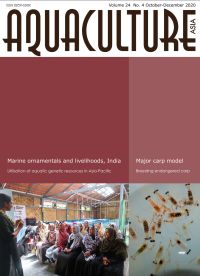
Framework for participatory linkage of marine ornamentals germplasm conservation to livelihoods: Is community aquaculture an inclusive option? Induced breeding of farm-bred and pond-raised critically endangered peninsular carp, Hypselobarbus pulchellus; A way forward for utilisation of aquatic genetic resources in Asia-Pacific: Synthesis from deliberations during the Regional Workshop on Underutilized Fish and Marine Genetic Resources and their Amelioration 2019; Cast nets: The dominant active fishing gear in the Kashmir Valley; Moyna model of major carp farming in Purba Medinipur District, West Bengal, India; NACA Newsletter.

Framework for participatory linkage of marine ornamentals germplasm conservation to livelihoods: Is community aquaculture an inclusive option?

Exploratory surveys conducted on pristine reef islands has revealed hidden diversity with discovery of two shrimp species new to science, Periclimenella agattii and Urocaridella arabianensis and range extensions for Thor hainanensis and Argeiopsis inhacae. A hands-on training in marine ornamental shrimp rearing was organised at Agatti Island, Lakshadweep during March 2020 to develop a core mass of entrepreneurs to participate in community aquaculture. Another initiative has established a live germplasm resource centre for clownfish, which has ten species conserved in captivity. This facility also serves as a master breeding facility to produce seed for use in a community aquaculture program.

Cast nets: The dominant active fishing gear in the Kashmir Valley

Kashmir Valley is bestowed with abundant water resources in the form of high altitude lakes, wetlands, rivers and springs and the geophysical conditions offer a great scope for fish to thrive. Around 15% of the population has fisheries as a principal source of income. In Kashmir, the dominant active fishing gear is the cast net, known locally as zaal, and cast nets are heavily used in the Dal, Wular, and Manasbal lakes of the valley. This article describes typical designs of cast nets used in the valley.

Aquaculture Asia Magazine, July-September 2020

In this issue:

Hatchery techniques for the seed production of short-necked clams (Paphia undulata) in Nha Trang, Vietnam; Lovesome chum of the aquarium are wreaking havoc in East Kolkata Wetlands, India; Concept of indigenous recirculatory aquaculture system executed in West Bengal, India and other places; Homestead modular hatchery technology of brackishwater catfish, Mystus gulio: A potential alternate livelihood option for small and marginal farmers of Sunderban; NACA Newsletter.

Aquaculture Asia Magazine, April-June 2020

In this issue:

Potential new species in the Kingdom of Saudi Arabia: Sabaki tilapia (Oreochromis spilurus); Role of fish & fisheries in national nutrition of Pakistan; Success story of first fish farmer in India to be awarded ‘Padma Shri’; Insights into the fishing gear and ichthyofauna of major lentic water bodies of Kashmir Valley; NACA Newsletter.