Molluscs (shellfish and other)

Issues relating to aquaculture of shellfish, cephalopods and other molluscs.

Creative Commons Attribution.

Related

Species / commodity tags

Major farmed commodity or species groups.

In this collection

Report of the Seventeenth Meeting of the Asia Regional Advisory Group on Aquatic Animal Health

This report summarises the proceedings of the 17th meeting of the Advisory Group, held 13-14 November 2018 in Bangkok, Thailand. The group's role includes reviewing disease trends and emerging threats in the region, identifying developments in global aquatic disease issues and standards, evaluating the Quarterly Aquatic Animal Disease Reporting Programme and providing guidance on regional strategies to improve aquatic animal health management.

Quarterly Aquatic Animal Disease Report, July-September 2018

The 79th edition of the Quarterly Aquatic Animal Disease report contains information from eleven governments. The foreword discusses the outcomes of the 17th Meeting of the Asia Regional Advisory Group on Aquatic Animal Health, held in Bangkok, 13-14 November 2018.

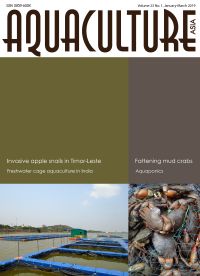
Aquaculture Asia Magazine, January-March 2019

In this issue:

Current status of freshwater cage aquaculture in India; Fattening of mud crab Scylla serrata in estuarine region of south-eastern West Bengal; Aquaponics - sustainable farming method in the fight against hunger; aquatic invasive apple snails (Pomacea spp.) in Timore-Leste - current status, spread and management in rice fields; NACA Newsletter.

Aquatic invasive apple snails (Pomacea spp.) in Timor-Leste: Current status, spread and management in rice fields

Anecdotal evidence suggests that apple snails were first introduced into Timor-Leste as food by migrants, although there is no exact information on when this occurred. The first reported damages to rice crops from the snails was around 1985 in the south and west. There is an urgent need for systematic surveys on the areas invaded and the rice crop losses. Synthetic molluscicide formulations are used to control snail populations, along with a variety of non-chemical management interventions.

Quarterly Aquatic Animal Disease Report, April-June 2018

The 78th edition of the Quarterly Aquatic Animal Disease Report contains information from twelve governments in the Asia-Pacific region. The foreword discusses three recent aquatic animal health consultations: The ASEAN Regional Technical Consultation on Aquatic Emergency Preparedness and Response Systems for Effective Management of Transboundary Disease Outbreaks in Southeast Asia; the Regional Consultation and Related Study on Antimicrobial Resistance Risk to Aquaculture in Asia; and the Preliminary Consultation on Monitoring of Antimicrobial Resistance in Bacterial Pathogens in Aquaculture.

Aquaculture Asia Magazine, October-December 2018

In this issue:

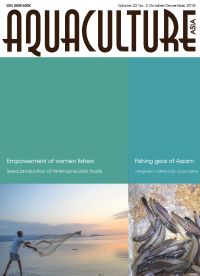
Concept of seed production of Heteropneustes fossilis in farmers' fields in West Bengal, India; Fishing gear and practices in flood waters of Assam; Fisherwomen empowerment: Shedding light on the invisible gender; Integrated multi-trophic aquaculture systems: A solution of sustainability.

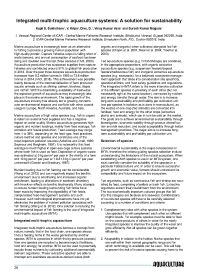
Integrated multi-trophic aquaculture systems: a solution for sustainability

Marine aquaculture of high value species such as fish is generally reliant on external food supplies and has a negative impact on water quality, generating high organic and nutrient loadings. Integrated multi-trophic aquaculture offers a solution to reduce environmental impact of farming systems, culturing complimentary species that can recycle nutrients and reduce nutrient pollution while generating additional products for sale. This article looks at species selection and integration of trophic levels in system design.

Quarterly Aquatic Animal Disease Report, January-March 2018

The 77th edition of the Quarterly Aquatic Animal Disease Report contains information from nine governments. The foreword discusses an intensive seven-day training course on tilapia lake virus (TiLV) that was jointly organised by China's National Fisheries Extension Center, Sun Yat-Sen University and the Food and Agriculture Organization of the United Nations.

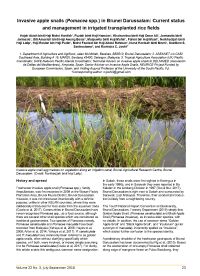
Invasive apple snails (Pomacea spp.) in Brunei Darussalam: Current status and management in irrigated transplanted rice fields

This short research note provides insights on the invasive apple snails (Pomacea spp.) and rice cultivation in Brunei Darussalam. This freshwater invasive snail was first detected in 2009, but it was never introduced intentionally. Since then their population has increased swiftly and spread to almost all the rice areas across the country, becoming a major pest of irrigated transplanted rice. Research and collaboration among infested countries is important for accurate species identification and better understanding of the invasion pathways.

Quarterly Aquatic Animal Disease Report, October-December 2017

The 76th edition of the Quarterly Aquatic Animal Disease Report contains information from 14 governments. The foreword discusses the outcomes of a Stakeholder Consultation on Progressive Management Pathway to Improve Aquaculture Biosecurity, organised by the Food and Agriculture Organization of the United Nations, Mississippi State University and the World Bank.

Report of the Sixteenth Meeting of the Asia Regional Advisory Group on Aquatic Animal Health

This report summarises the proceedings of the 16th meeting of the Advisory Group, held 26-27 August 2017 in Bali, Indonesia. The group's role includes reviewing disease trends and emerging threats in the region, identifying developments in global aquatic disease issues and standards, evaluating the Quarterly Aquatic Animal Disease Reporting Programme and providing guidance on regional strategies to improve aquatic animal health management. The meeting included discussion on Tilapia Lake Virus (TiLV) and developments in antimicrobial resistance.

A review of fresh water integrated multi-trophic aquaculture: Catching up on the dream of a blue revolution in India

Integrated multi-trophic aquaculture is a flexible concept, on which many variations can be developed and should not be viewed as confined to open-water, marine systems. Freshwater integrated multi-trophic aquaculture, perhaps better known as aquaponics, applies the same principles as those used in marine integrated multi-trophic systems. In particular, using plants to reduce phosphorus (and other nutrient) levels in effluents can help farmers meet water quality guidelines and prevent eutrophication in the environment.
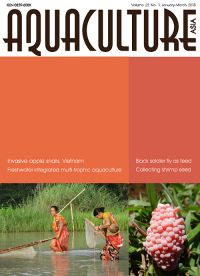
Aquaculture Asia Magazine, January-March 2018

In this issue:

Invasive apple snails (Pomacea spp.) in Vietnam: Short review; A review of fresh water integrated multi-trophic aquaculture: Catching up on the dream of a blue revolution in India; Pre-pupae (larvae) of black soldier fly - a potential alternate protein source for aquaculture feeds; Penaeid shrimp and giant prawn seed collection from Rupnarayan River in Purba Medinipur, West Bengal, India; NACA Newsletter; First training course on culture-based fisheries held in Nha Trang, Vietnam.

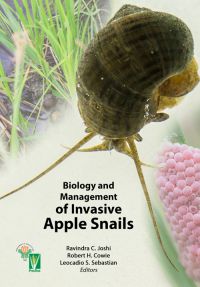
Biology and Management of Invasive Apple Snails

Apple snails have become a major pest of wetland rice in much of Southeast Asia. Two species are involved, Pomacea canaliculata and P. maculata. One or both of these species have become widely established not only in many parts of Southeast Asia but also in other parts of the world. This book provides an update on research into the biology, management and use of apple snails and highlights the need to prevent further spread of these species.

Report of the fifteenth meeting of the Asia Regional Advisory Group on Aquatic Animal Health, 21-23 November 2016

The Asia Regional Advisory Group on Aquatic Animal Health meets annually to discuss regional health issues including emerging disease threats. This report includes a review of regional disease status circa 2016, global and regional disease reporting arrangements, global issues and standards, progress in implementation of the the Regional Technical Guidelines on Health management for the Responsible Movement of Live Aquatic Animals, identification and designation of regional aquatic animal health resources and regional and international cooperation.

15th meeting of the Asia Regional Advisory Group on Aquatic Animal Health

The 15th meeting was held from 21-23 November 2016, in Bangkok, Thailand. A special session was held on addressing the use of anti-microbial substances in aquaculture and the development of anti-microbial resistance. This is an issue of global concern for both human and animal health, and it had been addressed by a resolution at FAO’s Thirty-ninth Conference in June 2015. The meeting reviewed in detail the status of aquatic animal disease in the region.

Report of the fourteenth meeting of the Asia Regional Advisory Group on Aquatic Animal Health, 23-25 November 2015

The Asia Regional Advisory Group on Aquatic Animal Health meets annually to discuss regional health issues including emerging disease threats. This report includes a review of regional disease status circa 2015, global and regional disease reporting arrangements, global issues and standards, progress in implementation of the the Regional Technical Guidelines on Health management for the Responsible Movement of Live Aquatic Animals, identification and designation of regional aquatic animal health resources and regional and international cooperation.

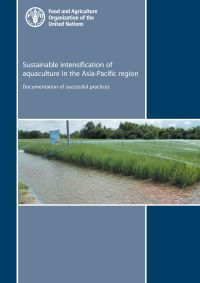
Sustainable intensification of aquaculture in the Asia-Pacific region: Documentation of successful practices

This publication is the major output of a regional programme jointly implemented by FAO and NACA in 2015 to document and disseminate successful practices that contribute to the sustainable intensification of aquaculture in the Asia-Pacific region. Twelve practices are described that contribute to at least one of the following: Improved production and resource use efficiency (land, water, feed, energy); improved environmental benefits; strengthened economic viability and farmers' resilience; and improved social acceptance and equity.

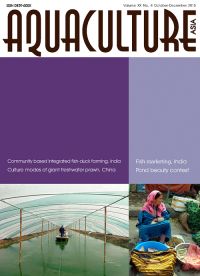
Aquaculture Asia Magazine, October-December 2015

In this issue:

Aquaculture feed supply chain attracting scrutiny. Pond beauty contest, Ram Kumar and social development. Culture modes of giant freshwater prawn in Yangtze River Delta for early harvest. Fish marketing in Kashmir, India - a case study of Srinagar. Community-based integrated fish-duck farming: A boon for rural development in agro-climatic conditions of Assam, India. Gastropod and bivalve fishery of Kakinada Bay, Andhra Pradesh, India: Management and conservation issues.

Report of the thirteenth meeting of the Asia Regional Advisory Group on Aquatic Animal Health, 22-23 November 2014

The Asia Regional Advisory Group on Aquatic Animal Health meets annually to discuss regional health issues including emerging disease threats. This report includes a review of regional disease status circa 2014, global and regional disease reporting arrangements, global issues and standards, progress in implementation of the the Regional Technical Guidelines on Health management for the Responsible Movement of Live Aquatic Animals, identification and designation of regional aquatic animal health resources and regional and international cooperation.