Shrimp

Information relating to the aquaculture of marine shrimp.

Creative Commons Attribution.

Related

Species / commodity tags

Major farmed commodity or species groups.

In this collection

Aquaculture certification and market access: Opportunity or bottleneck for small scale farmers?

C.V. Mohan presents on aquaculture certification and market access and the implications for small-scale farmers.

Fair trade certification: Enabling mechanism for small scale farmer groups

Sureel Singh presents on Fair trade as an enabling mechanism for small-scale farmers in India.

Shrimp BMP adoption through cluster management approach in India

G. Rajkumar presents on adoption of better management practices for shrimp farming via small-scale farmer cooperatives in India.

Lessons learned from ACIAR shrimp BMP programmes in Indonesia

Richard Callinan presents on lessons learned in ACIAR's shrimp BMP programmes in Indonesia.

Role of institutions in scaling up: Central Aquaculture Authority

Baskaran Manimaran presents on the Central Aquaculture Authority and scaling up of better management practices for shrimp farming in India.

National Workshop on Scaling up of Shrimp BMP Programme at the National Level

Better management practices have proved to be a highly effective tool for the Indian shrimp farming industry. Work to extend adoption of the practices is ongoing and in this view a national workshop was held in Chennai, 16-18 May 2011 at the Central Institute of Brackishwater Aquaculture to discuss scaling up strategies, to extend the concept to new areas and to involve more farmers and identify lessons learned that can be applied elsewhere.

Supporting and demonstrating small scale shrimp farmer group to access international market through certification

This project was conducted to demonstrate small scale shrimp farmer group access to international markets through certification schemes. This project proved that small-scale farmers organised into groups, can improve their technical capacities, and achieve access to markets. This achievement was the result of strong partnerships with producers, private sector and government agencies assisting to develop a sustainable business model for small scale aquaculture. Cost of compliance was found to be a significant barrier to entry.

National Training Workshop for Cluster Certification Trainers

International requirements on food safety, traceability, animal health and welfare and social responsibility are increasingly stringent. The burden of compliance and the cost of certification are particularly heavy for small scale farmers who are often excluded by the limited resources at their disposal. Working in groups can help small scale farmers attain economies of scale necessary to address compliance issues and participate in certification schemes, improving their competitive position.

Aquaculture Asia Magazine, April-June 2011

In this issue:

A visit to Vientianne, Lao PDR. Development of captive broodstock of giant river prawn Macrobrachium rosenbergii. Alien introduction and its impact on native fisheries and aquatic bioiversity of West Bengal, India. Ecological impacts of exotic fish species in India. Farm-made feeds support good growth and survivial of the humpback grouper. An easy way to hold live fish. Litopenaeus vannamei introduction: Sound management or expediency? Newsletter and more.

Report of the ninth meeting of the Asia Regional Advisory Group on Aquatic Animal Health, 8-10 November 2010

The Asia Regional Advisory Group on Aquatic Animal Health meets annually to discuss regional health issues including emerging disease threats. This report includes a review of regional disease status circa 2010, global and regional disease reporting arrangements, global issues and standards, progress in implementation of the the Regional Technical Guidelines on Health management for the Responsible Movement of Live Aquatic Animals, identification and designation of regional aquatic animal health resources and regional and international cooperation.

Technical brief: Climate change vulnerability and adaptation for improved extensive shrimp farming in Vietnam

In Vietnam, small scale farmers and other stakeholders involved in aquaculture perceive that climate changes such as frequent extreme weather events have serious impacts on their farming systems. Farmers have started to adapt by changing the management practices. Institutional initiatives that have been introduced includes provision of budget for climate change response for aquaculture, aquaculture area planning and monitoring, government financial support, policy on mangrove planting for coastal protection and development of farmer associations.

Global Conference on Aquaculture 2010

The conference was organised by FAO, the Thai Department of Fisheries and NACA and held in the Mövenpick Resort and Spa, Phuket, Thailand, 22-25 September. The conference was the third in a series of aquaculture development conferences, following on from the Conference on Aquaculture in the Third Millennium held in Bangkok 2000, and the FAO Technical Conference on Aquaculture, held in Kyoto 1976.

Aquaculture Asia Magazine, January-March 2011

In this issue:

Recent developments and future prospects of inland aquaculture in Asia. Factors influencing success of Penaeus vannamei culture. Freshwater prawn farming in a carbon-nitrogen controlled periphyton-based system: A sustainable approach to increase stagnant pond productivity. Constraints to fish production in community ponds in Orissa, India. Continued confidence in inland fisheries developmentg of a Sri Lankan youth begins to pay off. The Asia-Pacific Quarterly Aquatic Animal Disease Report: 12 years and beyond.

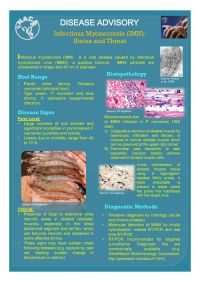
Disease advisory: Infectious myonecrosis

Infectious myonecrosis is a viral disease caused by infectious myonecrosis virus. It affects Pacific white shrimp Penaeus vannamei, tiger shrimp P. monodon and blue shrimp P. stylirostris. IMN is associated with heavy losses in farmed shrimp of 40-70%. Originally reported from Brazil, outbreaks were first reported in Indonesia in May 2006. With the current spread of the disease there is a high threat of the disease spreading to neighbouring P. vannamei-producing countries.

Phuket Consensus: A re-affirmation of commitment to the Bangkok Declaration

The Phuket Consensus is a declaration on aquaculture development endorsed by participants of the Global Conference on Aquaculture 2010, held in Phuket, Thailand, 22-25 September. The consensus builds on the Bangkok Declaration, which was formulated at the International Conference on Aquaculture in the Third Millennium, held in Bangkok, 20-25 February 2000. The consensus and declaration provide strategic guidance on sustainable development of aquaculture considering social, environmental, technical and economic issues.
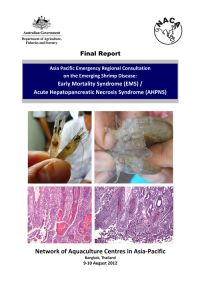
Final Report of the Emergency Regional Consultation on the Emerging Shrimp Disease Early Mortality Syndrome / Acute Hepatopancreatic Necrosis Syndrome

On 9-10 August 2012, an emergency regional consultation on Early Mortality Syndrome of shrimp and associated pathology described as acute hepatopancreatic necrosis syndrome  was held in Bangkok, Thailand. The consultation shared information on this emerging disease, its occurrence, pathology and diagnosis, and to develop a coordinated regional response to the issue. Audio recordings of 19 technical presentations made at the regional Consultation meeting are available on NACA website, and the presentation slides are also available.

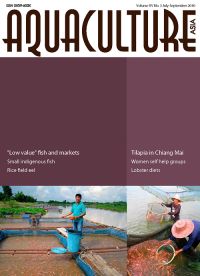
Aquaculture Asia Magazine, July-September 2010

In this issue:

Relative efficacies of lobsters Panulirus ornatus and P. homarus cultured using pellet feeds and trash fish, Vietnam. Tilapia in Chiang Mai, Thailand. Marketing low-value cultured fish in Bangladesh: An evaluation of value chain. Current practices of rice field eel Monopterus albus culture in Vietnam. Self-help group makes fisherwomen self-relian: A story of success. Small indigenous freshwater fish species of India: Significance, conservation and utilisation. 

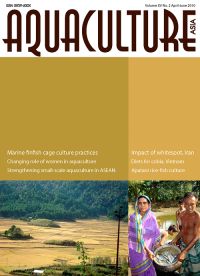
Aquaculture Asia Magazine, April-June 2010

In this issue:

The Dedanaw Project, Myanmar. The changing face of women for small-scale aquaculture in Bangladesh. Strengthening capacity of small holders in ASEAN. Carp seed production in Orissa, India. Sustainable mountain paddy-fish farming of the Apatani tribes. The economic impacts of whitespot virus on shrimp production in Iran. Current practices of marine finfish cage culture in China, Indonesia, Thailand and Vietnam. Effects of trash fish on growth and body composition of cobia.

Shrimp price study, phase II: Case studies in Vietnam, Indonesia and Bangladesh

This report is the outcome of a study conducted by NACA to assess the shrimp price trends in Vietnam, Indonesia and Bangladesh from January 2008 to June 2009, updating the previous study Evaluation of the impact of the Indian Ocean Tsunami and US Anti-Dumping Duties on the Shrimp Farming Sector of South and South-East Asia, 2006. The previous study highlighted the need for continuous collection of price data at all levels in the supply chain.

Training of Trainers: Strengthening capacity of small holder ASEAN aquaculture farmers

This is the manual for the "train the trainers" course aiming to increase the capacity of small-scale farmers in ASEAN countries. The manual focusses on five countries and commodities: Snakehead (Cambodia), Tilapia (Thailand), seaweed (Philippines), marine fish (Indonesia) and shrimp (Vietnam). In this volume, lectures presented by experts are included. The training program included technical aspects related to the culture of commodities, marketing, access to information, organization of farmer groups, gender and good culture practices.