Shrimp

Information relating to the aquaculture of marine shrimp.

Creative Commons Attribution.

Related

Species / commodity tags

Major farmed commodity or species groups.

In this collection

Monodon slow growth syndrome and Laem-Singh virus retinopathy: Disease card

During 2002, slow growth of farmed Penaeus monodon was reported throughout shrimp growing areas of Thailand and figures indicated that annual production volume was reduced by approximately 36%. The cause of this slow growth was not determined but laboratory trails suggested that a filterable infectious agent was involved. Injected extracts affected P. monodon but not P. vannamei. The slow growth condition was referred to as monodon slow growth syndrome or MSGS. This disease card provides an overview.

Aquaculture Asia Magazine, October-December 2008

In this issue:

An increasingly secure future for wastewater-fed aquaculture in Kolkata, India? First culture-based fisheries growth cycle in Lao PDR is overhwelmingly encouraging. Revival of abandoned shrimp farms in Andhra Pradesh. Growth of industries linked with aquaculture in Kolleru Lake area, India. Applications of nutritional biotechnology in aquaculture. Technical and management aspects of catfish hatcheries in Vietnam. Asian seabass farming. Mariculture development opportunities in southeast Sulawesi, and much more.

NACA Newsletter Volume XXIII, No. 4, October-December 2008

In this issue:

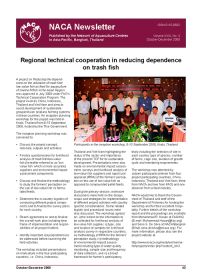
Regional technical cooperation in reducing dependence on trash fish. Culture, capture conflicts in Indonesian reservoirs: Phase 2. Progress on the IFC/NACA ACEH Shrimp Project. Indian shrimp farmer societies succeed through better management practices. Multidisciplinary situation appraisal of mangrove ecosystems in Thailand. New CIFA Director appointed. FAO Glossary of Aquaculture.

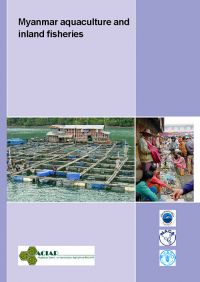
Myanmar aquaculture and inland fisheries

Fish and fish products are crucial in the nutrition and livelihoods of the Myanmar people. However, little information is available on their patterns of consumption, inter-regional differences, availability and types of fish consumed. This report is the outcome of two concurrent missions, one to coastal areas and one to inland areas. The report includes the findings of the missions as well as conclusions and recommendations in support of the long-term sustainability of fishery resources in Myanmar.

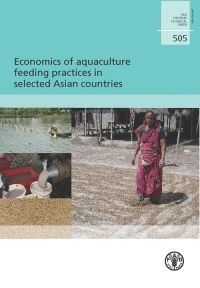
Economics of aquaculture feeding practices in selected Asian countries

This technical paper provides an analysis of the economic implications of, and the reasons for, adopting various feeding practices for different fish species and aquaculture systems in Asia. The systems studied include extensive/traditional, semi-intensive and intensive farms for a number of different species including sutchi and pangasiid catfishes (Bangladesh and Viet Nam), hybrid catfish (Thailand), carp polyculture (India and China), prawn and milkfish polyculture (the Philippines).

Report of the sixth meeting of the Asia Regional Advisory Group on Aquatic Animal Health, 12-14 December 2007

The Asia Regional Advisory Group on Aquatic Animal Health meets annually to discuss regional health issues including emerging disease threats. This report includes a review of regional disease status circa 2007, global and regional disease reporting arrangements, global issues and standards, progress in implementation of the the Regional Technical Guidelines on Health management for the Responsible Movement of Live Aquatic Animals, identification and designation of regional aquatic animal health resources and regional and international cooperation.

Report of the Workshop on Research Needs in Sustaining the Aquaculture Sector in Asia-Pacific to Year 2025 and Beyond

IDRC and NACA convened a workshop to identify the main research issues and needs to sustain Asian aquaculture into the first quarter of the 21st century, and also to bring them to the notice of relevant planners, managers and policy makers, and potential donors. The workshop was held in Rayong, Thailand from 4-7 June 2007. This report contains the issues papers drafted in preparation for the meeting and a summary of the discussions.

Aquaculture Asia Magazine, January-March 2008

In this issue:

Developing guidelines for sustainable freshwater aquaculture planning in Vietnam. Aquaculture production, certification and trade for small-scale farmers. Backyard hatcheries for crustaceans in Thailand. Alternative carp species for diversification in India. Genetic and reproduction technologies for aquaculture and fisheries management of Murray cod. Status of sahar domestication in Nepal. Comparative advantage analysis of shrimp production in Asia. Strategies to improve the livelihoods of the rural poor, Vietnam, and more.

NACA Newsletter Volume XXIII, No. 1, January-March 2008

In this issue:

Better management practices for catfish aquaculture in the Mekong Delta, Vietnam. Developing better management practices for marine finfish aquaculture. Workshop on modelling carrying capacity for tropical finfish cage culture: Towards a consensus view. First comprehensive genetic management plan for Asian fish species: Mahseer. NACA and World Fisheries Trust sign agreement on collaboration. Fish Health Master Class. Second Workshop on Application of Molecular Genetic Techniques in Inland Fisheries and Aquaculture Management. Two new species of spiny eels described from Myanmar. Importance of species identification in conservation. Koh Yao Noi mangrove replanting in celebration of 80th birthday of His Majesty the King of Thailand. Responsible movement of live food finfish within ASEAN: Implementation workshop. Consultation on aquaculture certification guidelines. Strengthening regional mechanisms to maximise benefits to small-holder shrimp farmer groups adopting better management practices.

Aquaculture Asia Magazine, October-December 2007

In this issue:

A different form of dumping: The need for a precautionary approach for yet another new species for shrimp farming in Asia. Sustainable livelihoods of pangus farming in Bangladesh. Business approach to national broodstock centres in Vietnam. Freshwater aquaculture in Myanmar. Traditional carp culture in Central Europe. Egg and larval quality in sand bass Psammoperca weigiensis. Effect of protein and lipid level of growth performance of tiger grouper Epinephelus fuscoguttatus.

NACA Newsletter Volume XXII, No. 4, October-December 2007

In this issue:

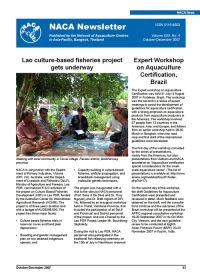
Lao culture-based fisheries project gets underway. Expert Workshop on Aquaculture Certification, Brazil. Strategies for Development of Asian Reservoir and Lake Fisheries Management. EUS identified as cause of fish kills in Africa. NACA seeks shrimp farm specialists for assignments in Indonesia. FDA detains five species of farm-raised seafood from China. 7th Symposium on Diseases in Asian Aquaculture. Aquafeed Horizons Asia 2008. Scientists join fight against frog diseases. Artificial propagation of snow trout Schizothorax zarudnyi by Iranian experts. NACA keynotes three international meetings. Culture, capture conflicts project review, Indonesia. Sign up to the coldwater aquaculture Yahoo! Tech Group. Website publishing and administration training, Vietnam. Aquatic Animal diseases Significant to Asia-Pacific: Identification Field Guide.

Practical Manual on Better Management Practices for Tambak Farming in Aceh

This practical manual provides better management practices for the farming of shrimp in tambak systems in Aceh, Indonesia. The manual addresses the formation of farmer groups, crop planning, and specifies better management practices. These include: Location of tambaks, design and construction of tambaks, pond preparation practices, shrimp seed selection and stocking practices, feed management practices, water management practices, health management practices, harvest and post-harvest handling practices, keeping records and improved marketing practices.
Application of PCR for improved shrimp health management in Asia

This is the report of the project Application of PCR for improved shrimp health management in the Asian region. The training programme included two training workshops that were designed to provide a good understanding of PCR methodology, laboratory practices and trouble shooting in detection of both DNA and RNA viruses. The workshops were followed by by two rounds of an anonymous PCR inter-calibration or ring testing exercise to allow laboratories to gauge their own performance.


Good management practices for broodstock collectors

The National Aquaculture Development Authority of Sri Lanka (NAQDA) took several steps to regularise collectors of Penaeus monodon under the restructuring programme of the shrimp aquaculture industry in Sri Lanka. Regularisation of broodstock collectors is very imperative mitigate transmission of white spot disease. NAQDA developed these practices in consultation with the Department of Fisheries and Aquatic Resources, shrimp hatchery owners, broodstock suppliers, NARA, Wayamba environmental authority, Sri Lanka aquaculture development alliance and the consortium for shrimp aquaculture development.

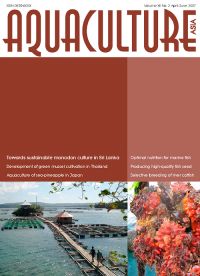
Aquaculture Asia Magazine, April-June 2007

In this issue:

Sustainable black tiger shrimp farming in Sri Lanka. An economic analysis of Persian sturgeon stock enhancement. Aquaculture and environmental sustainability in Thailand: Food or financial security? Cage fish culture - successful income generation in manmade reservoir Kulekhani, Nepal. Diversification of rice farming alleviates poverty in a Bangladesh village. Sea-pineapple aquaculture in Japan. Green mussel cultivation in Thailand. Selective breeding for growh and fillet yield in Vietnamese catfish. Producing quality fish seed in rural Asia.

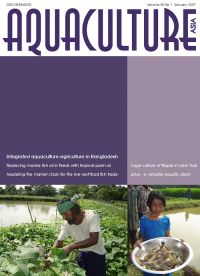
Aquaculture Asia Magazine, January-March 2007

In this issue:

Cage aquaculture of tilapia in Lake Taal, Philippines. Development and adoption of BMPs by farmer groups. Lotus - an aquatic plant of versatile qualities. Integrated aquaculture-agriculture systems in Bangladesh: Potential for sustainable livelihoods and nutrititional security of the rural poor. Spreadsheet model of the market chain for the live reef food fish trade. Regional Grouper Hatchery Production Training Course. Replacing marine fish oil in aquafeeds with tropical palm oil products. NACA Newsletter.

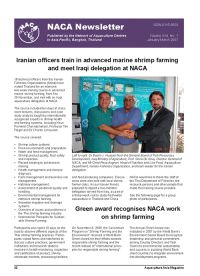
NACA Newsletter Volume XXII, No. 1, January-March 2007

In this issue:

Iranian officers train in advanced marine shrimp farming and meet Iraqi delegation at NACA. Green award recognises NACA work on sustainable shrimp farming. International Principles for Responsible Shrimp Farming now available in Spanish. Building capacity on aquatic animal epidemiology in I.R. Iran. NACA Fisheries Team meets with new Governor of Aceh. Aquaculture Certification: Programme to implement the COFI Sub-Committee on Aquaculture recommendation. Recent Developments in the Aquaculture Feed Industry. Global Advances in the Ecology and Management of Golden Apple Snails. NACA mission to Myanmar. Workshop on Insurance in Aquaculture to be held in Bali, May 2007. Catfish 2007 Vietnam. Tilapia 2007 Kuala Lumpur.

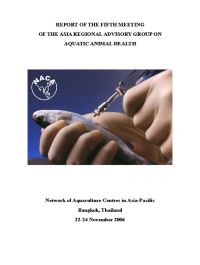
Report of the fifth meeting of the Asia Regional Advisory Group on Aquatic Animal Health, 22-24 November 2006

The Asia Regional Advisory Group on Aquatic Animal Health meets annually to discuss regional health issues including emerging disease threats. This report includes a review of regional disease status circa 2006, global and regional disease reporting arrangements, global issues and standards, progress in implementation of the the Regional Technical Guidelines on Health management for the Responsible Movement of Live Aquatic Animals, identification and designation of regional aquatic animal health resources and regional and international cooperation.

Principes Internationaux pour l'Elevage Responsable de la Crevette

L'élevage de la crevette est l’un des secteurs d'aquaculture le plus en essor dans beaucoup de régions du monde, il est également l’un des plus controversés. L'expansion rapide de ce secteur a généré, certes, des sources de revenus pour plusieurs pays, mais elle a été accompagnée par une préoccupation croissante sur les impacts environnemental et social. Les Principes Internationaux pour l'Elevage Responsable de la Crevette fournissent la base sur laquelle les parties prenantes peuvent collaborer pour un développement plus durable de l'élevage de crevette.

负责任虾类养殖国际准则

在世界许多地方,虾类养殖是水产养殖业增长最快,而且也是最具争 议的部门之一。这一部门的快速发展为许多国家创造了收入,但也伴随着 对环境和社会影响的忧虑。《负责任虾类养殖国际准则》在以更可持续的 方式发展虾类养殖方面为利益相关者之间开展合作提供了基础。《国际准 则》由虾类养殖与环境协作计划制定。该协作包括联合国粮食及农业组织 (粮农组织)、亚太水产养殖中心网、联合国环境规划署保护海洋环境免 受陆上活动污染全球行动纲领协调办公室、世界银行和世界自然基金会。