Shrimp

Information relating to the aquaculture of marine shrimp.

Creative Commons Attribution.

Related

Species / commodity tags

Major farmed commodity or species groups.

In this collection

Integrated taxonomy, conservation and sustainable development: Multiple facets of biodiversity

Focussed explorations from the ICAR-National Bureau of Fish Genetic Resources (NBFGR), an organisation mandated for cataloguing of genetic resources of India include surveys of various ecosystems ranging from fauna of deep sea to the high-altitude regions of the Himalaya, falling under diverse biogeographic zones and unexplored regions of the country, including North-eastern India, Western Ghats, Lakshadweep and the Andaman and Nicobar Islands. This article describes the results of these efforts, which include discovery of 14 new fish species and six new distribution records between 2015 to 2020.

NACA Newsletter, Vol. XXXVI, April-June 2021

In this issue:

Shrimp health: Online Consultation on Strategies for Hepatopancreatic Microsporidiosis caused by Enterocytozoon hepatopenaei (EHP); Webinar: Pathogen Free: Non-infectious Diseases and Disorders of Aquatic Animals; Quarterly Aquatic Animal Disease Report, July-September 2020; Register for the Global Conference on Aquaculture Millennium +20; Scholarship opportunity: Lancang-Mekong Rice-Fish Programme; International Artemia Aquaculture Consortium.

Report of the Nineteenth Meeting of the Asia Regional Advisory Group on Aquatic Animal Health

This report summarises the proceedings of the 19th meeting of the Advisory Group, held 26-27 November 2020 via video conference. The group's role includes reviewing disease trends and emerging threats in the region, identifying developments in global aquatic disease issues and standards, evaluating the Quarterly Aquatic Animal Disease Reporting Programme and providing guidance on regional strategies to improve aquatic animal health management.

Shrimp health: Videos from the EHP consultation now available on Youtube

Video recordings of technical presentations from the Online Consultation on Strategies for Hepatopancreatic Microsporidiosis caused by Enterocytozoon hepatopenaei (9-10 February 2021) are now available for viewing via Youtube. Presentations include information on the history of EHP, development of research tools, transmission route and recommendations for its control on farm.

Please visit NACA's Youtube channel to access the videos. Our Youtube channel is brand new, please consider subscribing for more technical aquaculture videos!

Quarterly Aquatic animal Disease Report, July-September 2020

The 87th edition of the Quarterly Aquatic Animal Disease Report contains information from fifteen governments. The foreword discusses the 19th Meeting of the Asia Regional Advisory Group on Aquatic Animal Health, held 26-27 November 2020.

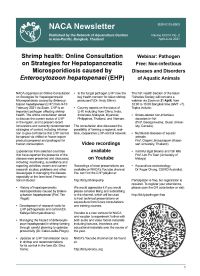
Shrimp health: Online Consultation on Strategies for Hepatopancreatic Microsporidiosis caused by Enterocytozoon hepatopenaei (EHP)

NACA is organising an Online Consultation on Strategies for Hepatopancreatic Microsporidiosis caused by Enterocytozoon hepatopenaei (EHP) from 9-10 February 2021 via Zoom. EHP is an important pathogen affecting shrimp health. The online consultation aims to discuss the current status of EHP in the region, and to present recent innovations and currently recommended strategies of control (including information to give confidence that EHP cannot be spread via chilled or frozen export products prepared and packaged for human consumption). Experiences from selected countries which have reported the presence of the disease will be presented and discussed. Participation is free but registration is required.

Aquaculture Asia Magazine, January-March 2021

In this issue:

Exotic trout fisheries resources and potentialities in Uttarakhand; Scenario of captive production of Clarias magur in India; Strategies to reduce feed cost by improving gut health and nutrient utilisation of fish in aquaculture; Fish pituitary gland collection and supply as a vocation in West Bengal, India; Coral trout Plectropomus leopardus aquaculture research and fingerling production in Indonesia; Smartphone app improving smallholder shrimp farming practices in Bangladesh; NACA Newsletter.

Smartphone app improving smallholder shrimp farming practices in Bangladesh

The Shrimp Farming BD App contains information on improved technologies - from pond preparation through to harvest - and has a calculator that farmers can use to work out the quantities of chemicals, feeds and other inputs they need for their pond. Also incorporated is a Frequently Asked Questions (FAQ) page where users can find answers to common questions with a single click: and they can send specific technical questions to SAFETI specialists online and receive an answer back within hours. The app can also be used to post news messages, and a link to market prices is planned. 

Quarterly Aquatic Animal Disease Report, April-June 2020

The 86th edition of the Quarterly Aquatic Animal Disease Report contains information from fifteen governments. The foreword provides a discussion of a webinar on decapod iridescent virus 1 (DIV1), held on 20 August 2020.

NACA Newsletter, Vol. XXXV No. 4, October-December 2020

In this issue:

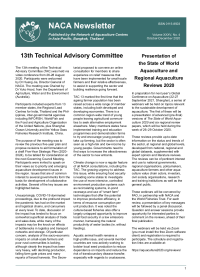
13th Technical Advisory Committee; Presentation of the State of World Aquaculture and Regional Aquaculture Reviews 2020; Online training course on mariculture technologies for the Asia-Pacific region; Quarterly Aquatic Animal Disease Report, January-March 2020; Regional Webinar on Infection with Decapod Iridescent Virus 1 (DIV1) and Preparedness for Emerging Shrimp Diseases; China announces import measures to respond to nucleic acid positives of COVID-19 detected from the outer packaging of frozen white leg shrimp from Ecuador.

Regional Webinar on Infection with Decapod Iridescent Virus 1 (DIV1) and Preparedness for Emerging Shrimp Diseases

A Regional Webinar on Infection with Decapod Iridescent Virus 1 and Preparedness for Emerging Shrimp Diseases will be held via Zoom video conference on 10-11 September 2020. This consultation will discuss and plan actions for the prevention and management of this disease. Specific objectives are to:

  • Provide updated technological information on DIV1.
  • Advocate the strengthening of diagnostic capacities as well as active surveillance of DIV1 (to detect presence or absence of the virus).
  • Formulate recommendations on sanitary measures (including biosecurity) for disease prevention.
  • Promote emergency preparedness for emerging diseases.

Participation is open to all interested parties but registration is required.

China announces import measures to respond to nucleic acid positives of COVID-19 detected from the outer packaging of frozen white leg shrimp from Ecuador

Chinese Customs detected nucleic acid positives of COVID-19 on packaging containing frozen white leg shrimp produced in Ecuador on 3 July. Experts believe that the positive results do not represent infectious virus. However, in order to protect the health of consumers, the General Administration of Customs decided to suspend the registration of the relevant enterprises, suspend the import and export of the products of the relevant enterprises, and take measures such as the return of goods and destruction of goods temporarily detained.

NACA Newsletter, Vol. XXXV No. 3, July-September 2020

In this issue:

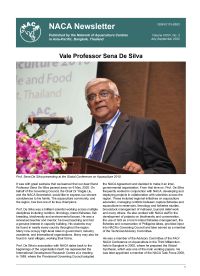
Vale Professor Sena De Silva; the State of World Fisheries and Aquaculture 2020; Viral covert mortality disease (VCMD): Disease card; Disease advisory: Decapod iridescent virus 1 (DIV1): An emerging threat to the shrimp industry; Infection with decapod iridescent virus 1 (DIV1): Disease card; Proceedings of the Regional Workshop on Underutilized Fish and Marine Genetic Resources and their Amelioration; Latest special issue of Gender, Technology & Development examines new learnings on women and fisheries; Development of a global information system for farmed types of aquatic genetic resources; Quarterly Aquatic Animal Disease Report, October-December 2019.

Viral covert mortality disease (VCMD): Disease card

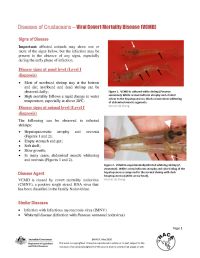
This disease advisory describes the history, known host range, clinical signs and PCR detection methods for viral covert mortality disease (VCMD). Crustaceans currently known to be susceptible to VCMD include Penaeus vannamei, P. chinensis, P. japonicus, P. monodon, Macrobrachium rosenbergii, Procambarus clarkii, Exopalaemon carinicauda, Ocypode cordimanus, Diogenes edwardsii, Corophium sinense, Parathemisto gaudichaud and Tubuca arcuate. Fish species including Mugilogobius abei, Carassius auratus, and Paralichthys olivaceus may also be susceptible to the virus.
Quarterly Aquatic Animal Disease Report, October-December 2019

The 84th edition of the Quarterly Aquatic Animal Disease Report contains information from eleven governments. The foreword discusses meetings of the ad hoc Steering Committee of the Regional Collaboration Framework on Aquatic Animal Health in Asia and the Pacific.

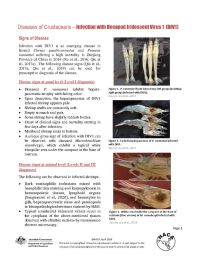
Infection with decapod iridescent virus 1 (DIV1): Disease card

Infection with DIV1 is an emerging disease in farmed Cherax quadricarinatus and Penaeus vannamei suffering a high mortality. This disease card provides information on signs of disease at pond and animal level (levels I - III diagnoses), the disease agent, known host range and distribution in the Asia-Pacific region, molecular diagnostic methods and provides key expert contact points.

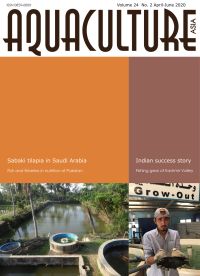
Aquaculture Asia Magazine, April-June 2020

In this issue:

Potential new species in the Kingdom of Saudi Arabia: Sabaki tilapia (Oreochromis spilurus); Role of fish & fisheries in national nutrition of Pakistan; Success story of first fish farmer in India to be awarded ‘Padma Shri’; Insights into the fishing gear and ichthyofauna of major lentic water bodies of Kashmir Valley; NACA Newsletter.

Disease advisory: Decapod Iridescent Virus 1 (DIV1): An emerging threat to the shrimp industry

This disease advisory describes the history, known host range, clinical signs and PCR detection methods for decapod iridescent virus 1 (DIV1). Preventative strategies are suggested. Currently known susceptible species of DIV1 include Penaeus vannamei, Macrobrachium rosenbergii, Exopalaemon carinicauda, M. nipponense, Procambarus clarkii, and Cherax quadricarinatus. Clinical signs of infected P. vannamei are not typical, including slightly reddish body, hepatopancreatic atrophy with colour fading, and empty stomach and guts.

NACA Newsletter, Vol. XXXV No. 2, April-June 2020

In this issue:

Urgent warning: Positive PCR detection results for infectious myonecrosis virus (IMNV) and decapod iridescent virus 1 (DIV1) in captured Penaeus monodon from the Indian Ocean; COVID-19 news; Urgent announcement on usefulness of the lymphoid organ (LO) as an additional prime target for diagnosis of decapod iridescent virus 1 (DIV1) in diseased P. vannamei; Fresh or frozen seafood?; Report of the Eighteenth Meeting of the Asia Regional Advisory Group on Aquatic Animal Health; COVID-19 fallout could push half a billion people into poverty in developing countries; Simple techniques double crablet production.

Urgent warning: Positive PCR detection results for infectious myonecrosis virus (IMNV) and decapod iridescent virus 1 (DIV1) in captured Penaeus monodon from the Indian Ocean

From a survey of wild, adult Penaeus monodon of potential broodstock size from the Indian Ocean in April 2018, we obtained positive nested RT-PCR test results for infectious myonecrosis virus (IMNV) and positive nested PCR test results for DIV1. As a confirmatory step, a second round of nested PCR tests was carried out using new, in-house primers designed from regions of the respective viral genomes distant from the target regions used in the first round of tests. These results suggested the possibility that the grossly normal, PCR-positive captured P. monodon specimens might be infected with the respective viruses at the carrier level. If so, they might serve as potential vehicles for introduction of IMNV and/or DIV1 into crustacean culture systems, especially if they were used in hatcheries for production of PL for distribution to shrimp farmers without proper precautions in place.