Stock enhancement

Information relating to stock enhancement practices.

Creative Commons Attribution.

Related

Subject tags

A collection of subject tags relating to technical matters.

In this collection

Videos: Webinar on management of Artemia resources of the Great Salt Lake, Utah USA

Video recordings and the report of the webinar are now available. The International Artemia Aquaculture Consortium (IAAC) hosted a webinar on Management of the Artemia Resources of the Great Salt Lake, 5 May 2022, at 14:00 UTC. The purpose of the webinar was to familiarise participants with recent international developments in Artemia research cooperation, and to examine the Great Salt Lake as a case study in successful management of Artemia resources in a multi-stakeholder environment.

Free registration: Belt & Road Forum for International Freshwater Fishery Industry Innovation, 16 August

An online forum will be held on 16 August to enable technical exchange between policymakers, fishery extension officers, researchers and entrepreneurs in development of the freshwater fisheries industry through technology innovation.

The forum will focus on innovations and developments in freshwater fishery biotech, breeding, culture models, digitisation, and industrialisation, featuring presentations and discussions from experts of international organisations, the Chinese Academy of Sciences, Chinese Academy of Engineering, universities and entrepreneurs in virtual exchanges and discussions. Participation is free but registration is required.
Webinar: Culture-based fisheries for rural development

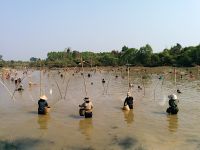
Join us on 31 May for a free webinar on Culture-based fisheries for rural development, with leading experts from the Asian region. Culture-based fisheries (CBF) are practices to enhance fish stocks in waters that don't have enough natural recruitment to sustain a fishery. CBF practices are usually applied in small water bodies such as village dams and irrigation reservoirs. Fish growth is driven by the natural productivity of the waters, foraging on natural food supplies. The simplicity and low capital requirements of CBF make it easy for farming communities to learn and adopt.

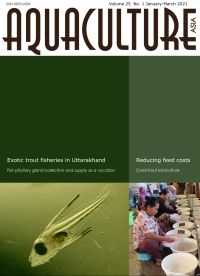
Aquaculture Asia Magazine, January-March 2021

In this issue:

Exotic trout fisheries resources and potentialities in Uttarakhand; Scenario of captive production of Clarias magur in India; Strategies to reduce feed cost by improving gut health and nutrient utilisation of fish in aquaculture; Fish pituitary gland collection and supply as a vocation in West Bengal, India; Coral trout Plectropomus leopardus aquaculture research and fingerling production in Indonesia; Smartphone app improving smallholder shrimp farming practices in Bangladesh; NACA Newsletter.

Exotic trout fisheries resources and potentialities in Uttarakhand

Commercial trout farming in Uttarakhand has advanced progressively during the last decade and has become a profitable occupation among the rural masses especially in the colder regimes where no other fish farming has possibilities. The rainbow trout here plays the most dominant role as a commercially important candidate species for culture in this hill locked Himalayan state of India. This article describes the current status of trout fisheries resources and trout aquaculture in Uttarakhand, and their potential further development.

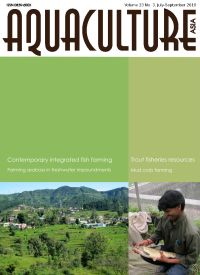
Aquaculture Asia Magazine, July-September 2019

In this issue:

Farming of Asian seabass Lates calcarifer in freshwater impoundments in West Bengal, India; An integrated approach to contemporary fish farming practice incorporating traditional knowledge in mid hills in India: A success story; Mud crab farming: An alternative livelihood in the Indian Sundarban; Trout fisheries resources and potentialities in the Menchukha region of Arunachal Pradesh; NACA Newsletter.

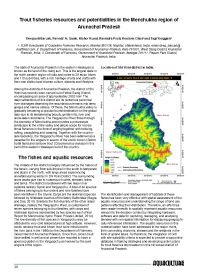
Trout fisheries resources and potentialities in the Menchukha region of Arunachal Pradesh

The success of any aquaculture project or fish farm depends to a large extent on selection of a suitable site. Site selection using the conventional method, based on very limited data, can result in inaccurate information and cause discrepancies among the implementing agencies. The utilisation of remote sensing and geographic information systems can provide a useful source of additional information. This article provides a GIS-based analysis of the suitability of sites for trout farming and the establishment of sport fisheries in the Menchukha valley, Arunachal Pradesh.

Expert Consultation on Invasive Alien Fish Species, 19 December, New Delhi

An Expert Consultation on Invasive Alien Fish Species: Need for a Risk Benefit Assessment and Management Framework for Healthy Freshwater Systems will be organised on 19 December 2018 in New Delhi, India. The consultation will flag the need for an equilibrium between access to non-native germplasm and the minimisation of risk to ecosystems and native fish diversity from such introductions. As a major outcome, an objective tool is expected to be developed, which can be used to evaluate prospective introductions and support decision making.

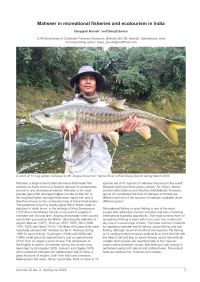
Mahseer in recreational fisheries and ecotourism in India

Mahseer are the most popular game fish amongst anglers in India, with a reputation as one of the toughest fighters amongst freshwater sports fish. In this article, we have made an attempt to compile information on recreational mahseer fisheries in India. The importance of the mighty mahseer as a game fish is told through the perspectives of active anglers and the visions of stakeholders and researchers in conservation and ecotourism are presented.

Trout fisheries in the uplands of Arunachal Pradesh: Resources and opportunities

The potential for augmentation of fish production and fish-based eco-tourism in Arunachal Pradesh are immense. The landscape of the state is characterised by lofty mountains with snow-clad peaks, dense forests, turbulent streams and a rich diversity of flora and fauna. We review the potential of some of the lakes in the region to support trout fisheries for both recreational fishing and eco-tourism, with a view to providing job opportunities for highland communities.

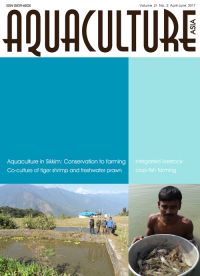
Aquaculture Asia Magazine, April-June 2017

In this issue:

Inspiring story of aquaculture in Sikkim - a journey from conservation to farming; farming of scampi and tiger shrimp together - a case study from West Bengal; Labeo pangusia - a candidate for diversification of hill aquaculture; sustainability of an integrated livestock-fish-crop farming system as a small scale enterprise; sustainable coastal aquaculture in India; potential scope and prospects of domestic fish market in Chhattisgarh.

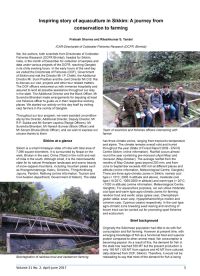
Inspiring story of aquaculture in Sikkim: A journey from conservation to farming

Sikkim is a small Himalayan state of India with three climatic zones ranging from tropical to temperate to alpine. The moderate-cool and warm agro-climatic zones are suitable for farming rainbow trout and exotic carp species, while brown trout hatchery and ranching can be conducted in the alpine areas. We report on the status of exotic carp and trout farming in Sikkim including farming practices, constraints faced by local farmers and possible solutions.

Giant Prawn 2017

The fourth major international event on giant freshwater prawns was organised by the Asian Institute of Technology from 20-24 March 2007. The conference, organised by Salin Krishna and Michael New, built on a series of highly successful events that trace back to the very beginnings of the industry. The first conference, Giant Prawn 1980 brought together all those involved in freshwater prawn research and farming for the first time and set many priorities for future research and development.

General aspects of stock enhancement in fisheries developments

In recent years, stocking programs have been subjected to substantial criticism due to perceived impact of hatchery-bred fish on genetic structure and fitness of wild stocks, transfer of disease, introduction of exotic species and non-target species, and their effects on other aquatic species and the environment. To maximise the potential benefits to fisheries from stock enhancement a responsible and ecologically sustainable approach should be adopted for all stocking programs.

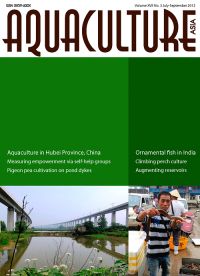
Aquaculture Asia Magazine, July-September 2012

In this issue:

Aquaculture in Hubei Province, central China. Ornamental fish farming - a successful cottage industry in rural and urban India. Measuring empowerment of women through self-help groups in aquaculture. Pigeon pea Cajanus cajan cultivation over fish pond dykes - an economically viable farming approach. Culture of freshwater climbing perch Anabas testudineus. Augmentation of fish production from a small reservoir of Vidarbha: A success story. Emergency consultation on early mortality syndrome of shrimp.

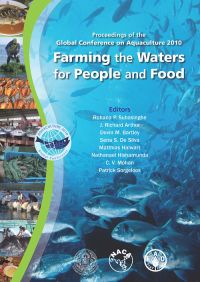
Proceedings of the Global Conference on Aquaculture 2010

The Global Conference on Aquaculture 2010 reviewed the present status and trends in aquaculture development, addressed emerging issues relevant to aquaculture development, assessed opportunities and challenges for future aquaculture development and built consensus on advancing aquaculture as a global, sustainable and competitive food production sector. This volume provides information on how aquaculture could be mobilized to alleviate global poverty and improve food and nutrition security in the coming decades.

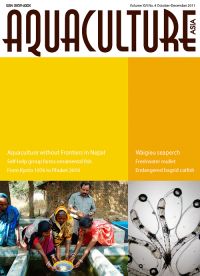
Aquaculture Asia Magazine, October-December 2011

In this issue:

Visit to the AwF funded small-scale aquaculture project in Nepal. Success story of the Barakhandapat Ornamental Fish Breeding Unit, India. From Kyoto 1976 to Bangkok 2000 and Phuket 2010: Aquaculture development and personal transitions. Embryonic and larval development of Waigieu seaperch Psammoperca waigiensis. Culture feasibility of freshwater mullet Rhinomugil corsula in ponds in India. Management in seed production of an endangered catfish Horabagrus brachysoma during its hatchery phase.

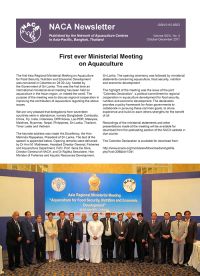
NACA Newsletter, Volume XXVI, No. 4, October-December 2011

In this issue:

First ever Ministerial Meeting on aquaculture. Keynote address delivered by His Excellency, Mahinda Rajapaksa, President of Sri Lanka. Farewell Sena and welcome Eknath! 2nd Regional Training Course on Application of Business Management Principles in Small Scale Aquaculture. Consultation on Lake and Reservoir Fisheries and Aquaculture Development in Asia. Asia Regional Seminar on Certification for Small Scale Aquaculture in Thailand. Special issue of the AFS Journal: Integrated technologies for advanced shrimp production. Farmers as Stakeholders in Commercial Aquaculture: Free download. Marker for banned antibiotic naturally occurs in freshwater prawns and other crustaceans.

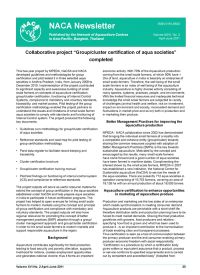
NACA Newsletter, Volume XXVI, No. 2, April-June 2011

In this issue:

Collaborative project "Grouper/cluster certification of aqua societies" completed. Report of the Advisory Group on Aquatic Animal Health available. Guidelines on Aquaculture Society Certification released. Listen to us online. Workshop on ecosystem approach to inland fisheries: Data needs and implementation strategies. Disease advisory: Infectious myonecrosis (IMN) status and threat. 7th Regional Grouper Hatchery Production Training Course, 25 September - 15 October, Situbondo, Indonesia.

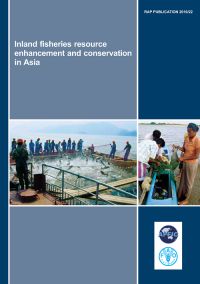
Inland Fisheries Resource Enhancement and Conservation in Asia

This regional review study is an effort to promote improved inland fisheries management under the Code of Conduct for Responsible Fisheries. It covers ten Asian countries with significant inland capture fisheries, namely Bangladesh, China, India, Indonesia, the Republic of Korea, Myanmar, Nepal, Sri Lanka, Thailand and Viet Nam. The papers were presented and discussed at a regional workshop held from 8-11 February 2010 in Pattaya, Thailand. Audio recordings of the presentations are also available for download.