Environment and Sustainability

Global population is forecast to reach around 9 billion by 2050. To feed the world, global agricultural output must increase by around 60% from present levels. This must be achieved against a background of increasing competition for natural resources such as water, feed ingredients and farming sites.

Maintaining environmental integrity while massively increasing food production will require farming systems to reduce their unit production environmental footprint. Many farming practices that are regarded as sustainable today will not be acceptable when scaled up. Sustainable intensification of aquaculture means doing more with less. The Environment and Sustainability Programme aims to help aquaculture become a more efficient user of natural resources, both in terms of farm productivity and environmental efficiency.

The programme develops better management practices for major aquaculture farming systems, and promotes aquaculture as a secondary or additional use of water resources. The programme focusses on practical interventions that can be directly achieved by small-scale farmers in a developing country context.

Key activities

Key activities of the programme are:

  • Development of better management practices for key aquaculture production systems.
  • Organising small-scale farmers into associations to facilitate cluster-based approaches to extension.
  • Development of culture-based fisheries as a secondary use of water bodies.
  • Development of strategic policy frameworks to guide governments and development agencies in promoting sustainable intensification of aquaculture.

Creative Commons Attribution.
Related

Subject tags

A collection of subject tags relating to technical matters.

In this collection

Technical brief: Vulnerability and adaptation to climate change for polyculture systems, Vietnam

This brief summarises the results from the interdisciplinary study conducted within the Aquaclimate project in Ca Mau and Bac Lieu provinces of the lower Mekong Delta looking at the impacts of climate change on small scale improved polyculture systems. The brief provides guidelines for policy development to address the climate change impacts on small scale improved polyculture farming systems in Vietnam and how adaptation measures should be implemented in the region.

Policy brief: Vulnerability and adaptation to climate change for polyculture systems, Vietnam

This policy brief summarises the results from the interdisciplinary study in Ca Mau and Bac Lieu provinces of the lower Mekong Delta looking at the impacts of climate change on small scale improved polyculture farming. The brief provides guidelines for policy development to address the climate change impacts on small scale improved polyculture farming systems in Vietnam and how adaptation measures should be implemented in the region. The guidelines are based on recommendations from stakeholders including farmers.

Aquaculture Asia Magazine, October-December 2012

In this issue:

American Soybean Association field trials in China. AusAID funded project on Institutional Support for Development of Mariculture in South East Sulawesi. Income enhancement of farmers through intensive fish culture in polythene lined farm ponds. Consultation on Sustainable Intensification of Aquaculture in the Asia-Pacific: Towards a new paradigm. Taxonomic status of mahseer fishes in north-eastern India: A report on the recent DNA barcoding studies. Biology and aquaculture of the rohu, Labeo rohita.

Aquaculture Asia Magazine, July-September 2012

In this issue:

Aquaculture in Hubei Province, central China. Ornamental fish farming - a successful cottage industry in rural and urban India. Measuring empowerment of women through self-help groups in aquaculture. Pigeon pea Cajanus cajan cultivation over fish pond dykes - an economically viable farming approach. Culture of freshwater climbing perch Anabas testudineus. Augmentation of fish production from a small reservoir of Vidarbha: A success story. Emergency consultation on early mortality syndrome of shrimp.

NACA Newsletter, Volume XXVII, No. 3, July-September 2012

In this issue:

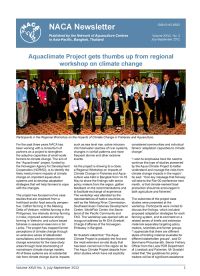
Aquaclimate Project gets thumbs up from regional workshop on climate change. Developing climate resilient aquaculture: The Aquaclimate Project. Regional framework for cooperation on climate change. Emergency regional consultation on shrimp early mortality syndrome, 9-10 August, Bangkok. Regional study/workshop on adoption of aquaculture assessment tools for sustainability. Regional proficiency testing for aquatic animal disease diagnostic laboratories.

Proceedings of the Global Conference on Aquaculture 2010

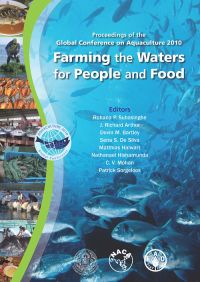
The Global Conference on Aquaculture 2010 reviewed the present status and trends in aquaculture development, addressed emerging issues relevant to aquaculture development, assessed opportunities and challenges for future aquaculture development and built consensus on advancing aquaculture as a global, sustainable and competitive food production sector. This volume provides information on how aquaculture could be mobilized to alleviate global poverty and improve food and nutrition security in the coming decades.

Aquaculture Asia Magazine, April-June 2012

In this issue:

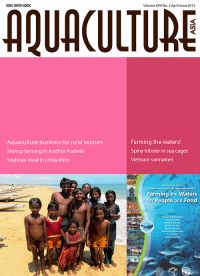
Shrimp farming in Andhra Pradesh, India. Small indigenous freshwater fish species in village community ponds to ensure nutritional security of rural poor. Postlarvae culture and technical status of whiteleg shrimp Penaeus vannamei hatcheries, Vietnam. Jatropha meal as a promising plant protein source for aquaculture feeds. Use of soybean meal in cobia diets. Capture based aquaculture of spiny lobster Panulirus polyphagus in open sea cages. Institutional linkage helping rural women gain employment.

NACA Newsletter, Volume XXVII, No. 2, April-June 2012

In this issue:

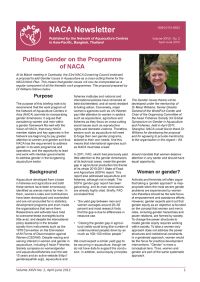
Putting Gender on the Programme of NACA. Proceedings of the Global Conference on Aquaculture 2010 available for download. Peter Edwards to mentor the new Sustainable Farming Systems Programme. International Fisheries Symposium, 6-8 December, Can Tho, Vietnam. Broodstock management training course launched by NACA and UNU-FTP.

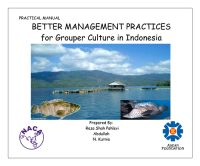
Better management practices for grouper culture in Indonesia: A practical manual

This practical manual covers key aspects for successful grouper farming including formation of farmer groups, cage crop planning, crop calendar and better management practices for cage aquaculture of grouper. These include site selection, design, cage preparation, seed selection and stocking practices, feed, water and health management, harvest and post-harvest, record keeping, marketing and capital strengthening. It is designed for use by small-scale farmers.

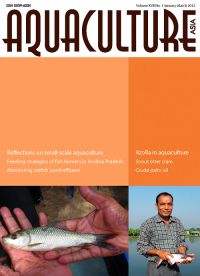
Aquaculture Asia Magazine, January-March 2012

In this issue:

Reflections on small-scale aquaculture. Azolla - an aquatic fern of significance to small-scale aquaculture. Monitoring quantity and quality of striped catfish pond effluent. Feeding strategies adopted by fish farmers in Andhra Pradesh, India. Hatchery techniques applied for the artificiant production of snout otter clam (Lutraria rhynchaeria) in small scale farms in Nha Trang City, Vietnam. Crude palm oil is a sustainable alternative to the growing fish oil scarcity, particularly for the aquaculture of warm freshwater fish species.

National Training Workshop for Cluster Certification Trainers

International requirements on food safety, traceability, animal health and welfare and social responsibility are increasingly stringent. The burden of compliance and the cost of certification are particularly heavy for small scale farmers who are often excluded by the limited resources at their disposal. Working in groups can help small scale farmers attain economies of scale necessary to address compliance issues and participate in certification schemes, improving their competitive position.

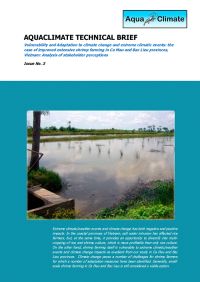
Technical brief: Climate change vulnerability and adaptation for improved extensive shrimp farming in Vietnam

In Vietnam, small scale farmers and other stakeholders involved in aquaculture perceive that climate changes such as frequent extreme weather events have serious impacts on their farming systems. Farmers have started to adapt by changing the management practices. Institutional initiatives that have been introduced includes provision of budget for climate change response for aquaculture, aquaculture area planning and monitoring, government financial support, policy on mangrove planting for coastal protection and development of farmer associations.

Global Conference on Aquaculture 2010

The conference was organised by FAO, the Thai Department of Fisheries and NACA and held in the Mövenpick Resort and Spa, Phuket, Thailand, 22-25 September. The conference was the third in a series of aquaculture development conferences, following on from the Conference on Aquaculture in the Third Millennium held in Bangkok 2000, and the FAO Technical Conference on Aquaculture, held in Kyoto 1976.

Global aquaculture development since 2000: Progress made in implementing the Bangkok Declaration and Strategy for Aquaculture Development Beyond 2000

This keynote presentation elaborates the achievements made in aquaculture globally during the past decade, in keeping with the Bangkok Declaration and Strategy, which brought the aquaculture sector to the current level. It has been recognised that the principles and strategies advocated by the Kyoto Declaration on Aquaculture in 1976, the Code of Conduct for Responsible Fisheries in 1995, and the Bangkok Declaration and Strategy in 2000 have served well the process and goals of aquaculture development.

Aquaculture development in Africa: Current status and future prospects

This review covers aquaculture development in sub-Saharan Africa. The bulk of the production (93 percent) is from freshwater and is predominantly the culture of the indigenous and ubiquitous species of tilapias and African catfishes. In 2007 catfish contributed about 49 percent of the total production, and interest in the culture of the species for domestic markets, intra- and inter-regional trade and exports overseas is still growing in several countries.

Aquaculture development in Asia-Pacific: Current status and future prospects

The Asia-Pacific region continues to lead in aquaculture production. The dominance of the region in the global aquaculture scene is also exemplified by the Asia-Pacific being the leading producer of the major cultured commodities viz. finfish, molluscs, shrimp and seaweed, and nine out of ten of the current leading aquaculture-producing countries being from the region. Among the countries in the region, China has continued to maintain its dominance in aquaculture production.

Aquaculture development in Europe: current status and future prospects

This review covers aquaculture development in Europe. In Europe, aquaculture generally has a marginal contribution to national economies and employment. Extensive and semi-intensive systems employ more people per unit production than modern intensive systems. arming systems, technologies and species are very diverse in Europe. Significant research and development has focused on improving the efficiency of production systems and the quality of the produced fish, while mitigating environmental impact.

Aquaculture development in Latin America and Carribbean: Current status and future prospects

This review covers aquaculture development in Latin America and the Caribbean Region. Current norms and market conditions tend to discourage the participation of small-scale farmers in this industry, implying that there is a need for governmental help in providing technology and technical assistance to these producers including management, market and marketing, financial aspects, logistic, etc. that commonly become the soft spots that have made past support efforts fail for most part.

Aquaculture development in the Near East: Current status and future prospects

This review covers aquaculture development in the Near East and North Africa. The main driving forces responsible for the expansion of the sector have included an increased public health awareness and interest in fish products, the passing of enabling policies driven by the need for consolidating domestic fish supply, compensating for declining capture fishery landings, strengthening the livelihood of rural communities and supporting food security programmes.

Aquaculture development in North America: current status and future prospects

This review covers the status and trends in aquaculture development in North America including the nations of Canada and the United States of America. It is organised by thematic areas including the social and economic background of the region; resources, services and technologies; aquaculture and environment; markets and trade; contribution of aquaculture to food security, social and economic development; external pressures on the sector; the role of shared information, research, networking and governance.