Global population is forecast to reach around 9 billion by 2050. To feed the world, global agricultural output must increase by around 60% from present levels. This must be achieved against a background of increasing competition for natural resources such as water, feed ingredients and farming sites.
Maintaining environmental integrity while massively increasing food production will require farming systems to reduce their unit production environmental footprint. Many farming practices that are regarded as sustainable today will not be acceptable when scaled up. Sustainable intensification of aquaculture means doing more with less. The Environment and Sustainability Programme aims to help aquaculture become a more efficient user of natural resources, both in terms of farm productivity and environmental efficiency.
The programme develops better management practices for major aquaculture farming systems, and promotes aquaculture as a secondary or additional use of water resources. The programme focusses on practical interventions that can be directly achieved by small-scale farmers in a developing country context.
Key activities
Key activities of the programme are:
Development of better management practices for key aquaculture production systems.
Organising small-scale farmers into associations to facilitate cluster-based approaches to extension.
Development of culture-based fisheries as a secondary use of water bodies.
Development of strategic policy frameworks to guide governments and development agencies in promoting sustainable intensification of aquaculture.
Update: The forum will now be held on 13 December and and updated conference agenda is available below. Please register your attendance using the form linked below. A Zoom link will be sent to all registered participants before the meeting, thank you.
A free online forum will be organised by the Agriculture Trade Promotion Center, Ministry of Agriculture and Rural Affairs of the People’s Republic of China, and Yellow Sea Fisheries Research Institute, Chinese Academy of Fishery Sciences, and NACA. The forum aims to strengthen international exchange and cooperation in aquatic trade, promote high-quality development of fisheries, disseminate advanced concepts, technologies, and models of aquaculture in the Asia-Pacific region and Silk Road countries, and promote the health and sustainable development of global fisheries. Participation is free but registration is required.
As a follow on from the September FAO/NACA workshop on aquaculture transformation, FAO and NACA convened a high-level meeting to discuss the issue and the outcome of the previous consultation with policy makers. The meeting was held virtually from 22-23 November and was attended by 79 senior officials from 25 countries and international organisations, with observers from industry and international NGOs. Specific objectives of the high-level meeting were to: Engage senior policy makers and business leaders in the process of defining regional targets, action areas and initiatives for aquaculture transformation in the region by 2030, identify strategies and mechanisms to stimulate innovation and investment, and to recommend follow up actions and commitments.
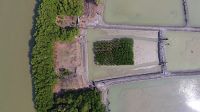
Nature-based solutions are interventions that aim to protect, restore and sustainably manage natural and modified ecosystems to benefit human well-being and biodiversity and address societal concerns. Integrated mangrove-shrimp farming or simply aquaculture is the coexistence of mangroves and shrimp aquaculture in a tide-fed environment. In comparison to other shrimp farming systems, integrated mangrove-shrimp farming can additionally produce timber and supports biodiversity. To understand the possible benefits of mangrove integration, our consortium compared three integrated mangrove-aquaculture systems together with three local farmers in North 24 Parganas. This article describes our findings, and important factors to consider before deploying integrated mangrove-aquaculture systems.
The University of Stirling has been awarded funds by the British Council to provide funding for four Early Academic Fellowships for Women in STEM. These fellowships will be 6-12 months in duration. The scholarships are available to women who are passport holders and permanent residents of India, Pakistan, Bangladesh, Nepal and Sri Lanka. For further information please visit the University of Stirling website. The deadline for submissions is 31 March 2022.
A free virtual seminar series will be held from 13-17 December, hosted by the Freshwater Fisheries Research Center, Chinese Academy of Fisheries Sciences, in partnership with NACA and the Chinese Ministry of Agriculture and Rural Affairs. The seminar will be held via Zoom. It will give participants a background in aquatic resource conservation practices, recommend options for sustainable aquaculture farming systems with potential for intensification with intervention strategies, and build a communication and experience exchange platform for information dissemination and future collaboration. Participation is free. Registration closes 10 December.
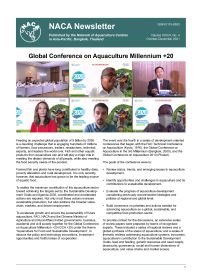
Global Conference on Aquaculture Millennium +20; Workshop on SDG-aligned Artemia aquaculture; Professor Sena De Silva Memorial Oration, 8 October 2021; Apply now: Training Course on Mariculture Technology in Asia-Pacific; New project on “Blue transformation in aquaculture”; Webinar on Status of Artemia cyst use in fish and crustacean hatcheries.
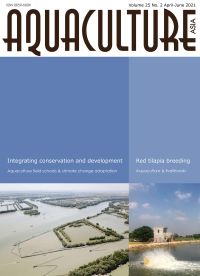
Integrated taxonomy, conservation and sustainable development: Multiple facets of biodiversity; A note on 100th birth anniversary of the late Dr Hiralal Chaudhuri; Aquaculture field schools supporting mangroves for climate change adaptation of Indonesian milkfish-shrimp farmers; An insight to red tilapia breeding and culture: A farmer advisory; Aquaculture for livelihoods and food security in North-western India; NACA Newsletter.
28 June 2021 | Woro Yuniati, Ratna Fadillah, Sri Rejeki, Lestari Widowati, Restiana Ariyati, Apri Astra, Roel Bosma | 1749 Downloads | .pdf | 3.33 MB
Over the last five decades, over 30 million people along Java’s north coast have experienced subsidence and subsequent soil erosion. In 2015, Building with Nature Indonesia (BwNI-Demak) started a coastal protection project in 10 communities of nine coastal villages of Demak regency. The protection measures introduced included the use of permeable structures (dams) that successfully capture sediment and support natural recovery of mangroves, and aquaculture field schools, to train small-scale farmers on good aquaculture practices such as low external inputs sustainable aquaculture, associated mangrove aquaculture and multi-trophic srhimp aquaculture.
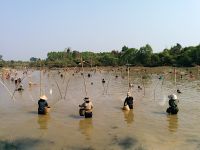
Join us on 31 May for a free webinar on Culture-based fisheries for rural development, with leading experts from the Asian region. Culture-based fisheries (CBF) are practices to enhance fish stocks in waters that don't have enough natural recruitment to sustain a fishery. CBF practices are usually applied in small water bodies such as village dams and irrigation reservoirs. Fish growth is driven by the natural productivity of the waters, foraging on natural food supplies. The simplicity and low capital requirements of CBF make it easy for farming communities to learn and adopt.
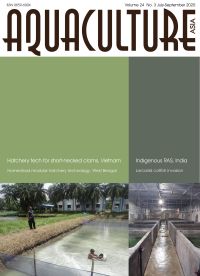
Hatchery techniques for the seed production of short-necked clams (Paphia undulata) in Nha Trang, Vietnam; Lovesome chum of the aquarium are wreaking havoc in East Kolkata Wetlands, India; Concept of indigenous recirculatory aquaculture system executed in West Bengal, India and other places; Homestead modular hatchery technology of brackishwater catfish, Mystus gulio: A potential alternate livelihood option for small and marginal farmers of Sunderban; NACA Newsletter.
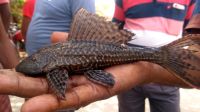
Loricariid catfish species of the genus Pterygoplichthys, known in the aquarium trade as 'plecos' and 'algae eaters', have extensively invaded and proliferated in the East Kolkata Wetlands in West Bengal. Loricariids have capacity to alter the ecosystem and biodiversity of invasion sites, by physically altering the invaded habitats and by competing with native animals for food and space. The aquarium trade pathway is the most significant source of loricariid introductions globally. This article discusses the invasion of loricariid catfish in the East Kolkata Wetlands, and the environmental and economic impact on local fishers.
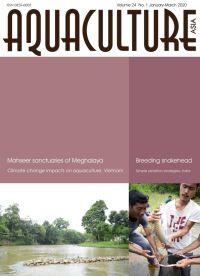
Mahseer sanctuaries of Meghalaya: A conservation and recreational perspective; Impacts of climate change on aquaculture in Vietnam: A review of local knowledge; Simple means of water aeration adopted by progressive fish breeders in West Bengal, India; Breeding striped snakehead (Channa striata) using the concrete tank method in the Cangkringan Area, Special Region of Yogyakarta; NACA Newsletter.
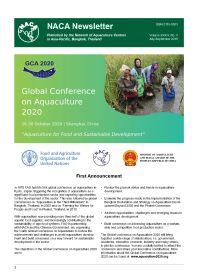
First announcement: Global Conference on Aquaculture 2020, 26-30 October, Shanghai, China; Bangladesh delegation visits Thailand to study shrimp aquaculture; Expert Consultation on Development of Sustainable Aquaculture Guidelines, Rome; Report of the Seventeenth Meeting of the Asia Regional Advisory Group on Aquatic Animal Health; Quarterly Aquatic Animal Disease Report, October-December 2018; Tuskfish 2 Alpha: Testers wanted.
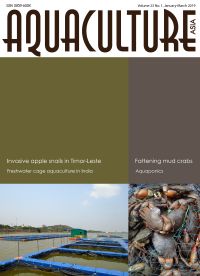
Current status of freshwater cage aquaculture in India; Fattening of mud crab Scylla serrata in estuarine region of south-eastern West Bengal; Aquaponics - sustainable farming method in the fight against hunger; aquatic invasive apple snails (Pomacea spp.) in Timore-Leste - current status, spread and management in rice fields; NACA Newsletter.
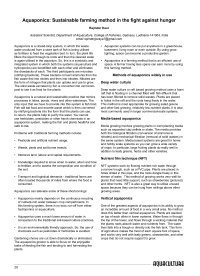
Aquaponics is a closed-loop system in which the waste water produced from a tank of fish is used as fertiliser to feed a bed of vegetation. In turn, the plant life filters the water through its roots and the cleaned water is returned to the fish tank for reuse. Aquaponics is a form of integrated food production system in which the wastes from one production compartment are used as inputs for others.
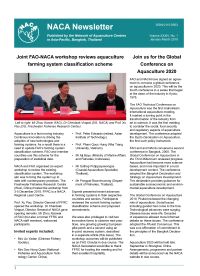
Joint FAO-NACA workshop reviews aquaculture farming system classification scheme; Join us for the Global Conference on Aquaculture 2020; Expert Consultation on Genetically Responsible Aquaculture; Strengthening governance in aquaculture; Pike perch and in-pond raceways; Quarterly Aquatic Animal Disease Report, April-June 2018.
FAO and NACA have signed an agreement to convene a global conference on aquaculture in 2020. This will be the fourth conference in a series that began at the dawn of the industry in Kyoto, 1976. Aquaculture 2020 will be held late in the year in China. Arrangements, programme and partner details will be announced via the NACA website in due course.
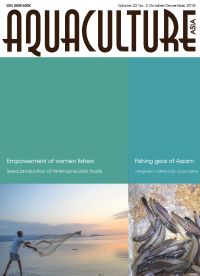
Concept of seed production of Heteropneustes fossilis in farmers' fields in West Bengal, India; Fishing gear and practices in flood waters of Assam; Fisherwomen empowerment: Shedding light on the invisible gender; Integrated multi-trophic aquaculture systems: A solution of sustainability.
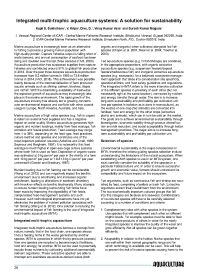
4 October 2018 | Kapil S. Sukhdhane, V. Kripa, D. Divu, Vinay Kumar Vase and Suresh Kumar Mojjada | 5406 Downloads | .pdf | 397.16 KB
Marine aquaculture of high value species such as fish is generally reliant on external food supplies and has a negative impact on water quality, generating high organic and nutrient loadings. Integrated multi-trophic aquaculture offers a solution to reduce environmental impact of farming systems, culturing complimentary species that can recycle nutrients and reduce nutrient pollution while generating additional products for sale. This article looks at species selection and integration of trophic levels in system design.
Aquaculture has seen spectacular growth in recent years, and Aqua 2018 celebrated aquaculture’s role as one of the most important food industries worldwide. Held 25-29 August in Montpellier, France, Aqua 2018 brought together scientists, practitioners, students, industry and civil society to highlight the latest global developments in aquaculture research and innovation.