NACA member governments are: Australia, Bangladesh, Cambodia, China, Hong Kong SAR, India, Indonesia, I.R. Iran, Kingdom of Saudi Arabia, Korea (DPR), Lao PDR, Malaysia, Maldives, Myanmar, Nepal, Pakistan, Philippines, Sri Lanka, Thailand and Vietnam.
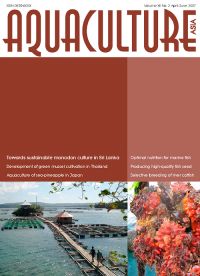
Sustainable black tiger shrimp farming in Sri Lanka. An economic analysis of Persian sturgeon stock enhancement. Aquaculture and environmental sustainability in Thailand: Food or financial security? Cage fish culture - successful income generation in manmade reservoir Kulekhani, Nepal. Diversification of rice farming alleviates poverty in a Bangladesh village. Sea-pineapple aquaculture in Japan. Green mussel cultivation in Thailand. Selective breeding for growh and fillet yield in Vietnamese catfish. Producing quality fish seed in rural Asia.
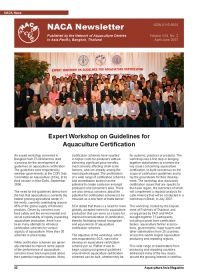
Expert Workshop on Guidelines for Aquaculture Certification. Responsible movement of live food finfish within ASEAN: Cebu Workshop finalises the standard operating procedures. Information and capacity requirements for maintaining aquatic animal biosecurity identified. China-ASEAN efforts to minimise risk of spread of aquatic pathogens. National Centre for Sustainable Aquaculture inaugurated. NACA Better Management Practices program expands in Indonesia. Manual on Application of Molecular Tools in Aquaculture and Inland Fisheries Management. Research Needs to Sustain Asia-Pacific Aquaculture to 2025 and Beyond. Endemic freshwater finfish of Asia: Distribution and conservation status.
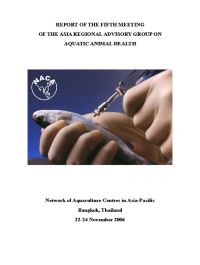
The Asia Regional Advisory Group on Aquatic Animal Health meets annually to discuss regional health issues including emerging disease threats. This report includes a review of regional disease status circa 2006, global and regional disease reporting arrangements, global issues and standards, progress in implementation of the the Regional Technical Guidelines on Health management for the Responsible Movement of Live Aquatic Animals, identification and designation of regional aquatic animal health resources and regional and international cooperation.
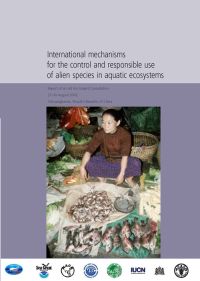
The use of alien species is a proven means to increase production and value from aquatic ecosystems. However, alien species are now recognised as one of the most significant threats to aquatic biodiversity. There are a range of international mechanisms that have been established to assist countries in meeting international obligations and responsibilities. Implementation is often difficult due to lack of awareness and problems with enforcement. Regional coordination of policies is needed for effective national management.
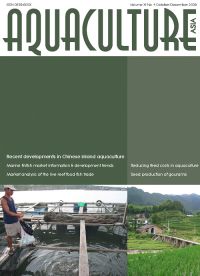
Peter Edwards writes on rural aquaculture: Recent developments in Chinese inland aquaculture. Reducing feed costs in aquaculture: Is the use of mixed feeding schedules the answer for semi-intensive practices? Seed production technology of ornamental gouramis Colisa fasciata and C. lalia under captive conditions. Marine finfish market information and aquaculture development trends in selected locations in Indonesia and Malaysia. Market analysis of the live reef food fish trade.
This paper provides an overview of seafood consumption production in southeast Asia circa 2006. It forecasts a need for aquaculture to expand area under culture and intensity; highlights the potential for fishmeal to constrain growth, and identifies a trend towards cultivation of high-value species. Sources for the review included a regional synthesis of aquaculture developed for a regional workshop in 2005, a review of marine finfish hatchery development and a regional survey of cage fish culture.
This report examines the role mariculture could play in reducing poverty and providing alternative livelihood opportunities for people living in coastal areas. This includes a review of the current status of coastal poverty, coastal livelihoods and vulnerabilities within the Asia-Pacific region and the experiences and examples of sustainable economic development through mariculture. This review then identifies key follow-up actions and recommends strategies for future pro-poor mariculture development.
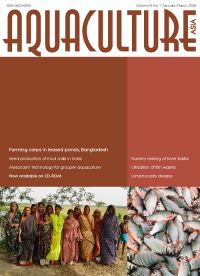
Nursery rearing of silver barb Puntius goniotus. Artemia enrichment and biomasss production for larviculture. Seed production of mud crab Scylla serrata in India. Macrobrachium on the southwest coast of India. Fish wastes in urban and suburban markets of Kolkata: Problems and solutions. Groups of poor women farming carps in leased ponds, Bangladesh. Lymphocystis disease and diagnostic methods in China. Mesocosm technology advances grouper aquaculture in northern Australia.
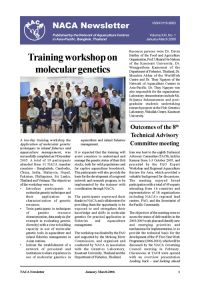
Training workshop on molecular genetics. Outcomes of the 8th Technical Advisory Committee Meeting. Taking the 'grey' out of 'grey literature'. An introduction to the South Iran Aquaculture Research Center. Aquaclubs in India achieve good crops this year, with further challenges ahead. Rebuilding resilience of coastal populations and aquatic resources. Recent activities in STREAM. First international PCR training workshop completed. AusAID funds two aquatic animal health projects. Asia Regional Advisory Group continues to support aquatic animal disease management in the region. Indonesia accedes to the NACA Agreement. Governing Council 17 to set NACA Work Programme 2006-2010. Marine fish culture manuals now available in Thai. Aquaculture Rehabilitation Guide in Aceh, Indonesia. Boat building in the tsunami affected areas of NAD: Fishing vessel quality issues. Australasian Aquaculture 2006, 27 - 30 August, Adelaide. East Asian Seas Congress, 12-16 December 2006, China. Aquafeed Production Workshop, 8 March 2006, Thailand.
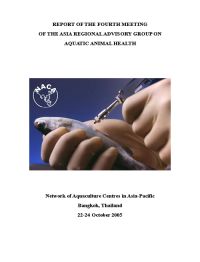
The Asia Regional Advisory Group on Aquatic Animal Health meets annually to discuss regional health issues including emerging disease threats. This report includes a review of regional disease status circa 2005, global and regional disease reporting arrangements, global issues and standards, progress in implementation of the the Regional Technical Guidelines on Health management for the Responsible Movement of Live Aquatic Animals, identification and designation of regional aquatic animal health resources and regional and international cooperation.
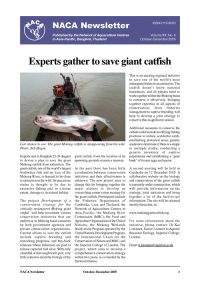
Experts gather to save giant catfish. Workshops on dissemination of better practice models for culture-based fisheries. Dr Chris Baldock, 1947-2005. MAHSEER 2006. MOU signing on conservation of Mahseer in Malaysia and Indonesia. Application of molecular genetics in aquaculture and inland fisheries management. New president of Iran Fisheries Organization. Workshop on the fishery management tool 'EnhanceFish'. Regional Mariculture Development Workshop in China, March 2006. Invitation to apply for position of Director General of NACA. MPEDA expands program on shrimp farmer clubs.
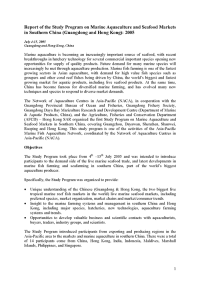
A study tour of seafood markets in southern China (Guangdong Province and Hong Kong SAR) was conducted in 2005. The programme provided participants with exposure to some of China's larges live marine seafood markets, provided insight on marine farming systems and management including major species and technologies, and provided participants with the opportunity to develop valuable business and scientific contacts with farmers, buyers, traders, industry groups and scientists.
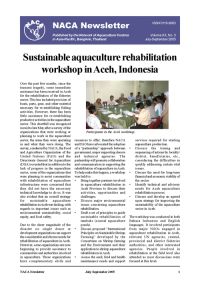
Sustainable aquaculture rehabilitation workshop in Aceh, Indonesia. STREAM policy briefs and better practice guidelines. 25 years of training in integrated fish farming. The Responsibilities of Leadership. A helping hand for those who needed it after the tsunami. An introduction to Mirza Koochek Khan Higher Fisheries Education & Training Centre, Iran. ACIAR funded regional project on shrimp health. Impact of aquatic animal health strategies. Farewell Sih Yang Sim. Welcome Koji Yamamoto.
This document is the technical proceedings of the Asia Regional Scoping Workshop on “Primary Aquatic Animal Health Care in Rural, Small-scale, Aquaculture Development,” held in Dhaka, Bangladesh from 27 - 30 September 1999. The objectives of the workshop were to review information on socio-economic impacts, risks of disease incursions and health management strategies in rural, small-scale aquaculture and enhanced fisheries programmes; and to identify potential interventions for their better health management and appropriate followup actions.
This case study is based on a farm survey of 41 farms out of the total 340 farms in the Rushan County. The results presented in this paper highlight two main problems. The first issue revolves around labor cost statistics. The value of labor cost during the culture period forms a larger than proportionate ratio of total variable cost. The second problem lies in the high fixed cost incurred by rehabilitated farms.
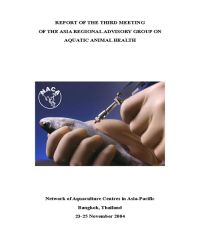
The Asia Regional Advisory Group on Aquatic Animal Health meets annually to discuss regional health issues including emerging disease threats. This report includes a review of regional disease status circa 2004, global and regional disease reporting arrangements, global issues and standards, progress in implementation of the the Regional Technical Guidelines on Health management for the Responsible Movement of Live Aquatic Animals, identification and designation of regional aquatic animal health resources and regional and international cooperation.
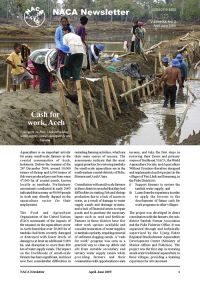
Cash for work, Aceh. HRH Chulabhorn opens new molecular genetics laboratory, Thailand. Aquatic epidemiology training. STREAM Regional Conference and BMP Workshop. Dr Modadugu V. Gupta awarded the 2005 World Food Prize. Study program on marine aquaculture and seafood markets in southern China, 2005. The third Regional Grouper Hatchery Production Training Course.
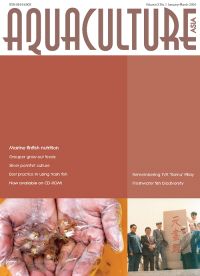
Freshwater prawn culture in China and its market prospects. Demise of wastewater-fed duckweed-based aquaculture in Bangladesh. Freshwater finfish biodiversity - an Asian perspective. Her farm is destroyed, how can we help? Women oyster vendors in Eastern Thailand. Farm-level feeds and feeding practices for marine finfish. ACIAR grouper grow-out feeds and CSIRO research. Feed development and application for juvenile grouper. Grouper growout feeds. Silver pomfret culture technology.
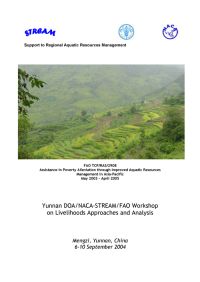
This is the report of the “Yunnan DOA/NACA-STREAM/FAO Workshop on Livelihoods Approaches and Analysis” that was conducted in Mengzi, Yunnan from 6-10 September 2004. The purpose of the workshop was to develop and document mechanisms for training in livelihoods approaches and analysis, and to build national capacity to conduct livelihoods analysis. The workshop in Yunnan was the first STREAM event in China, with colleagues coming to participate from throughout the province.