NACA member governments are: Australia, Bangladesh, Cambodia, China, Hong Kong SAR, India, Indonesia, I.R. Iran, Kingdom of Saudi Arabia, Korea (DPR), Lao PDR, Malaysia, Maldives, Myanmar, Nepal, Pakistan, Philippines, Sri Lanka, Thailand and Vietnam.
13th Technical Advisory Committee; Presentation of the State of World Aquaculture and Regional Aquaculture Reviews 2020; Online training course on mariculture technologies for the Asia-Pacific region; Quarterly Aquatic Animal Disease Report, January-March 2020; Regional Webinar on Infection with Decapod Iridescent Virus 1 (DIV1) and Preparedness for Emerging Shrimp Diseases; China announces import measures to respond to nucleic acid positives of COVID-19 detected from the outer packaging of frozen white leg shrimp from Ecuador.
The Yellow Sea Fisheries Research Institute, Chinese Academy of Fisheries Sciences and NACA are organising a free online training course on mariculture technologies, to be held from 21-25 September 2020. The programme will cover breeding, disease control and prevention, nutrition and feed research, breeding model construction, farm technology development, engineering, quality, safety and inspection technology for aquatic products. The course is open to government officials, researchers, enterprise managers and technicians from developing countries. The deadline for applications is 19 September 2020.
Chinese Customs detected nucleic acid positives of COVID-19 on packaging containing frozen white leg shrimp produced in Ecuador on 3 July. Experts believe that the positive results do not represent infectious virus. However, in order to protect the health of consumers, the General Administration of Customs decided to suspend the registration of the relevant enterprises, suspend the import and export of the products of the relevant enterprises, and take measures such as the return of goods and destruction of goods temporarily detained.
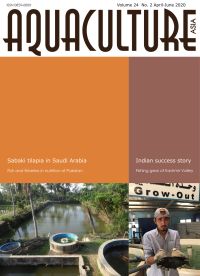
Potential new species in the Kingdom of Saudi Arabia: Sabaki tilapia (Oreochromis spilurus); Role of fish & fisheries in national nutrition of Pakistan; Success story of first fish farmer in India to be awarded ‘Padma Shri’; Insights into the fishing gear and ichthyofauna of major lentic water bodies of Kashmir Valley; NACA Newsletter.
Urgent warning: Positive PCR detection results for infectious myonecrosis virus (IMNV) and decapod iridescent virus 1 (DIV1) in captured Penaeus monodon from the Indian Ocean; COVID-19 news; Urgent announcement on usefulness of the lymphoid organ (LO) as an additional prime target for diagnosis of decapod iridescent virus 1 (DIV1) in diseased P. vannamei; Fresh or frozen seafood?; Report of the Eighteenth Meeting of the Asia Regional Advisory Group on Aquatic Animal Health; COVID-19 fallout could push half a billion people into poverty in developing countries; Simple techniques double crablet production.
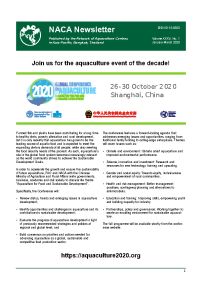
Due to the devastating impacts of the COVID-19 pandemic the conference has been postponed. New dates have not been set, but it is anticipated that the meeting will be held in 2021 when circumstances allow. The venue will remain Shanghai, China. In the meantime, work on the programme will continue. Updates will be posted in due course.
Join us for the aquaculture event of the decade! 18th Meeting of the Asia Regional Advisory Group on Aquatic Animal Health; New Director General of the Department of Fisheries, Thailand; Thailand holds National Sea Bass Fair; Tuskfish CMS 2.0 is available; Regional consultations on strengthening aquaculture governance and demographic changes in fishing communities; INFOFISH World Shrimp Conference and Exposition.
The 35th Session of Asia-Pacific Fishery Commission has identified the lack of effective governance as a major threat to sustainable aquaculture growth for greater contribution to achievement of the Sustainable Development Goals. The objectives of the consultation were to: Share the results of country studies on aquaculture governance in respective countries; identify gaps, issues and challenges in aquaculture governance; and recommend strategies and actions to improve and strengthen aquaculture governance.
27 January 2020 | Qingyin Wang | 4227 views | .mp3 | 9.92 MB
Audio recording of presentation delivered at the Consultation on Strengthening Governance of Aquaculture for Sustainable Development in Asia-Pacific, 5-6 November 2019, Bangkok, Thailand.
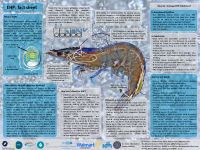
EHP or Enterocytozoon hepatopenaei is a fungal microsporidian parasite that infects the hepatopancreas (hp) of tiger shrimp (Penaeus monodon) and whiteleg shrimp (P. vannamei) in Thailand and results in slow growth and, in chronic infections, mortalities. EHP is also known from Brunei, China, India, Indonesia, Malaysia, Philippines, Venezuela and Vietnam. This fact sheet provides information on the EHP life cycle, signs of infection, diagnosis and management in both hatcheries and growout, as well technical contacts for further information.
Two consultations were held back to back in Thailand from 5-7 November, namely the Consultation on Strengthening Governance of Aquaculture for Sustainable Development in Asia-Pacific and the Consultation on Demographic Changes in Fishing Communities in Asia. The consultations were held at the Centara Grand Hotel at Ladprao, Bangkok. The consultations were attended by 29 participants from 15 countries in the Asia-Pacific region. The consultations were jointly organised by FAO and NACA. Audio recordings are available of some presentations.
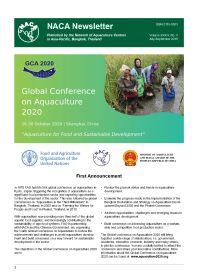
First announcement: Global Conference on Aquaculture 2020, 26-30 October, Shanghai, China; Bangladesh delegation visits Thailand to study shrimp aquaculture; Expert Consultation on Development of Sustainable Aquaculture Guidelines, Rome; Report of the Seventeenth Meeting of the Asia Regional Advisory Group on Aquatic Animal Health; Quarterly Aquatic Animal Disease Report, October-December 2018; Tuskfish 2 Alpha: Testers wanted.
This report summarises the proceedings of the 17th meeting of the Advisory Group, held 13-14 November 2018 in Bangkok, Thailand. The group's role includes reviewing disease trends and emerging threats in the region, identifying developments in global aquatic disease issues and standards, evaluating the Quarterly Aquatic Animal Disease Reporting Programme and providing guidance on regional strategies to improve aquatic animal health management.
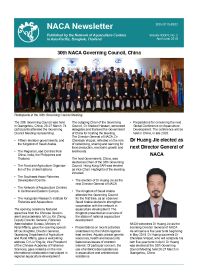
30th NACA Governing Council Meeting, China; Dr Huang Jie elected as the next Director General of NACA; Expert Consultation on Genetically Responsible Aquaculture; Launch of AGRISI: Aquatic Genetic Resource System of India; Aquatic animal epidemiology training course held at NBFGR; Asia-Pacific Laboratory Proficiency Testing Workshop; Proceedings of the FishAdapt Conference; Quarterly Aquatic Animal Disease Report, July-September 2018; Centex Shrimp International Training Course on Biology and Pathology of Penaeid Shrimp; INFOFISH World Shrimp Trade Conference and Exposition.
The 30th Governing Council was held in Guangzhou, China, 26-27 March. 74 participants attended the Governing Council Meeting representing fifteen member governments, with the Kingdom of Saudi Arabia attending as an observer. The host Government, China, was elected as Chair of the 30th Governing Council. Hong Kong SAR was elected as Vice Chair. Key outcomes included the election of Dr Huang Jie as the next Director General of NACA, and preparations for the Global Conference on Aquaculture 2020.
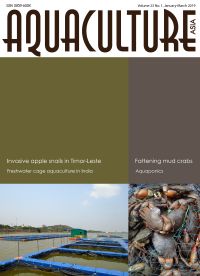
Current status of freshwater cage aquaculture in India; Fattening of mud crab Scylla serrata in estuarine region of south-eastern West Bengal; Aquaponics - sustainable farming method in the fight against hunger; aquatic invasive apple snails (Pomacea spp.) in Timore-Leste - current status, spread and management in rice fields; NACA Newsletter.
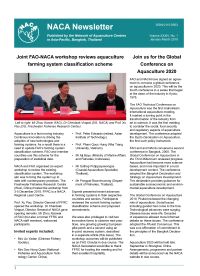
Joint FAO-NACA workshop reviews aquaculture farming system classification scheme; Join us for the Global Conference on Aquaculture 2020; Expert Consultation on Genetically Responsible Aquaculture; Strengthening governance in aquaculture; Pike perch and in-pond raceways; Quarterly Aquatic Animal Disease Report, April-June 2018.
Aquaculture is a fast moving industry. Continous innovation is driving the adoption of new technologies and farming systems. As a result there is a need to update FAO's farming system classification scheme. FAO and member countries use this scheme for the preparation of statistical data. NACA and FAO organised an expert workshop to review the existing classification system. The workshop aim was to bring the system up to date with contemporary practices.
FAO and NACA have signed an agreement to convene a global conference on aquaculture in 2020. This will be the fourth conference in a series that began at the dawn of the industry in Kyoto, 1976. Aquaculture 2020 will be held late in the year in China. Arrangements, programme and partner details will be announced via the NACA website in due course.
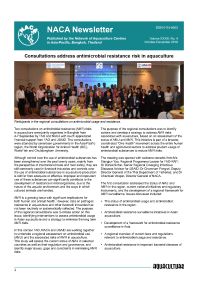
Consultations address antimicrobial resistance risk in aquaculture; ASEAN consultation on emergency aquatic animal disease preparedness and response; Applications for the position of Director General, NACA; Aqua 2018 - #WeRAquaculture; Asian Aquaculture 2018: Celebrating Asian Aquaculture, 3-6 December, Thailand; and Training and Deans' Forum organised in China.