NACA member governments are: Australia, Bangladesh, Cambodia, China, Hong Kong SAR, India, Indonesia, I.R. Iran, Kingdom of Saudi Arabia, Korea (DPR), Lao PDR, Malaysia, Maldives, Myanmar, Nepal, Pakistan, Philippines, Sri Lanka, Thailand and Vietnam.
Habitat breeding and seed rearing of a near threatened featherback, Chitala chitala; Wild seed collection and modified-extensive farming of Mystus gulio in inland water bodies of South 24 Parganas, West Bengal; Freshwater pearl culture practices and challenges in India; Next generation probiotics: Future therapeutics for sustainable aquaculture; NACA Newsletter.
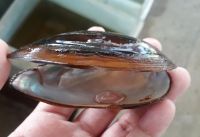
In 1987, ICAR-CIFA initiated research on the culture and production of freshwater pearls and since then it has been working towards the development of the technology of producing pearls in freshwater environments. Though the breeding protocol for seed production of Lamellidens marginalis is under progress, the culture practice for pearl production has already been standardised. This article describes the culture practices used for freshwater pearl farming in India, including site selection, implant techniques, post-operative care and growout conditions. Challenges and future prospects of the industry are also discussed.
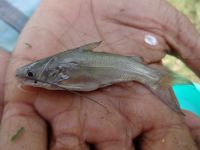
The cultivable small- to medium-sized bagrid catfish Mystus gulio is an estuarine species sold as a high-priced food fish in retail markets in cities and towns of southern West Bengal. M. gulio is a good addition to mixed species culture-based fisheries in canals in the Indian Sundarbans region. It adapts and grows well in freshwater ponds and is recommended for freshwater fish culture in areas of the Sundarbans vulnerable to saline water intrusion. This article describes the seed collection, nursery and grow-out practices of M. gulio as practiced in modified-extensive mixed culture systems in West Bengal, India.
The humped featherback, Chitala chitala is considered to be one of the most commercially important food, sport, aquarium and highly priced cultivable fish in Assam. However, over exploitation, habitat degradation and pollution has caused wild populations to decline in recent decades, to the point where the species is categorised as Near Threatened on the IUCN Red List. Here we present the biological aspects of breeding and larval rearing protocols of the humped featherback, which has been prioritised as a new candidate species for freshwater aquaculture in India. The information will also aid in stock enhancement and conservation of this species.
Opinion: Benefits of animal welfare in Indian aquaculture; Imparting skill on formulated fish feed preparation to women’s self-help groups in villages – an experience; Farming of the anadromous shad, Tenualosa ilisha: Signs of taking off in India; Some facts on cannibalism in Wallago attu and its management during captive seed production; NACA Newsletter.
Wallago attu is a large catfish reaching 45 kg found in the Indian subcontinent, Thailand, Vietnam, Cambodia and Indonesia. Early attempts at captive production encountered high losses due to cannibalism during early life stages. This article discusses the causative factors governing cannibalism in this catfish, including rapid transfer from live to commercial feed, size differences during stocking, seasonal changes, feeding at long intervals, high density rearing, feed distribution, feeding method and size of feed, and management strategies for minimising losses during the seed rearing period.
The andadromous shad Tenualosa ilisha (also known as hilsa) is an economically important food fish in south and southeast Asia. Populations of the species are declining globally, largely due to overexploitation and habitat modification. Its fishery has drastically declined in the Bay of Bengal bordering India. Considering the excessive demand and very high market price there have been efforts for domestication and farming of the species in India. Early efforts were not measurably successful. However, momentum on developing captive breeding and farming technologies for this species has been re-invigorated with research funding from the Indian Council of Agricultural Research.
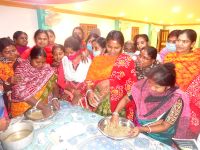
Preparation of locally made floating pelleted fish feed can be a profitable and sustainable income generating entrepreneurial activity for women's self-help groups in rural areas. Using such feed can also help small-scale marginal fish farmers to improve production and reduce their operating costs. This article describes initiatives to train women's self-help groups in formulated feed production in West Bengal, India.
Parasites and disease are amongst the greatest issues affecting Indian aquculture, incurring substantial economic losses every year. Due to disease risk, some farmers may use antibiotics as a prophylactic measure, with consequent risk of increasing anti-microbial resistance. Organic aquaculture has the potential to allow reduced chemical inputs, but must be coupled with other paradigms to alleviate disease issues. The Fish Welfare Initiative believes that measures to improve animal welfare, in particular water quality and stocking density, can contribute to improved animal health outcomes.
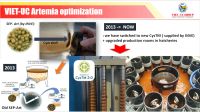
Videos from our recent webinar Status of the use of Artemia cysts in fish and crustacean hatcheries around the world are now available on NACA's Youtube channel. Please consider subscribing for more technical aquaculture content!
Video recordings of technical presentations from the webinar on Culture-based fisheries for rural development (31 May 2021) are now available on Youtube. Presentations cover technical constraints, the socio-economic and impact on communities, micro-nutrient security, monitoring and evaluation, improving water quality through stocking selected species, biodiversity considerations, and success stories.
Please visit NACA's Youtube channel to access the videos. Our Youtube channel is brand new, please consider subscribing for more technical aquaculture videos!
India’s seaweed sector is an emerging area for the development of the rural economy. A growing interest of the government and subsequent announcement of a ‘multi-purpose seaweed park’ in Tamil Nadu will boost the seaweed farming and related industries. India aims to increase seaweed production to 1,150,000 metric tons from the current production levels of 2,500 metric tons in the next five years. SMART AGRIPOST in collaboration with ICAR-CMFRI and industry associations, is pleased to organize a two-day virtual conference and exhibition, Seaweed India 2021 on 26-27 August 2021, to connect all stakeholders. The webinar will help review and deliberate on the opportunities and challenges in the emerging seaweed sector in India with regard to its various dimensions.
Integrated taxonomy, conservation and sustainable development: Multiple facets of biodiversity; A note on 100th birth anniversary of the late Dr Hiralal Chaudhuri; Aquaculture field schools supporting mangroves for climate change adaptation of Indonesian milkfish-shrimp farmers; An insight to red tilapia breeding and culture: A farmer advisory; Aquaculture for livelihoods and food security in North-western India; NACA Newsletter.
In the north-western states of India there is great scope for aquaculture to generate employment opportunities, improve the socio-economic status of farming communities, furnish additional food and nutritional security and boost the national economy. This article describes the present state of Indian aquaculture and prospects for increasing production through diversification, use of village/community ponds and inland saline aquaculture of shrimp and other species, along with major concerns and action plans.
The aquaculture of red tilapia is proving to be highly successful due to its attractive colour, faster growth rate and good market demand. Expansion of the industry will depend on adequate supply of quality seed. This article describes the status of red tilapia aquaculture and good practices in broodstock management and nursery rearing using hapa systems and all-male seed production techniques, including hapa installation, breeding, egg collection and related issues.
The 88th edition of the Quarterly Aquatic Animal Disease Report contains information from thirteen governments. The foreword provides an announcement on the new format for the Aquatic Animal Disease Report from January 2021 onwards.
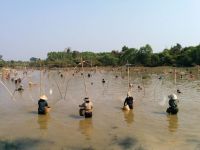
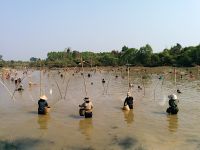
Join us on 31 May for a free webinar on Culture-based fisheries for rural development, with leading experts from the Asian region. Culture-based fisheries (CBF) are practices to enhance fish stocks in waters that don't have enough natural recruitment to sustain a fishery. CBF practices are usually applied in small water bodies such as village dams and irrigation reservoirs. Fish growth is driven by the natural productivity of the waters, foraging on natural food supplies. The simplicity and low capital requirements of CBF make it easy for farming communities to learn and adopt.
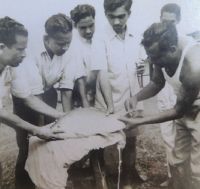
The year 2021 is the one-hundredth anniversary of the birth of the ‘Father of Induced Fish Breeding in India’, the late Dr Hiralal Chaudhuri, DSc, former Senior Fishery Scientist at the ICAR-Central Inland Fisheries Research Institute, Barrackpore, India and Ex-Chief Technical Advisor in Aquaculture, FAO/UNDP at Lao PDR. In his honour, National Fish Farmers’ Day is celebrated annually on 10 July, to acknowledge the contribution made by professional fish farmers and breeders to India’s economy, food supply and production of table-sized major carps and other important inland food fishes.
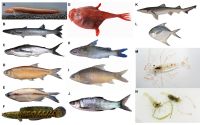
Focussed explorations from the ICAR-National Bureau of Fish Genetic Resources (NBFGR), an organisation mandated for cataloguing of genetic resources of India include surveys of various ecosystems ranging from fauna of deep sea to the high-altitude regions of the Himalaya, falling under diverse biogeographic zones and unexplored regions of the country, including North-eastern India, Western Ghats, Lakshadweep and the Andaman and Nicobar Islands. This article describes the results of these efforts, which include discovery of 14 new fish species and six new distribution records between 2015 to 2020.
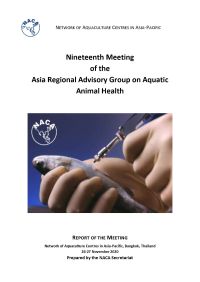
This report summarises the proceedings of the 19th meeting of the Advisory Group, held 26-27 November 2020 via video conference. The group's role includes reviewing disease trends and emerging threats in the region, identifying developments in global aquatic disease issues and standards, evaluating the Quarterly Aquatic Animal Disease Reporting Programme and providing guidance on regional strategies to improve aquatic animal health management.