NACA member governments are: Australia, Bangladesh, Cambodia, China, Hong Kong SAR, India, Indonesia, I.R. Iran, Kingdom of Saudi Arabia, Korea (DPR), Lao PDR, Malaysia, Maldives, Myanmar, Nepal, Pakistan, Philippines, Sri Lanka, Thailand and Vietnam.
Marine aquaculture of high value species such as fish is generally reliant on external food supplies and has a negative impact on water quality, generating high organic and nutrient loadings. Integrated multi-trophic aquaculture offers a solution to reduce environmental impact of farming systems, culturing complimentary species that can recycle nutrients and reduce nutrient pollution while generating additional products for sale. This article looks at species selection and integration of trophic levels in system design.
The 77th edition of the Quarterly Aquatic Animal Disease Report contains information from nine governments. The foreword discusses an intensive seven-day training course on tilapia lake virus (TiLV) that was jointly organised by China's National Fisheries Extension Center, Sun Yat-Sen University and the Food and Agriculture Organization of the United Nations.
In the ornamental fish markets of India, the euryhaline spotted scat Scatophagus argus and pearlspot Etroplus suratensis are popularly sold as ornamental fish. This article describes the nursing of wild-caught spotted scat seed and in-pond breeding of pearlspot to produce marketable sized fish at the Joykrishna hatchery and fish seed farm, located in the Hooghly River estuarine zone in coastal West Bengal, India. The fish are reared in brackishwater ponds for commercial utilisation as ornamental fish, supplying Hyderabad and other cities.
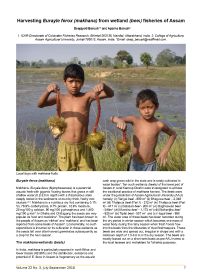
Makhana, Euryale ferox is a perennial aquatic herb with gigantic floating leaves that grows in still, shallow water. The sowing and harvesting of makhana seeds, a casual food for rural folk, is conducted by groups of migratory people belonging to the Mallah or Sahini community of Bihar. The makhana seeds are usually fallen and scattered over the bottom of the wetlands (beels) and must be collected manually by diving during September-November. The raw seeds sell for Rs. 60-70 per kg in Assam.
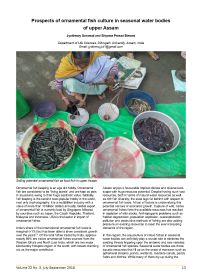
India’s share of the international ornamental fish trade is marginal but has been able to show consistent growth over the years. Of the total ornamental fishes traded by India, approximately 85% are native fishes sourced from the Western Ghats and North East India. The aquaculture of native fishes in seasonal water bodies can play a role in both conservation and generation of livelihoods. Imparting knowledge regarding ornamental fish trade and establishing market linkages is required to further develop the industry.
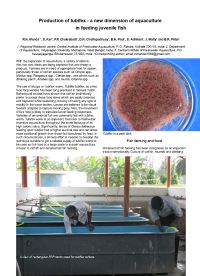
The use of sludge or ‘tubifex’ worm, Tubifex tubifex, as a live food for juvenile fish has been long practiced in farmers’ fields and it is an important fish food for spawn rearing. The cost of tubifex worm becomes prohibitive in the dry season, when supplies are limited. We conducted trials to test the feasibility of culturing tubifex using a selection of agro-industrial wastes. Net biomass production was highest using rice mill sludge as a food source, over a culture period of 20 days.
Rearing of spotted scat and pearlspot in coastal West Bengal, India; harvesting Eurayle ferox (makhana) from wetland fisheries of Assam; prospects of ornamental fish culture in seasonal water bodies in Assam; production of tubifex, a new dimention in aquaculture in feeding juvenile fish; invasive apple snails in Brunei Darussalam; aquaculture trends and opportunities in Sindh, Pakistan; NACA Newsletter.
The 76th edition of the Quarterly Aquatic Animal Disease Report contains information from 14 governments. The foreword discusses the outcomes of a Stakeholder Consultation on Progressive Management Pathway to Improve Aquaculture Biosecurity, organised by the Food and Agriculture Organization of the United Nations, Mississippi State University and the World Bank.
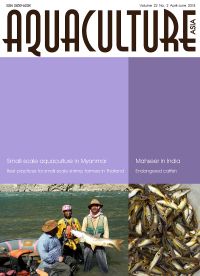
Mahseer in recreational fisheries and ecotourism in India; Small-scale aquaculture of wild fish in Myanmar: A preliminary report from the Bago Region; Current know how and possibility for growout culture of an endangered catfish, Horabagrus brachysoma; Accelerated poverty alleviation of tribal households - cage fish farming by displaced fishers in reservoirs of Jharkhand; Adaptive learning in sustainable aquaculture: Best practices for small-scale shrimp farmers in Thailand; NACA Newsletter.
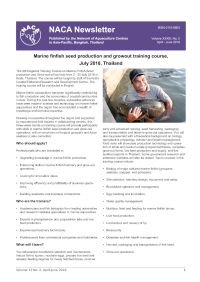
Marine finfish seed production and growout training course, Thailand; global fish passage forum to include first symposium on hydropower and fish; International Workshop on Rehabilitation, Propagation and Conservation of Mahseer, India; World Brackishwater Aquaculture Conference, January 2019, India; Offshore Mariculture Asia 2018, 15-17 May, Singapore; Video lectures: Regional Training Course on Culture-based Fisheries in Inland Waters; Youth and Fish Drawing Competition Art Book; Report of the Sixteenth Meeting of the Asia Regional Advisory Group on Aquatic Animal Health.
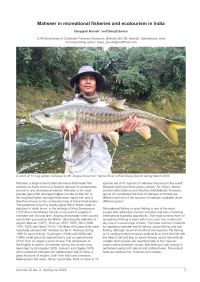
Mahseer are the most popular game fish amongst anglers in India, with a reputation as one of the toughest fighters amongst freshwater sports fish. In this article, we have made an attempt to compile information on recreational mahseer fisheries in India. The importance of the mighty mahseer as a game fish is told through the perspectives of active anglers and the visions of stakeholders and researchers in conservation and ecotourism are presented.
Jharkhand, India, has a significant population of tribal people, around 28% of the state's 33 million. Agriculture is the main livelihood and subsistence-level farming is predominant, offering limited opportunities for employment to landless people for most of the year. This article documents the experience of the Jharkhand Department of Fisheries in developing cage-based aquaculture as an alternative livelihood for tribal fishers that had been displaced by the construction of reservoirs, working in association with fisher collectives.
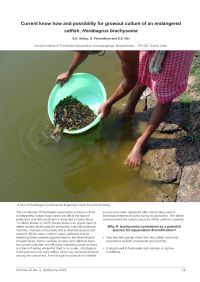
Some varieties of freshwater fish have low growth potential but remain economically attractive due to market preferences. The endangered catfish Horabagrus brachysoma is one such fish, which has limited production but high market demand, and a number of favourable biological characteristics. This article provides guidelines for the culture of this catfish in captivity including for the breeding, nursery, stocking and growout, including advice on pre- and post-stocking practices, harvesting and health management.
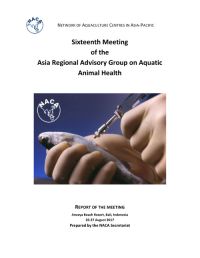
This report summarises the proceedings of the 16th meeting of the Advisory Group, held 26-27 August 2017 in Bali, Indonesia. The group's role includes reviewing disease trends and emerging threats in the region, identifying developments in global aquatic disease issues and standards, evaluating the Quarterly Aquatic Animal Disease Reporting Programme and providing guidance on regional strategies to improve aquatic animal health management. The meeting included discussion on Tilapia Lake Virus (TiLV) and developments in antimicrobial resistance.
Despite their abundance at one time in India and other Asian nations, wild mahseer populations have been declining because of degradation of aquatic ecosystems, urbanisation and indiscriminate fishing. Wild mahseer are populations are presently struggling for their mere existence.
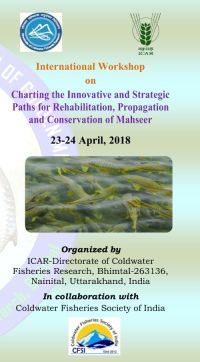
An international workshop on mahseer conservation, propagation and rehabilitation will be held in Bhimtal, India from 23-24 April 2018. The workshop is organised by the ICAR-Directorate of Coldwater Fisheries Research in collaboration with the Coldwater Fisheries Society of India.
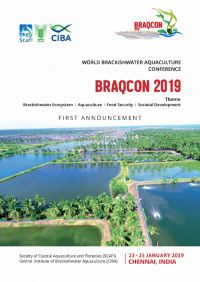
BRAQCON 2019 wil cover latest research and development in the broader themes of the conference in the form of special sessions, contributed papers, expert group discussions and brainstorming on issues facing aquaculturists and ecosystem managers in India and around the world. The conference themes include: Brackishwater ecosystems, estuarine biodiversity and conservation; aquaculture production systems; larviculture; fish and shellfish nutrition; environment and climate change; aquatic animal health; socio-economic and livelihood issues; and aquaculture genetics and biotechnology.
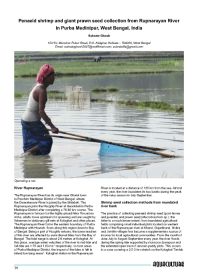
The practice of collecting penaeid shrimp seed and prawn seed from inundated agricultural fields adjacent to the Rupnarayan River has become a supplementary source of income for local communities. During the wet season each year, the river floods the extended open tract of unsown paddy fields. This article describes the traditional fishing practices, gear and livelihoods associated with capture and grow out of shrimp and prawn seed in this region of West Bengal, India.
Integrated multi-trophic aquaculture is a flexible concept, on which many variations can be developed and should not be viewed as confined to open-water, marine systems. Freshwater integrated multi-trophic aquaculture, perhaps better known as aquaponics, applies the same principles as those used in marine integrated multi-trophic systems. In particular, using plants to reduce phosphorus (and other nutrient) levels in effluents can help farmers meet water quality guidelines and prevent eutrophication in the environment.
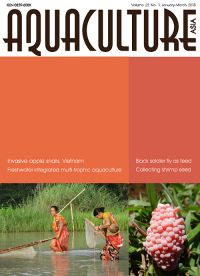
Invasive apple snails (Pomacea spp.) in Vietnam: Short review; A review of fresh water integrated multi-trophic aquaculture: Catching up on the dream of a blue revolution in India; Pre-pupae (larvae) of black soldier fly - a potential alternate protein source for aquaculture feeds; Penaeid shrimp and giant prawn seed collection from Rupnarayan River in Purba Medinipur, West Bengal, India; NACA Newsletter; First training course on culture-based fisheries held in Nha Trang, Vietnam.
First training course on culture-based fisheries held in Nha Trang, Vietnam; GAF7: Gender in Aquaculture and Fisheries; 3rd International Symposium on Aquaculture and Fisheries Education, India; International Fishing Industry Safety and Health Conference, Canada; WHO: Stop using antibiotics in healthy animals to prevent the spread of antibiotic resistance; Register for the 8th International Symposium on Aquatic Animal Health; Quarterly Aquatic Animal Disease Report, July-September 2017; Biology and Management of Invasive Apple Snails; Antimicrobial use in the aquaculture sector.