India

India's involvement in NACA.

Creative Commons Attribution.

Related

NACA member governments

NACA member governments are: Australia, Bangladesh, Cambodia, China, Hong Kong SAR, India, Indonesia, I.R. Iran, Kingdom of Saudi Arabia, Korea (DPR), Lao PDR, Malaysia, Maldives, Myanmar, Nepal, Pakistan, Philippines, Sri Lanka, Thailand and Vietnam.

In this collection

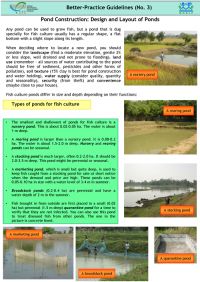
Pond construction: Design and layout of ponds

Any pond can be used to grow fish, but a pond that is dug specially for fish culture usually has a regular shape, a flat bottom with a slight slope along its length. When deciding where to locate a new pond, you should consider the landscape, land use, soil texture (15% clay is best for pond construction and water holding), water supply (consider quality, quantity and seasonality), security (from theft) and convenience (maybe close to your house).

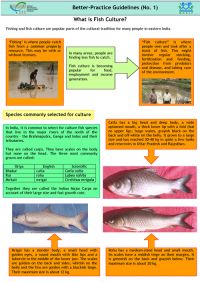
Better-practice guidelines: What is fish culture?

Fish culture is where people own and look after a stock of fish. This might involve regular stocking, fertilisation and feeding, protection from predators and disease and taking care of the environment.

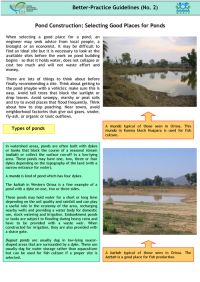
Pond construction: Selecting good places for ponds

When selecting a good place for a pond, an engineer may seek advice from local people, a biologist or an economist. It may be difficult to find an ideal site but it is necessary to look at the available sites before the work on pond building begins – so that it holds water, does not collapse or cost too much and will not waste effort and money. There are lots of things to think about before finally recommending a site.

STREAM Journal Volume 4, No. 4, October-December 2005

In this issue: Seaweed culture and farmer incomes in Bekasi, Indonesia. Significant change for a self-help group. Conflict over fishing in Jharkhand. Critical steps in preparing coastal communities for effective policy changes. New guidelines on data collection and information sharing for co-management. About the STREAM Journal. About STREAM. This edition is also available in Ilonggo.

Quarterly Aquatic Animal Disease Report, October-December 2005

This report, the 30th in the series, contains information about the aquatic animal health status of sixteen states in the Asia-Pacific region. The foreword discusses capacity building and harmonisation in aquatic animal health within ASEAN.

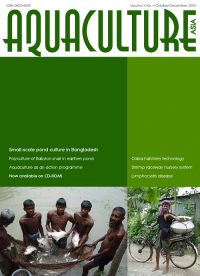
Aquaculture Asia Magazine, October-December 2005

In this issue:

Small-scale pond culture in Bangladesh. Issues and challenges in community-based aquaculture. Aquaculture as an action programme building confidence and self-worth. Transforming policy recommendations into pro-poor service provision. Grow out of spotted Babylon to marketable size in polyculture with seabass. Influence of economic conditions and global shocks on grouper markets. Status of cobia hatchery technology in Vietnam. Organic shrimp raceway system. Macrobrachium rosenbergii in Vembanad Lake. Management of monogenean parasites.

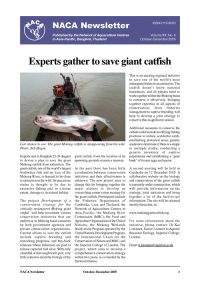
NACA Newsletter Volume XX, No. 4, October-December 2005

In this issue:

Experts gather to save giant catfish. Workshops on dissemination of better practice models for culture-based fisheries. Dr Chris Baldock, 1947-2005. MAHSEER 2006. MOU signing on conservation of Mahseer in Malaysia and Indonesia. Application of molecular genetics in aquaculture and inland fisheries management. New president of Iran Fisheries Organization. Workshop on the fishery management tool 'EnhanceFish'. Regional Mariculture Development Workshop in China, March 2006. Invitation to apply for position of Director General of NACA. MPEDA expands program on shrimp farmer clubs.

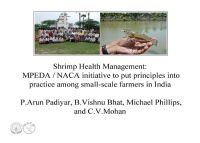
Shrimp health management: MPEDA/NACA initiative to put principles into practice among small-scale farmers in India

Presentation on a MPEDIA/NACA intiative to implement better management practices for shrimp farming amongst small-scale farmers in India via formation of farmer groups. The practices are based on the International Principles for Responsible Shrimp Farming. Adoption of improved farming practices reduces the incidence of disease and improves crop outcomes for small-scale farmers. This presentation was made at the World Aquaculture Society Conference in Bali, Indonesia, 2005.

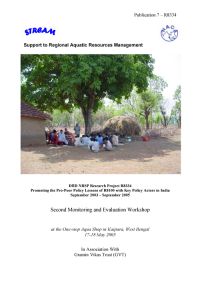
Second monitoring and evaluation workshop: Promoting the pro-poor policy lessons of R8100 with key policy actors in India

The objective of this project, in taking forward the achievements of the earlier projects, is to develop and promote mechanisms for the delivery of rural services that can reach and benefit marginalised poor men and women of scheduled tribes and scheduled castes. This workshop in Kaipara Village was meant to “understand the quality of performance in service delivery to poor people through the project monitoring and evaluation system.” Significant change stories were prepared by participants.


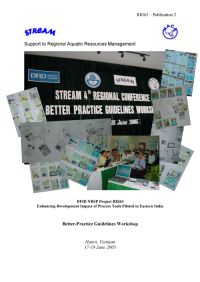
Report of the Better-Practice Guidelines Workshop, Hanoi, Vietnam, 17-18 June 2005

This workshop report is an output from an additional uptake and promotion activity of the DFID NRSP Project R8363 “Enhancing Development Impact of Process Tools Piloted in Eastern India”, which was extended to the end of August 2005. It describes a Better-Practice Guidelines (BPG) Workshop which was the latest project activity to share process tools for Building Social Capital (Self-Help Groups), Consensus-Building and Information Access Surveys. Since the project began, the BPG genre has expanded from the original three concepts shared, to currently twenty-five BPGs prepared not only by STREAM but also by farmers and fish producers. The genre has also been adopted by other organisations, including the DFID-funded Western Orissa Rural Livelihoods Project to share rural aquaculture techniques, and Stirling University to support the uptake and promotion of their work on Self-Recruiting Species and Local Resource User Groups.

The workshop was attended by STREAM National Coordinators and Communications Hub Managers from Cambodia, India, Indonesia, Myanmar, Nepal, Pakistan, Philippines, Sri Lanka and Vietnam, and STREAM Regional Office colleagues based in Thailand, Australia and India. The participants reviewed and assessed the BPGs and Policy Briefs in Bahasa Indonesia, Bengali, English, Hindi, Ilongo, Khmer, Myanmar, Nepali, Oriya, Sinhala, Urdu and Vietnamese. They also began to plan how the uptake and promotion of these tools may be specifically supported in each national context as well as planning the development of further BPG and PB topics.
STREAM Journal Volume 4, No. 3, July-September 2005

In this issue: One-stop aqua shops - an emerging phenomenon in eastern India. Ranchi One-stop Aqua Shop. Kaipara One-stop Aqua Shop. Bilenjore One-stop Aqua Shop. Patnagarh One-stop Aqua Shop. Using bar-coding in a one-stop aqua shop. About the STREAM Journal. About STREAM.

Quarterly Aquatic Animal Disease Report, July-September 2005

This report, the 29th in the series, contains information about the aquatic animal health status of fourteen states in the Asia-Pacific region. The foreword discusses the outcomes of the fourth meeting of the Asia Regional Advisory Group on Aquatic Animal Health.

NACA Newsletter Volume XX, No. 3, July-September 2005

In this issue:

Sustainable aquaculture rehabilitation workshop in Aceh, Indonesia. STREAM policy briefs and better practice guidelines. 25 years of training in integrated fish farming. The Responsibilities of Leadership. A helping hand for those who needed it after the tsunami. An introduction to Mirza Koochek Khan Higher Fisheries Education & Training Centre, Iran. ACIAR funded regional project on shrimp health. Impact of aquatic animal health strategies. Farewell Sih Yang Sim. Welcome Koji Yamamoto.

Primary aquatic animal health care in rural, small-scale aquaculture development

This document is the technical proceedings of the Asia Regional Scoping Workshop on “Primary Aquatic Animal Health Care in Rural, Small-scale, Aquaculture Development,” held in Dhaka, Bangladesh from 27 - 30 September 1999. The objectives of the workshop were  to review information on socio-economic impacts, risks of disease incursions and health management strategies in rural, small-scale aquaculture and enhanced fisheries programmes; and to identify potential interventions for their better health management and appropriate followup actions.

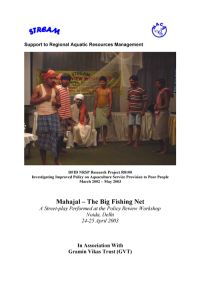
Mahajal - the big fishing net: A street play performed at the Policy Review Workshop, Noida, Delhi, 24-25 April 2003

Mahajal – The Big Fishing Net was written by Mr Rakesh Raman, a playwright from Ranchi, Jharkhand, and performed by his theatre troupe. The play was written as an interpretation of the outcomes of the project case studies carried out in Jharkhand, Orissa and West Bengal. Act One sets the scene of fisherfolk’s livelihoods and the difficulties they face in a tribal village. Act Two places the project’s policy change recommendations within the context of their lives and aspirations.

Shrimp Health Management Extension Manual

This extension manual summarises farm level risk factors and practical management practices that can be used to reduce risks of shrimp disease outbreaks and improve farm production. The recommendations are based on a study conducted in Andhra Pradesh, India. The publication is therefore of particular relevance to Andhra Pradesh, but many recommendations are still of use to farmers from other areas.

STREAM Journal Volume 4, No. 2, April-June 2005

In this issue: Changes in Jabarrah. Palu Hijau in the Banggai Islands  - using knowledge for change. Three stories from Nepal. Me and my work. Livelihoods approaches - skills learned, applied and shared. About the STREAM Journal. About STREAM. This edition is also available in Ilonggo and Vietnamese.

Quarterly Aquatic Animal Disease Report, April-June 2005

This report, the 28th in the series, contains information about the aquatic animal health status of seventeen states in the Asia-Pacific region. The foreword discusses the need for improved surveillance and transparent reporting of aquatic animal disease.

STREAM Journal Volume 4, No. 1, January-March 2005

In this issue: Young people taking bolder steps. Providing a venue for voices to be heard. Rehabilitation of a bundu pond - STREAM's initiative and DOF's action. Coastal resources utilisation and conservation issues in Cox's Bazar, Bangladesh. People, fish and reefs - a livelihoods learning curve. Understanding the marine ornamental trade and its impact on the livelihoods of poor stakeholders in the Philippines. About the STREAM Journal. About STREAM. This edition is also available in Ilonggo and Vietnamese.

Quarterly Aquatic Animal Disease Report, January-March 2005

This report, the 27th in the series, contains information about the aquatic animal health status of fifteen states in the Asia-Pacific region. The foreword discusses identification of regional expertise in aquatic animal health, in terms of experts, resource centres and reference laboratories.