NACA member governments are: Australia, Bangladesh, Cambodia, China, Hong Kong SAR, India, Indonesia, I.R. Iran, Kingdom of Saudi Arabia, Korea (DPR), Lao PDR, Malaysia, Maldives, Myanmar, Nepal, Pakistan, Philippines, Sri Lanka, Thailand and Vietnam.
The 71st edition of the Quarterly Aquatic Animal Disease Report contains information from 15 governments. The foreword provides information about the 10th Symposium on Diseases in Asian Aquaculture.
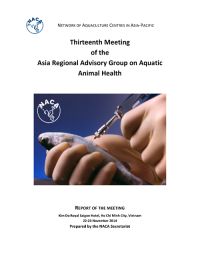
The Asia Regional Advisory Group on Aquatic Animal Health meets annually to discuss regional health issues including emerging disease threats. This report includes a review of regional disease status circa 2015, global and regional disease reporting arrangements, global issues and standards, progress in implementation of the the Regional Technical Guidelines on Health management for the Responsible Movement of Live Aquatic Animals, identification and designation of regional aquatic animal health resources and regional and international cooperation.
This Code of Practice is prepared to promote or ensure compliance to World Trade Organisation-Sanitary and Phytosanitary measures for the movement of live aquatic organisms in the Lower Mekong Basin. The goals of the Code are to achieve environmental protection and management, biodiversity conservation as well as prevention of spread of disease epizootics. Most of the points listed in this Code are based on the inputs of MRC Member Countries.
This report, the 71st in the series, contains information about the aquatic animal health status of sixteen states in the Asia-Pacific region. The foreword discusses changes to the Quarterly Aquatic Animal Disease Report, including a move to electronic-only distribution.
This report, the 70th in the series, contains information about the aquatic animal health status of nine states in the Asia-Pacific region. The foreword discusses tilapia lake virus, a new viral disease of farmed tilapia.
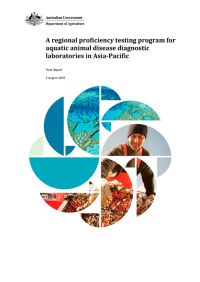
A Regional Proficiency Testing Program for Aquatic Animal Disease Diagnostic Laboratories in Asia-Pacific was developed to strengthen diagnostic capability across Asia. This capability was identified as a requirement to facilitate the sanitary safety of trade in aquatic animal products. The program provided 41 laboratories across the Asia-Pacific with the opportunity to assess their diagnostic performance for 10 regionally significant aquatic animal pathogens, and to adapt or modify practices where necessary to improve.
This report, the 69th in the series, contains information about the aquatic animal health status of nine states in the Asia-Pacific region. The foreword discusses the outcomes of the 14th meeting on the Asia Regional Advisory Group on Aquatic Animal Health.
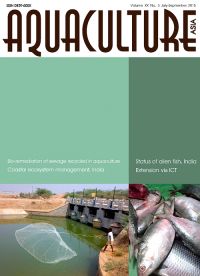
Changes to the magazine and website. Status of alien fish species farming and it's implications for Andhra Pradesh, India. Bridging the research-extension-farmer-input and market linkage gap in coastal aquaculture through application of ICT. Bio-remediation of domestic sewerage recycled in aquaculture: A Central Institute of Freshwater Aquaculture model. Role of family farming in marine and coastal ecosystem management in India. Conservation of fish genetic resources: An introduction to the state fishes of India.
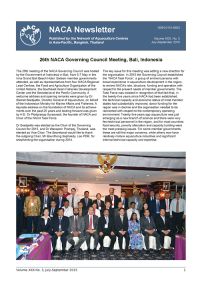
26th NACA Governing Council Meeting, Bali, Indonesia. Regional Workshop on the Status of Aquatic Genetic Resources. Developing an environmental monitoring system to strengthen fisheries and aquaculture in the Lower Mekong basin. Regional workshop documents sustainable intensification practices in aquaculture. Perspectives on culture-based fisheries developments in Asia. SUPERSEAS PhD opportunities.
The Asia Regional Advisory Group on Aquatic Animal Health meets annually to discuss regional health issues including emerging disease threats. This report includes a review of regional disease status circa 2014, global and regional disease reporting arrangements, global issues and standards, progress in implementation of the the Regional Technical Guidelines on Health management for the Responsible Movement of Live Aquatic Animals, identification and designation of regional aquatic animal health resources and regional and international cooperation.
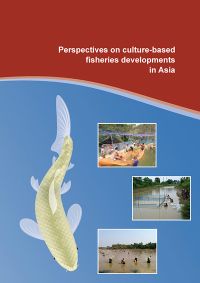
This book is the proceedings of the “Regional Consultation on Culture-Based Fisheries Development in Asia”, held in Siem Reap, Cambodia, 21-23rd of October 2014, under the auspices of the Australian Centre for International Agricultural Research (ACIAR), the Mekong River Commission (MRC) and the Network of Aquaculture Centres in Asia-Pacific (NACA). The consultation was jointly organised by NACA and the Fisheries Administration of the Royal Government of Cambodia.
FAO and NACA convened a stakeholder consultation in Bangkok 25-27 March 2015 to discuss development of an environmental monitoring system for the lower Mekong Basin. The objective of the system is to strengthen the resilience of fisheries and aquaculture and to improve early warning for fishers and farmers. The workshop was preceded by baseline assessments of existing environmental monitoring and early warning systems relevant to fisheries and aquaculture in the target area.
This report, the 68th in the series, contains information about the aquatic animal health status of thirteen states in the Asia-Pacific region. The foreword discusses harmonisation in ASEAN aquaculture certification.
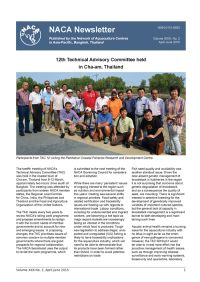
12th Technical Advisory Committee held in Cha-am, Thailand. Audio recordings: WAS special session on regional cooperation for improved biosecurity. AFSPAN Final Technical Report now available! Pillay Aquaculture Foundation Awards for Scientists in Least Developed Countries. Gender seminar conducted and ASEAN Gender Network launched. A two-tube, nested PCR detection method for AHPND bacteria. 9th Regional Grouper Hatchery Production Training Course. Developing an environmental monitoring system to strengthen fisheries and aquaculture in the Lower Mekong Basin. Asia-Pacific Regional Workshop on the Status of Aquatic Genetic Resources for Food and Agriculture.
The objectives of the Aquaculture for Food Security, Poverty Alleviation and Nutrition (AFSPAN) project were to strengthen the knowledge base and develop new and more rigorous methodologies of quantifying the contribution of aquaculture to combat hunger and poverty, thus providing the evidence upon which sound strategies, policies and research programs can be developed to support the sustainable expansion of aquaculture to maximise its impact on food and nutrition security and poverty alleviation.
This report, the 67th in the series, contains information about the aquatic animal health status of fourteen states in the Asia-Pacific region. The foreword discusses the OIE Regional Workshop on Safe International Trade in Aquatic Animals and Aquatic Animal Products.
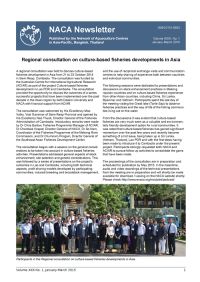
Regional consultation on culture-based fisheries developments in Asia. Gender Assessment Synthesis Workshop. NACA participation in the 5th Global Symposium on Gender in Aquaculture and Fisheries, Lucknow, India. Broodstock Management in Aquaculture: Long term effort required for regional capacity building. Urgent appeal to control spread of the shrimp microsporidian parasite Enterocytozoon hepatopenaei (EHP).
Asia produces nearly 90% of world aquaculture output. However, growth of the industry is increasingly constrained by various factors, including poor broodstock quality and genetic deterioration of domesticated stock. This has arisen in part from a general lack of planning, knowledge and skills in broodstock management. Capacity building across the region is urgently required for hatchery operators at different scales through information exchange, experience sharing and training.
A regional consultation was held to discuss culture-based fisheries development in Asia from 21 to 23 October 2014 in Siem Reap, Cambodia. The consultation was funded by the Australian Centre for International Agricultural Research as part of the project Culture-based fisheries development in Lao PDR and Cambodia. The consultation provided the opportunity to discuss the outcomes of a series successful projects that have been implemented over the past decade in the Asian region.
The NACA/USAID MARKET Gender Project organised a Gender Assessment Synthesis Workshop in Bangkok, Thailand from 29 September to 1 October 2014, which was attended by the MARKET gender project teams from Cambodia, Thailand and Vietnam. The objectives of the Synthesis Workshop were to assess the status of work on the in-country gender assessment reports and the case studies, including make a start on writing of case studies.