30 January 2004Graham Haylor and William Savage | 1545 Downloads | .pdf | 447.15 KB
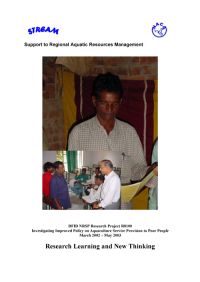
This report, at the request of NRSP, highlights “research learning and new thinking” arising from project R8100. It considers the project’s process from a strategic viewpoint, which is summarised in a conceptual matrix. The main features of the process’s overall strategy considered in more detail are a strategy for bringing through the voices of poor people – described as facilitated advocacy, with the role played by the project being one of “making it easier for people to speak for themselves”.
30 January 2004Graham Haylor, William Savage and S.D. Tripathi | 1400 Downloads | .pdf | 399.6 KB
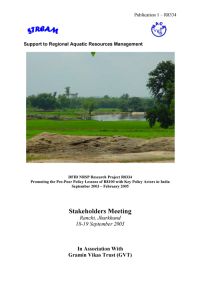
The meetings and this document discuss the lessons learnt by project R8100 and consider how the follow on project might take these forward. This document combines the minutes of the Delhi meetings and the Stakeholder meeting in Ranchi, and captures as stories the summary of project R8100 and the visit to Jabarrah. The objectives of R8334 are presented, with comments on these recorded, and the project flow chart and proposed revisions to it are included.
30 January 2004Graham Haylor, William Savage and S.D. Tripathi | 1759 Downloads | .pdf | 267.98 KB
Three consecutive State-level Communications Strategy Workshops were held in the capitals of Jharkhand, Orissa and West Bengal states. The aim of the workshops, as with all project activities, was to “contribute to ‘giving people a voice’ in policy-making processes that have an impact on their livelihoods.” The specific objectives were to review and orient participants to the project’s four outputs and to draft a state-level communications strategy, including ideas for a monitoring and evaluation process.
30 January 2004Malene Felsing, Graham Haylor, Gautam Dutta, Brajendu Kumar, Smita Shweta, A. Natarajan, Gulshan Arora and Virendra Singh | 1917 Downloads | .pdf | 239.11 KB
The feasibility of integrated aquaculture in seasonal water bodies in rainfed farming areas of Eastern India was assessed in on-farm trials. Fry of Indian major carps: Catla, mrigal, rohu, common carp, and silver barb, and advanced fingerlings of Indian major carps were raised to marketable size. Key factors for the success of aquaculture in seasonal water bodies are access to credit, production enhancing inputs and water bodies that hold water for more than 120 days of the year.
30 January 2004Paul Bulcock, Graham Haylor and William Savage | 1653 Downloads | .pdf | 516.56 KB
Development approaches are constantly evolving, acting on and utilising lessons learnt from past experiences. As a result, “good governance” approaches are currently topical, an intrinsic component of which is how rural poor people can participate in policy-making processes. By reviewing lessons learnt, and considering these with examples from within and outside India, an indication can be given of the most appropriate ways to begin to affect policy, although a specific blueprint will not be suggested.