Freshwater finfish

Information relating to aquaculture of freshwater finfish.

Creative Commons Attribution.

Related

Species / commodity tags

Major farmed commodity or species groups.

In this collection

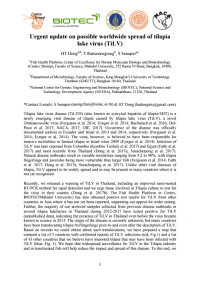
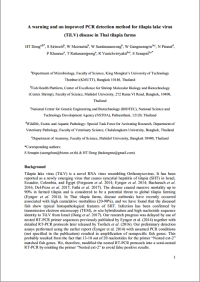
A warning and an improved PCR detection method for tilapia lake virus (TiLV) disease in Thai tilapia farms

Tilapia lake virus (TiLV) is an emerging virus that causes syncytial hepatitis of tilapia with mortalities of up to 90%. Recent disease outbreaks in Thai tilapia farms have been associated with high cumulative mortalities and histopathological features typical of SHT. Infection has now been confirmed. The semi-nested RT-PCR protocol described here may be used freely for non-commercial applications to detect TiLV. The authors urge laboratories in Asia to test for TiLV when abnormal tilapia mortality occurs.

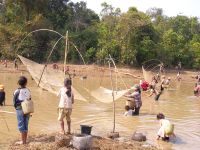
What are culture-based fisheries?

Culture-based fisheries (CBF) are often conducted in small water bodies, perennial and or seasonal, that retain water for at least six to eight months of the year. CBF are stock enhancement practices in water bodies that are generally incapable of supporting sustainable fisheries through self-recruiting fish populations, and where the stock is managed and owned, either individually and or collectively. Feed is rarely added and the stock are left to forage on natural foods.

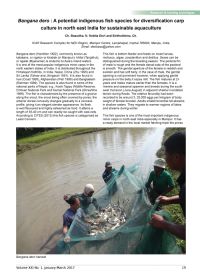
Bangana dero: A potential indigenous fish species for diversification of carp culture in north east India for sustainable aquaculture

Bangana dero is one of the most popular indigenous minor carps in the north eastern states of India, fetching triple the market prices of Indian major carps. B. dero is a bottom feeder and feeds on insect larvae, molluscs, algae, zooplankton and detritus. Over the last two decades the occurrence of wild juveniles of this fish in Indian rivers has fallen drastically. A protocol for induced breeding, larviculture, nursery rearing and growout including polyculture of B. dero is described.

Participatory market chain approach: An unidentified sustainable supply chain model to boost fish nurseries

In Nepal, low quality and seasonal access to fish seed is an important restriction on the development of the aquaculture sector. Commercialisation of fish farming cannot progress rapidly in the absence of critical inputs and a regular supply of quality fish seed is an integral requirement for the transition of fish farming from a subsistence activity to a commercial enterprise. Participatory market chain approaches are a key tool for the social and economic improvement of farmers and market participants.

Report of the fifteenth meeting of the Asia Regional Advisory Group on Aquatic Animal Health, 21-23 November 2016

The Asia Regional Advisory Group on Aquatic Animal Health meets annually to discuss regional health issues including emerging disease threats. This report includes a review of regional disease status circa 2016, global and regional disease reporting arrangements, global issues and standards, progress in implementation of the the Regional Technical Guidelines on Health management for the Responsible Movement of Live Aquatic Animals, identification and designation of regional aquatic animal health resources and regional and international cooperation.

15th meeting of the Asia Regional Advisory Group on Aquatic Animal Health

The 15th meeting was held from 21-23 November 2016, in Bangkok, Thailand. A special session was held on addressing the use of anti-microbial substances in aquaculture and the development of anti-microbial resistance. This is an issue of global concern for both human and animal health, and it had been addressed by a resolution at FAO’s Thirty-ninth Conference in June 2015. The meeting reviewed in detail the status of aquatic animal disease in the region.

Report of the fourteenth meeting of the Asia Regional Advisory Group on Aquatic Animal Health, 23-25 November 2015

The Asia Regional Advisory Group on Aquatic Animal Health meets annually to discuss regional health issues including emerging disease threats. This report includes a review of regional disease status circa 2015, global and regional disease reporting arrangements, global issues and standards, progress in implementation of the the Regional Technical Guidelines on Health management for the Responsible Movement of Live Aquatic Animals, identification and designation of regional aquatic animal health resources and regional and international cooperation.

Guidelines for hatchery production of Pa Phia fingerlings in Lao PDR

The objective of this manual was to provide basic guidelines for the hatchery production of Pa Phia (Labeo chrysophekadion) fingerlings. It includes information on managing and spawning broodstock, genetic guidelines, egg incubation, hatching larviculture and fry rearing. Although the guidelines were specifically developed for production of Pa Phia at government hatcheries in the Lao PDR, they may be applied to other, related, species and could be adopted and commercialised by the private sector hatcheries

Final Draft Code of Practice for Trans-boundary Movement of Aquatic Organisms in the Lower Mekong Basin

This Code of Practice is prepared to promote or ensure compliance to World Trade Organisation-Sanitary and Phytosanitary measures for the movement of live aquatic organisms in the Lower Mekong Basin. The goals of the Code are to achieve environmental protection and management, biodiversity conservation as well as prevention of spread of disease epizootics. Most of the points listed in this Code are based on the inputs of MRC Member Countries.

Sustainable intensification of aquaculture in the Asia-Pacific region: Documentation of successful practices

This publication is the major output of a regional programme jointly implemented by FAO and NACA in 2015 to document and disseminate successful practices that contribute to the sustainable intensification of aquaculture in the Asia-Pacific region. Twelve practices are described that contribute to at least one of the following: Improved production and resource use efficiency (land, water, feed, energy); improved environmental benefits; strengthened economic viability and farmers' resilience; and improved social acceptance and equity.

A regional proficiency testing program for aquatic animal disease diagnostic laboratories in Asia-Pacific

A Regional Proficiency Testing Program for Aquatic Animal Disease Diagnostic Laboratories in Asia-Pacific was developed to strengthen diagnostic capability across Asia. This capability was identified as a requirement to facilitate the sanitary safety of trade in aquatic animal products. The program provided 41 laboratories across the Asia-Pacific with the opportunity to assess their diagnostic performance for 10 regionally significant aquatic animal pathogens, and to adapt or modify practices where necessary to improve.

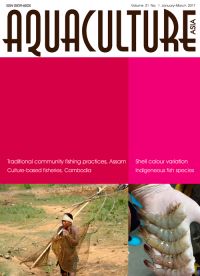
Aquaculture Asia Magazine, July-September 2015

In this issue:

Changes to the magazine and website. Status of alien fish species farming and it's implications for Andhra Pradesh, India. Bridging the research-extension-farmer-input and market linkage gap in coastal aquaculture through application of ICT. Bio-remediation of domestic sewerage recycled in aquaculture: A Central Institute of Freshwater Aquaculture model. Role of family farming in marine and coastal ecosystem management in India. Conservation of fish genetic resources: An introduction to the state fishes of India.

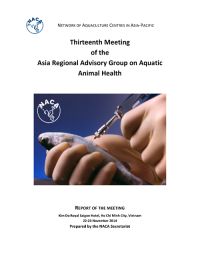
Report of the thirteenth meeting of the Asia Regional Advisory Group on Aquatic Animal Health, 22-23 November 2014

The Asia Regional Advisory Group on Aquatic Animal Health meets annually to discuss regional health issues including emerging disease threats. This report includes a review of regional disease status circa 2014, global and regional disease reporting arrangements, global issues and standards, progress in implementation of the the Regional Technical Guidelines on Health management for the Responsible Movement of Live Aquatic Animals, identification and designation of regional aquatic animal health resources and regional and international cooperation.

Results of a decade of R&D efforts on culture-based fisheries in Sri Lanka

Culture-based fisheries in village reservoirs of Sri Lanka is a communal activity involving agricultural farmers without prior experience in fisheries. Awareness programs have facilitated establishment of CBF in small village reservoirs. Dissemination of research findings through means such as production of a documentary film, publication of a monograph which was translated to several regional languages, and holding a series of regional workshops were instrumental for CBF development at the regional level.

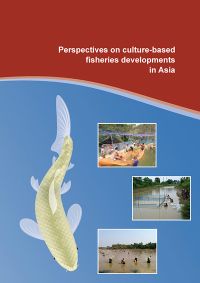
Perspectives on culture-based fisheries developments in Asia

This book is the proceedings of the “Regional Consultation on Culture-Based Fisheries Development in Asia”, held in Siem Reap, Cambodia, 21-23rd of October 2014, under the auspices of the Australian Centre for International Agricultural Research (ACIAR), the Mekong River Commission (MRC) and the Network of Aquaculture Centres in Asia-Pacific (NACA). The consultation was jointly organised by NACA and the Fisheries Administration of the Royal Government of Cambodia.

Aquaculture Asia Magazine, April-June 2015

In this issue:

Anti-microbials and alternatives. Successful demonstration of new model for rural development in Myanmar. Optimisation of Nile tilapia (Oreochromis niloticus) production in ponds based on improved farm management practices in Rwanda. EUS infection in freshwater fishes of Andhra Pradesh. Development of pond-reared broodstock / spawners of green mud crab Scylla serrata. ASEAN Gender Network launched. A two-tube nested PCR detection method for AHPND bacteria. 9th Regional Grouper Hatchery Production Training Course.

Aquaculture Asia Magazine, January-March 2015

Further training provided to aquaculturists in Fiji. Spatial planning for sustainable coastal shrimp production. Availability of grouper (Serranidae) fingerlings and seed in the coral reef of Son Tra Peninsula, central Viet Nam. Small-scale carp seed production through portable FRP hatchery at Khanguri, Odisha. Regional consultation on culture-based fisheries developments in Asia. Gender Assessment Synthesis Workshop. Broodstock management in aquaculture. Urgent appeal to control spread of the shrimp microsporidian parasite Enterocytozoon hepatopenaei (EHP).

Aquaculture Asia Magazine, October-December 2014

Promising aquaculture practices for sustainable intensification. Culture and breeding of Archcentrus spilurum at Tuticorin District of Tamil Nadu, India. Searching for ecological ways to reduce WSSV impact. Fisheries and aquaculture-based livelihoods prospects in East Kalimantan, Indonesia. Linking farms and landscapes in the governance of sustainable Vietnamese shrimp aquaculture. Resilience of shrimp farming based livelihoods in the Mekong Delta, Vietnam. Farming system affects the virulence of white spot syndrome virus (WSSV) in penaeid shrimp.

Aquaculture Asia Magazine, July-September 2014

In this issue:

Labour issues in the fishing and aquaculture industries. Commercial tilapia farming at take-off point in Fiji. Tank based captive breeding and seed production of the pearlspot (Etroplus suratensis). Cage culture of pearlspot in Kerala, India. Culture-based fisheries exchange visit from Lao PDR to Cambodia. National Fish Day, Cambodia. WAS Adelaide: Special Session on Regional Cooperation for Improved Biosecurity. Inbreeding and disease in tropical shrimp aquaculture: A reappraisal and caution.

Report of the twelfth meeting of the Asia Regional Advisory Group on Aquatic Animal Health, 11-13 November 2013

The Asia Regional Advisory Group on Aquatic Animal Health meets annually to discuss regional health issues including emerging disease threats. This report includes a review of regional disease status circa 2013, global and regional disease reporting arrangements, global issues and standards, progress in implementation of the the Regional Technical Guidelines on Health management for the Responsible Movement of Live Aquatic Animals, identification and designation of regional aquatic animal health resources and regional and international cooperation.