Hatchery and nursery

Information related to hatchery management, larval rearing and seed production in aquaculture.

Creative Commons Attribution.

Related

Subject tags

A collection of subject tags relating to technical matters.

In this collection

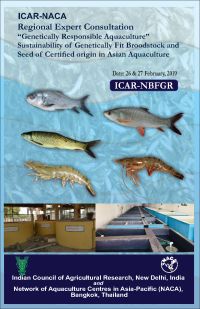
Expert Consultation on Genetically Responsible Aquaculture, Lucknow, India

The Indian Council of Agricultural Research (ICAR) and NACA will convene the consultation from 26-27 February 2019. The consultation will be hosted by the ICAR National Bureau of Fish Genetic Resources (NBFGR) in Lucknow, India. The aim of the consultation is to find ways to assure genetic quality in seed production systems. Experts will discuss broodstock management and mechanisms to verify seed origin and quality. The goal is to empower farmers and monitoring agencies with provision of quantifiable standards.

Training Course on Marine Finfish Seed Production and Grow-out, November, Thailand

The 9th Regional Training Course on Marine Finfish Seed production and Grow-out will be held from 19-30 November 2018 in Krabi, Thailand. The course will be taught by staff of the Krabi Coastal Fisheries Research and Development Centre. Drawing on expertise throughout the region, this three-week hands-on training course will provide participants with skills in marine finfish seed production and grow-out operations, with an emphasis on groupers and Asian seabass.

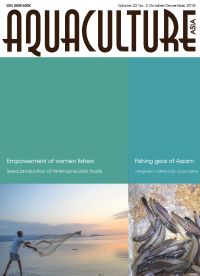
Aquaculture Asia Magazine, October-December 2018

In this issue:

Concept of seed production of Heteropneustes fossilis in farmers' fields in West Bengal, India; Fishing gear and practices in flood waters of Assam; Fisherwomen empowerment: Shedding light on the invisible gender; Integrated multi-trophic aquaculture systems: A solution of sustainability.

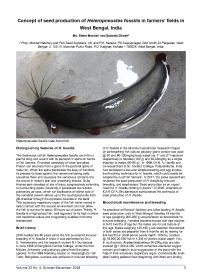
Concept of seed production of Heteropneustes fossilis in farmers' fields in West Bengal, India

The freshwater catfish Heteropneustes fossilis is a high-priced fish, well regarded in India for its nutritional and medicinal properties. The first successful induced breeding of this fish was in 1956 at Bangalore Central College (under the then Mysore University), although seed production was not standardised until 2000, at ICAR-CIFA, Bhubaneswar. This article describes broodstock maintenance, induced breeding techniques and the nursing of H. fossilis larvae in small ponds for sale in fish seed markets.

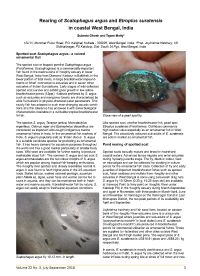
Rearing of Scatophagus argus and Etroplus suratensis in coastal West Bengal, India

In the ornamental fish markets of India, the euryhaline spotted scat Scatophagus argus and pearlspot Etroplus suratensis are popularly sold as ornamental fish. This article describes the nursing of wild-caught spotted scat seed and in-pond breeding of pearlspot to produce marketable sized fish at the Joykrishna hatchery and fish seed farm, located in the Hooghly River estuarine zone in coastal West Bengal, India. The fish are reared in brackishwater ponds for commercial utilisation as ornamental fish, supplying Hyderabad and other cities.

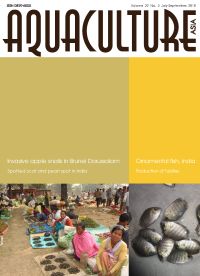
Aquaculture Asia Magazine, July-September 2018

In this issue:

Rearing of spotted scat and pearlspot in coastal West Bengal, India; harvesting Eurayle ferox (makhana) from wetland fisheries of Assam; prospects of ornamental fish culture in seasonal water bodies in Assam; production of tubifex, a new dimention in aquaculture in feeding juvenile fish; invasive apple snails in Brunei Darussalam; aquaculture trends and opportunities in Sindh, Pakistan; NACA Newsletter.

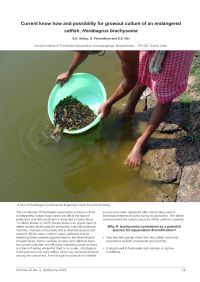
Current know-how and possibility for growout culture of an endangered catfish, Horabagrus brachysoma

Some varieties of freshwater fish have low growth potential but remain economically attractive due to market preferences. The endangered catfish Horabagrus brachysoma is one such fish, which has limited production but high market demand, and a number of favourable biological characteristics. This article provides guidelines for the culture of this catfish in captivity including for the breeding, nursery, stocking and growout, including advice on pre- and post-stocking practices, harvesting and health management.

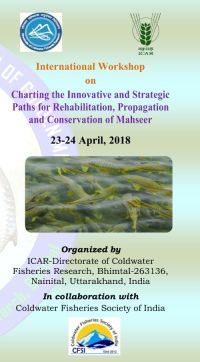
International Workshop on Rehabilitation, Propagation and Conservation of Mahseer, April, India

Despite their abundance at one time in India and other Asian nations, wild mahseer populations have been declining because of degradation of aquatic ecosystems, urbanisation and indiscriminate fishing. Wild mahseer are populations are presently struggling for their mere existence.

An international workshop on mahseer conservation, propagation and rehabilitation will be held in Bhimtal, India from 23-24 April 2018. The workshop is organised by the ICAR-Directorate of Coldwater Fisheries Research in collaboration with the Coldwater Fisheries Society of India.
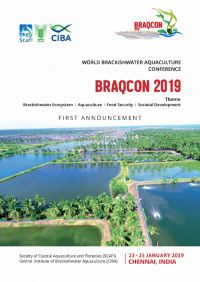
World Brackishwater Aquaculture Conference, 23-25 January 2019, Chennai, India

BRAQCON 2019 wil cover latest research and development in the broader themes of the conference in the form of special sessions, contributed papers, expert group discussions and brainstorming on issues facing aquaculturists and ecosystem managers in India and around the world. The conference themes include: Brackishwater ecosystems, estuarine biodiversity and conservation; aquaculture production systems; larviculture; fish and shellfish nutrition; environment and climate change; aquatic animal health; socio-economic and livelihood issues; and aquaculture genetics and biotechnology.

Video lectures: Regional Training Course on Culture-based Fisheries in Inland Waters

This collection contains video recordings of the lectures from the Regional Training Course on Culture-based Fisheries in Inland Waters, held at Nha Trang University, Vietnam. The objective of the course was to provide participants with the skills to assist local communities to plan and manage culture-based fisheries; a relatively simple and low cost technology that can deliver nutritional and economic benefits to rural communities with few livelihood options. The course was sponsored by the United Nations University Fisheries Training Programme.

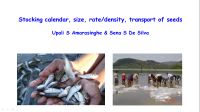
Stocking calendar, size, density and transport of seed

Better management practices for stocking and transport of seed for culture-based fisheries.

First training course on culture-based fisheries held in Nha Trang, Vietnam

The first ever Regional Training Course on Culture-based Fisheries in Inland Waters was held at Nha Trang University from 30 October to 8 November. The objective of the course was to provide participants with the skills to assist local communities to plan and manage culture-based fisheries. These practices are an example of a relatively simple and low cost technology that can deliver nutritional and economic benefits to rural communities, which often have few livelihood options.

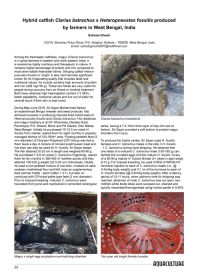
Hybrid catfish Clarias batrachus x Heteropneustes fossilis produced by farmers in West Bengal, India

Among the freshwater catfishes, magur (Clarias batrachus) is in great demand in eastern and north-eastern India; it is revered as highly nutritious and therapeutic in nature. During May-June 2016, Sri Sayer Mohammad Sarkar, an experienced magur breeder and seed producer, has achieved success in producing induced-bred hybrid seed of Heteropneustes fossilis and Clarias batrachus. His breeding protocol and experiences in nursery and growout of hybrid catfish are shared in this article.

Trout fisheries in the uplands of Arunachal Pradesh: Resources and opportunities

The potential for augmentation of fish production and fish-based eco-tourism in Arunachal Pradesh are immense. The landscape of the state is characterised by lofty mountains with snow-clad peaks, dense forests, turbulent streams and a rich diversity of flora and fauna. We review the potential of some of the lakes in the region to support trout fisheries for both recreational fishing and eco-tourism, with a view to providing job opportunities for highland communities.

Certificate Degree Programme on Sustainable Asian Aquaculture at AIT

The Asian Institute of Technology (AIT) is launching a new Certificate programme on Sustainable Asian Aquaculture via the AARM Academic programme, for one semester beginning August 2017. This certificate programme is a combination of well-designed course work and hands-on experience in specialised areas (fish/shrimp hatchery or farming). The programme is useful for both students (with credit transfer) and for working professionals and entrepreneurs (without credits).

Aquaculture Asia Magazine, April-June 2017

In this issue:

Inspiring story of aquaculture in Sikkim - a journey from conservation to farming; farming of scampi and tiger shrimp together - a case study from West Bengal; Labeo pangusia - a candidate for diversification of hill aquaculture; sustainability of an integrated livestock-fish-crop farming system as a small scale enterprise; sustainable coastal aquaculture in India; potential scope and prospects of domestic fish market in Chhattisgarh.

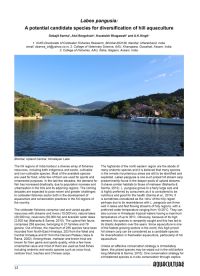
Labeo pangusia: A potential candidate species for diversification of hill aquaculture

Labeo pangusia is a highly prized hill stream carp found mainly in the deeper pools of upland streams. Heavy fishing pressure has led to depletion of wild populations in recent years and the species is likely to become threatened if a conservation strategy is not developed. We report on an investigation into the reproductive biology of this species and on the result of successful induced breeding trials.

Giant Prawn 2017

The fourth major international event on giant freshwater prawns was organised by the Asian Institute of Technology from 20-24 March 2007. The conference, organised by Salin Krishna and Michael New, built on a series of highly successful events that trace back to the very beginnings of the industry. The first conference, Giant Prawn 1980 brought together all those involved in freshwater prawn research and farming for the first time and set many priorities for future research and development.

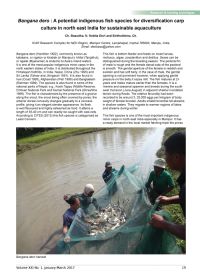
Bangana dero: A potential indigenous fish species for diversification of carp culture in north east India for sustainable aquaculture

Bangana dero is one of the most popular indigenous minor carps in the north eastern states of India, fetching triple the market prices of Indian major carps. B. dero is a bottom feeder and feeds on insect larvae, molluscs, algae, zooplankton and detritus. Over the last two decades the occurrence of wild juveniles of this fish in Indian rivers has fallen drastically. A protocol for induced breeding, larviculture, nursery rearing and growout including polyculture of B. dero is described.

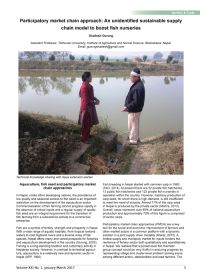
Participatory market chain approach: An unidentified sustainable supply chain model to boost fish nurseries

In Nepal, low quality and seasonal access to fish seed is an important restriction on the development of the aquaculture sector. Commercialisation of fish farming cannot progress rapidly in the absence of critical inputs and a regular supply of quality fish seed is an integral requirement for the transition of fish farming from a subsistence activity to a commercial enterprise. Participatory market chain approaches are a key tool for the social and economic improvement of farmers and market participants.