Inland aquaculture

Information relating to inland aquaculture practices.

Creative Commons Attribution.

Related

Subject tags

A collection of subject tags relating to technical matters.

In this collection

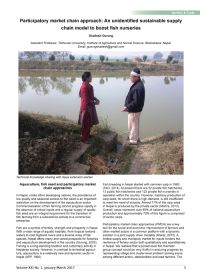
Participatory market chain approach: An unidentified sustainable supply chain model to boost fish nurseries

In Nepal, low quality and seasonal access to fish seed is an important restriction on the development of the aquaculture sector. Commercialisation of fish farming cannot progress rapidly in the absence of critical inputs and a regular supply of quality fish seed is an integral requirement for the transition of fish farming from a subsistence activity to a commercial enterprise. Participatory market chain approaches are a key tool for the social and economic improvement of farmers and market participants.

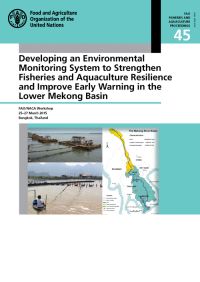
Developing an Environmental Monitoring System to Strengthen Fisheries and Aquaculture Resilience and Improve Early Warning in the Lower Mekong Basin

These are the proceedings of a consultation on the existence and effectiveness of environmental monitoring systems for fisheries and aquaculture in the Lower Mekong basin. The document provides a baseline assessment of environmental monitoring systems in Cambodia, Thailand and Vietnam and the report of a workshop to discuss the assessments findings and future steps towards an improved environmental monitoring and early warning system that will contribute to climate change adaptation in fisheries and aquaculture in the area.

15th meeting of the Asia Regional Advisory Group on Aquatic Animal Health

The 15th meeting was held from 21-23 November 2016, in Bangkok, Thailand. A special session was held on addressing the use of anti-microbial substances in aquaculture and the development of anti-microbial resistance. This is an issue of global concern for both human and animal health, and it had been addressed by a resolution at FAO’s Thirty-ninth Conference in June 2015. The meeting reviewed in detail the status of aquatic animal disease in the region.

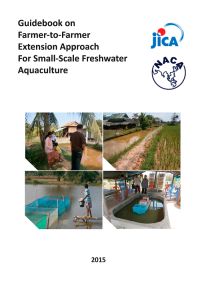
Development of a Guidebook on Farmer-to-Farmer Extension Approaches for Small-scale Aquaculture in the Asia-Pacific Region

The objectives of this project were to i) develop a guidebook in English on "Farmer-to-farmer extension approaches for small-scale aquaculture" and ii) to translate the developed guidebook into selected local dialects in Asia-Pacific and other regions (e.g. Africa). The project made use of the significant results from the JICA projects in Cambodia, Benin and other countries on farmer-to-farmer extension approaches on technology extension for small-scale farmers. The book is available in eleven languages (English, Arabic, Bahasa Indonesia, BurmeseFrenchKhmerLoatian, Malay, NepaliThai and Vietnamese.

Culture-based Fisheries Development in Lao PDR and Cambodia

Culture-based fisheries (CBF) are a useful development strategy for improving the income and food security of rural communities. CBF requires minimal capital outlay, mobilising farming communities to make use of existing small dams and reservoirs for the secondary purpose of foodfish production. The objective of this project is to introduce community-based CBF to Cambodia, and to consolidate the gains of communities that have adopted CBF in Lao PDR.

Development of regional code of practice for movement of aquatic organisms in the lower Mekong basin

The objective of this project was to develop an agreed code of practice for the transboundary movement of aquatic organisms that feeds into the fisheries management strategy for the lower Mekong basin. The code of practice provides guidance on risk management and mitigation measures be taken into account for live aquatic animal imports or other transfers that are part of the established commercial practice, or those related to scientific study at research facilities.

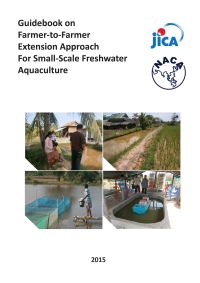
Guidebook on farmer-to-farmer extension approach for small-scale freshwater aquaculture

The success stories of many small-scale farmers in both Asian and African countries have brought insights on the effectiveness and self-sustaining mechanism of the farmer-to-farmer approach of aquaculture extension. This document will only serve as a guide on how to implement farmer-to-farmer approaches on small-scale freshwater aquaculture extension. Translations of the guidebook are available in Arabic, Bahasa Indonesia, Burmese, English, French, Khmer, Lao, Malay, Nepali and Thai.
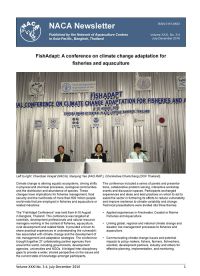
NACA Newsletter, Vol. XXXI, No. 3-4, July-December 2016

In this issue:

FishAdapt: A conference on climate change adaptation for fisheries and aquaculture. 11th Asian Fisheries and Aquaculture Forum convened in Bangkok. A new and improved PCR detection method for Enterocytozoon hepatopenaei (EHP) based on a gene encoding a spore wall protein. Radio interview on NACA's mission and role in regional food security. Quarterly Aquatic Animal Disease Report, Q1 2016. Guidebook on farmer-to-farmer extension approach for small-scale freshwater aquaculture. New NACA website in the works.

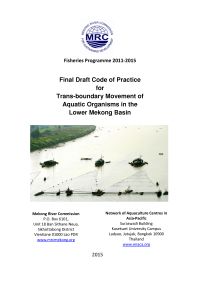
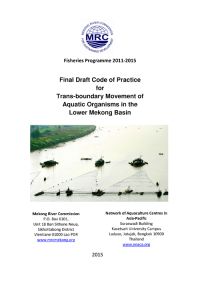
Final Draft Code of Practice for Trans-boundary Movement of Aquatic Organisms in the Lower Mekong Basin

This Code of Practice is prepared to promote or ensure compliance to World Trade Organisation-Sanitary and Phytosanitary measures for the movement of live aquatic organisms in the Lower Mekong Basin. The goals of the Code are to achieve environmental protection and management, biodiversity conservation as well as prevention of spread of disease epizootics. Most of the points listed in this Code are based on the inputs of MRC Member Countries.

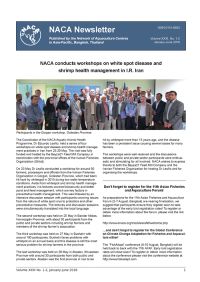
NACA Newsletter, Volume XXXI, No. 1-2, January-June 2016

In this issue:

NACA conducts workshops on white spot disease and shrimp health management in I.R. Iran. Don’t forget to register for the 11th Asian Fisheries and Aquaculture Forum! NACA pays tribute to Professor H.P.C. Shetty – Patron of the Pillay Aquaculture Foundation. EHP: Shrimp industry survey. 3rd International Conference on Fisheries and Aquaculture, 24-25 August, Negombo, Sri Lanka. Special Session on the Status of Aquatic Genetic Resources for Food and Agriculture. Second International Technical Workshop on Acute Hepatopancreatic Necrosis Disease (AHPND). Guidebook on Farmer-to-Farmer Extension Approach for Small-Scale Freshwater Aquaculture. Sustainable intensification of aquaculture in the Asia-Pacific region.

Regional workshop documents sustainable intensification practices in aquaculture

Due to the world’s rapidly growing population, which is expected to peak somewhere around 9.5 billion, food production will need to be massively increased over the next few decades. This increase must be achieved without further degrading the environment. The unit environmental footprint of food production must be significantly reduced from where it is today. This concept, termed sustainable intensification, applies as much to aquaculture as it does to other agricultural sectors.

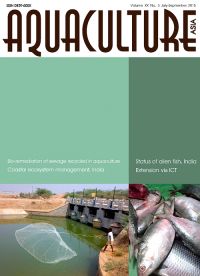
Aquaculture Asia Magazine, July-September 2015

In this issue:

Changes to the magazine and website. Status of alien fish species farming and it's implications for Andhra Pradesh, India. Bridging the research-extension-farmer-input and market linkage gap in coastal aquaculture through application of ICT. Bio-remediation of domestic sewerage recycled in aquaculture: A Central Institute of Freshwater Aquaculture model. Role of family farming in marine and coastal ecosystem management in India. Conservation of fish genetic resources: An introduction to the state fishes of India.

Summary of culture-based fisheries developments in Lao PDR

A summary of culture-based fisheries developments in Lao PDR based on publications, either in the primary literature, or as manuals and reports posted on the website of the Network of Aquaculture Centres in Asia-Pacific, that have originated from projects funded by the Australian Centre for International Agriculture research (ACIAR) since 1997.

Challenges and constraints for developing CBF in Cambodia and a possible strategy for success

The application of culture-based fisheries in Cambodian waters commenced with a project in sixteen small reservoirs located in four provinces. Initial consultations with the village communities responsible for the water regime management were held and their agreement obtained for monitoring and cooperating through the trial period. One common feature in all the reservoirs selected is the provision of a “conservation zone”, generally in the deeper areas of the water body, where fishing is prohibited.

Results of a decade of R&D efforts on culture-based fisheries in Sri Lanka

Culture-based fisheries in village reservoirs of Sri Lanka is a communal activity involving agricultural farmers without prior experience in fisheries. Awareness programs have facilitated establishment of CBF in small village reservoirs. Dissemination of research findings through means such as production of a documentary film, publication of a monograph which was translated to several regional languages, and holding a series of regional workshops were instrumental for CBF development at the regional level.

Potential of culture-based fisheries in Indonesian inland waters

Fish stocking in Indonesian lakes and reservoirs has been conducted for a long time. Since 1999, culture-based fisheries (CBF) practices based on scientific evidence such as using suitable fish species, consideration of the primary productivity, stocking density, economic evaluation and community participation, have been conducted in some reservoirs and lakes and have showed encouraging results. CBF is highly recommended and prioritised in small reservoirs with an area less than 200 ha.

Impact of introduction of culture-based fisheries on fish production in perennial reservoirs of Sri Lanka

Sri Lanka is blessed with a large number of irrigation reservoirs. Culture-based fisheries (CBF) in seasonal reservoirs was initiated in the 1980’s and the government has recognised CBF as an effective way of increasing fish supplies in rural areas, at affordable prices, while providing employment and income to farmers and thereby contributing towards alleviation of poverty. The role of fisher community based organisations and fisheries management for effecting successful CBF are discussed.

Culture-based fishery of giant freshwater prawn: Experiences from Thailand

Releasing of giant freshwater prawn (Macrobrachium rosenbergii) for the purposes of stock enhancement and to create a fishery has been conducted in Thailand since the 1980s. Average age at harvest is around 6 to 8 months, with an average total length of 20 cm. Overall, the success of stocking M. rosenbergii is poor since the recapture rate is generally less than 5 %. However, the economic return is high.

Culture-based fisheries in lakes of the Yangtze River basin, China, with special reference to stocking of mandarin fish and Chinese mitten crab

In this paper, the culture-based fisheries in lakes are presented, with special reference to mandarin fish and mitten crab stocking in lakes in China. The stocking rate of mandarin fish is determined by food consumption rates, which are mainly related to water temperature and fish size, and prey fish productivity. A bioenergetics model of mandarin fish was established to predict the growth and consumption of prey fish in stocked lakes.

Perspectives on culture-based fisheries developments in Asia

This book is the proceedings of the “Regional Consultation on Culture-Based Fisheries Development in Asia”, held in Siem Reap, Cambodia, 21-23rd of October 2014, under the auspices of the Australian Centre for International Agricultural Research (ACIAR), the Mekong River Commission (MRC) and the Network of Aquaculture Centres in Asia-Pacific (NACA). The consultation was jointly organised by NACA and the Fisheries Administration of the Royal Government of Cambodia.