Shrimp

Information relating to the aquaculture of marine shrimp.

Creative Commons Attribution.

Related

Species / commodity tags

Major farmed commodity or species groups.

In this collection

Report of the thirteenth meeting of the Asia Regional Advisory Group on Aquatic Animal Health, 22-23 November 2014

The Asia Regional Advisory Group on Aquatic Animal Health meets annually to discuss regional health issues including emerging disease threats. This report includes a review of regional disease status circa 2014, global and regional disease reporting arrangements, global issues and standards, progress in implementation of the the Regional Technical Guidelines on Health management for the Responsible Movement of Live Aquatic Animals, identification and designation of regional aquatic animal health resources and regional and international cooperation.

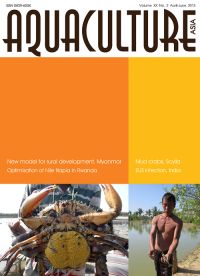
Aquaculture Asia Magazine, April-June 2015

In this issue:

Anti-microbials and alternatives. Successful demonstration of new model for rural development in Myanmar. Optimisation of Nile tilapia (Oreochromis niloticus) production in ponds based on improved farm management practices in Rwanda. EUS infection in freshwater fishes of Andhra Pradesh. Development of pond-reared broodstock / spawners of green mud crab Scylla serrata. ASEAN Gender Network launched. A two-tube nested PCR detection method for AHPND bacteria. 9th Regional Grouper Hatchery Production Training Course.

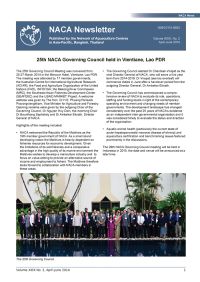
NACA Newsletter, Volume XXX, No. 2, April-June 2015

In this issue:

12th Technical Advisory Committee held in Cha-am, Thailand. Audio recordings: WAS special session on regional cooperation for improved biosecurity. AFSPAN Final Technical Report now available! Pillay Aquaculture Foundation Awards for Scientists in Least Developed Countries. Gender seminar conducted and ASEAN Gender Network launched. A two-tube, nested PCR detection method for AHPND bacteria. 9th Regional Grouper Hatchery Production Training Course. Developing an environmental monitoring system to strengthen fisheries and aquaculture in the Lower Mekong Basin. Asia-Pacific Regional Workshop on the Status of Aquatic Genetic Resources for Food and Agriculture.

Current progress in research on acute hepatopancreatic necrosis disease (AHPND) in Thailand

In early 2013, Vibrio parahaemolyticus was discovered as the causative agent of acute hepatopancreatic necrosis disease (AHPND). Subjecting 4 arbitrarily selected V. parahaemolyticus isolates obtained from a single farm in November 2012 to the previously reported immersion challenge protocol, we confirmed that 3 caused high mortality at different rates accompanied by characteristic lesions of AHPND while 1 caused high mortality without such lesions. Virulence may be determined by mobile genetic elements such as plasmids or bacteriophages.

World Aquaculture Adelaide: Special session on regional cooperation for improved biosecurity

A special session on Regional Cooperation for Improved Biosecurity was held at the World Aquaculture Adelaide 2014 conference, from 7-11 June. The session discussed i) regional cooperation in biosecurity, ii) dealing with emerging diseases, focussing on acute hepatopancreatic necrosis disease, and iii) domestication programmes and their implications for genetic diversity, disease susceptibility and resistance.
Factors driving the emergence and spread of new infectious diseases

The emergence and spread of new or previously unknown infectious diseases has had very significant impacts on public health, food security and international trade. Disease emergence is the consequence of environmental and/or sociological changes that disrupt the ecological relationship between pathogens and their natural hosts. Understanding the drivers of disease emergence will help us develop policies and practices that will reduce opportunities for disease emergence in aquaculture and improve prospects of containment.

A two-tube, nested PCR detection method for AHPND bacteria

A new method for the detection of AHPND-bacteria (AP4) has been published and is available for download. The advantage of the AP4 method over the previously published AP3 method is that it has 100 times higher sensitivity. Because of its higher sensitivity, the bacterial culture enrichment step needed when using the AP3 with low levels of AHPND bacteria may be omitted. However, the AP4 method should not be considered as a replacement for AP3.

Aquaculture Asia Magazine, January-March 2015

Further training provided to aquaculturists in Fiji. Spatial planning for sustainable coastal shrimp production. Availability of grouper (Serranidae) fingerlings and seed in the coral reef of Son Tra Peninsula, central Viet Nam. Small-scale carp seed production through portable FRP hatchery at Khanguri, Odisha. Regional consultation on culture-based fisheries developments in Asia. Gender Assessment Synthesis Workshop. Broodstock management in aquaculture. Urgent appeal to control spread of the shrimp microsporidian parasite Enterocytozoon hepatopenaei (EHP).

NACA Newsletter, Volume XXX, No. 1, January-March 2015

In this issue:

Regional consultation on culture-based fisheries developments in Asia. Gender Assessment Synthesis Workshop. NACA participation in the 5th Global Symposium on Gender in Aquaculture and Fisheries, Lucknow, India. Broodstock Management in Aquaculture: Long term effort required for regional capacity building. Urgent appeal to control spread of the shrimp microsporidian parasite Enterocytozoon hepatopenaei (EHP).

Urgent appeal to control spread of the shrimp microsporidian parasite Enterocytozoon hepatopenaei (EHP)

Enterocytozoon hepatopenaei (EHP) is a microsporidian parasite that was first characterized and named from the giant or black tiger shrimp Penaeus monodon from Thailand in 2009. EHP is confined to the shrimp hepatopancreas (HP) and morphologically resembles an unnamed microsporidian previously reported in the HP of Penaeus japonicas from Australia in 2001. Together, these studies suggest that EHP is not an exotic pathogen but that it is endemic to Australasia.

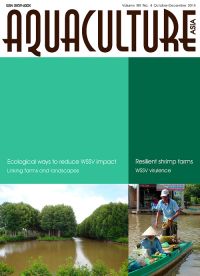
Aquaculture Asia Magazine, October-December 2014

Promising aquaculture practices for sustainable intensification. Culture and breeding of Archcentrus spilurum at Tuticorin District of Tamil Nadu, India. Searching for ecological ways to reduce WSSV impact. Fisheries and aquaculture-based livelihoods prospects in East Kalimantan, Indonesia. Linking farms and landscapes in the governance of sustainable Vietnamese shrimp aquaculture. Resilience of shrimp farming based livelihoods in the Mekong Delta, Vietnam. Farming system affects the virulence of white spot syndrome virus (WSSV) in penaeid shrimp.

Aquaculture Asia Magazine, July-September 2014

In this issue:

Labour issues in the fishing and aquaculture industries. Commercial tilapia farming at take-off point in Fiji. Tank based captive breeding and seed production of the pearlspot (Etroplus suratensis). Cage culture of pearlspot in Kerala, India. Culture-based fisheries exchange visit from Lao PDR to Cambodia. National Fish Day, Cambodia. WAS Adelaide: Special Session on Regional Cooperation for Improved Biosecurity. Inbreeding and disease in tropical shrimp aquaculture: A reappraisal and caution.

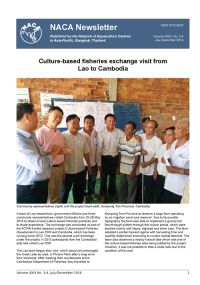
NACA Newsletter, Volume XXIX, No. 3-4, July-December 2014

In this issue:

Culture-based fisheries exchange visit from Lao to Cambodia. National Fish Day, Cambodia. WAS Adelaide: Special Session on Regional Cooperation for Improved Biosecurity. Inbreeding and disease in tropical shrimp aquaculture: a reappraisal and caution. Shrimp EMS/AHPND Special Session at DAA9. 2nd International Symposium on Aquaculture and Fisheries Education. Report on Sustainable Fisheries and Aquaculture for Food Security and Nutrition.

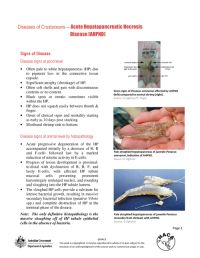
Acute Hepatopancreatic Necrosis Disease Card (updated June 2014)

Acute hepatopancreatic necrosis disease (AHPND) has recently been found to be caused by a pathogenic strain of Vibrio parahaemolyticus. This updated disease card provides a summary and guidance on disease signs at the pond level, at the animal level by histopathology, molecular diagnostic tools, host range, presence in Asia-Pacific, prevention and control and links to further information.

A new and improved PCR method for detection of AHPND bacteria

We describe a new method for detecting isolates of Vibrio parahaemolyticus that cause acute hepatopancreatic necrosis disease (AHPND). This method is based on the gene sequence of a protein discovered in a sub-fraction of cell-free culture broth from isolates of V. parhaemolyticus that cause AHPND, but not from V. parahaemolyticus or other bacteria that do not cause AHPND. This cell-free preparation caused the typical signs of acute AHPND when administered to shrimp by reverse gavage. 

Inbreeding and disease in tropical shrimp aquaculture: a reappraisal and caution

The disease crisis facing shrimp aquaculture may be propelled, in part, by an interaction between management practices that cause inbreeding, and the amplification by inbreeding of susceptibility to disease and environmental stresses. The study describes and numerically simulates gene flow from Penaeus (Litopenaeus) vannamei hatcheries that employ a ‘Breeder Lock’ to discourage use of their PL as breeders, through ‘copy hatcheries’ that breed the locked PL, to inbred shrimp in farm ponds. 

AHPND detection discussion group established

A Google Group on AHPND detection has been established to promote communication about the two AHPND detection methods (AP1 and AP2) that Dr Chu-Fang Lo and Dr Tim Flegel announced on 24 December 2013. The purpose of the group is to allow people using the methods to send in their comments and experiences about use of these two methods and other methods that might be developed.

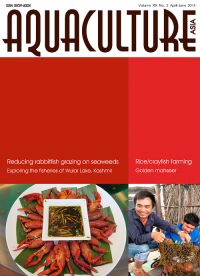
Aquaculture Asia Magazine, April-June 2014

In this issue:

Integrated rice/crayfish farming in Hubei Province, China. Improvement of seaweed Kappaphycus alvarezii culture production by reducing grazing by rabbit fish (Siganus spp.). Exploring the fisheries of Wular Lake, Kashmir, India. Golden mahseer Tor putitora - a possible candidate species for hill aquaculture. Free primers for specific detection of bacterial isolates that cause acute hepatopancreatic necrosis disease. Special session on regional cooperation for improved biosecurity. AHPND detection discussion group established.

NACA Newsletter, Volume XXIX, No. 2, April-June 2014

In this issue:

25th NACA Governing Council held in Vientiane, Lao PDR. Dr Cherdsak Viripat elected as next Director General of NACA. 9th Symposium on Diseases in Asian Aquaculture 24-28 November 2014, Vietnam. NACA to convene the 11th AFS Asian Fisheries and Aquaculture Forum. Free primers for specific detection of bacterial isolates that cause acute hepatopancreatic necrosis disease. World Aquaculture Adelaide 2014: Special session on regional cooperation for improved biosecurity. AHPND detection discussion group established. OIE Regional Workshop on Emerging Aquatic Animal Disease Response, in collaboration with NACA, Bali, Indonesia. United Kingdom - Southeast Asia Workshop on Sustainable Aquaculture.

Report of the twelfth meeting of the Asia Regional Advisory Group on Aquatic Animal Health, 11-13 November 2013

The Asia Regional Advisory Group on Aquatic Animal Health meets annually to discuss regional health issues including emerging disease threats. This report includes a review of regional disease status circa 2013, global and regional disease reporting arrangements, global issues and standards, progress in implementation of the the Regional Technical Guidelines on Health management for the Responsible Movement of Live Aquatic Animals, identification and designation of regional aquatic animal health resources and regional and international cooperation.