Shrimp

Information relating to the aquaculture of marine shrimp.

Creative Commons Attribution.

Related

Species / commodity tags

Major farmed commodity or species groups.

In this collection

NACA Newsletter, Vol. XXXX, April-June 2025

In this issue:

  • Report of the 23rd Asia regional Advisory Group on Aquatic Animal Health.
  • Sign up for our new Email Newsletter!
  • AQUAINNOVATE: An AquaHub Event.
  • Workshop on sustainable brine shrimp Artemia cultivation, 17 February, Tashkent.
  • Tuskfish CMS V2.1 released.
  • TCRS Shrimp Summit to spotlight issues.
  • Global Artemia Summit: 27 June, Entebbe, Uganda.

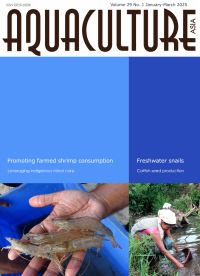
Aquaculture Asia Magazine, January-March 2025

In this issue:

  • Promoting farmed shrimp consumption in India’s domestic market: A step towards sustainability
  • Leveraging indigenous minor carp for sustainable aquaculture in Northeast India
  • Shaping the future of Indian aquaculture: A path to captive catfish seed success
  • Sustainable freshwater snail farming: Advancing nutrition security and rural livelihoods in Northeast India
  • Promotion and protection of small fish species through farming: An initiative in Tripura
  • NACA Newsletter

TCRS Shrimp Summit To Spotlight Issues Driving Industry Changes

PORTSMOUTH, NH:  Shrimp experts from around the world will gather in Bali this June for the third annual TCRS Shrimp Summit—a one-of-a-kind event that explores the issues impacting the industry's health and future, from the pond to the market. The summit is unique not just because it represents the full value chain, including major buyers, but because it spotlights the topics, both technical and tactical, that are driving change.

This year's Summit, which takes place 22-25 June, 2025, introduces several new sessions that demonstrate the event's role as a singular forum for investigating the issues that matter.

One such issue is Shrimp Welfare, particularly the use of eyestalk ablation for rapid egg production. Dr. Simão Zacarias, one of the session speakers and a recipient of the 2020 Global Aquaculture Innovation Award, says that, "although eyestalk ablation can boost egg production, it is also associated with female broodstock stress, physiological imbalance, mortality, and compromised diseas resistance in offspring."
Promoting farmed shrimp consumption in India’s domestic market: A step towards sustainability

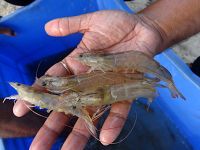
India's shrimp farming industry plays a crucial role in the national economy, with Penaeus vannamei dominating production and exports. Despite India being one of the world's largest shrimp producers, domestic shrimp consumption remains low. This article explores the economic significance of farmed shrimp, the challenges faced by shrimp farmers in West Bengal, and the potential for expanding the domestic market to enhance industry sustainability. Promoting farmed shrimp consumption within India is a viable strategy to stabilize the industry. Increasing consumer awareness of shrimp’s health benefits, developing efficient distribution networks, and leveraging marketing initiatives could enhance domestic demand. Government agencies, industry associations, and private enterprises must collaborate to establish shrimp as a mainstream protein source in Indian diets, thereby ensuring long-term sustainability for shrimp farmers.

Reported Aquatic Animal Diseases in the Asia-Pacific Region during the Second Quarter of 2024

With the implementation of the new aquatic animal disease reporting in the Asia Pacific region from January 2021 NACA is publishing reported aquatic animal diseases submitted by countries in the Asia-Pacific region. This report covers the second quarter of 2024 and the original and updated reports can be accessed from the QAAD page.

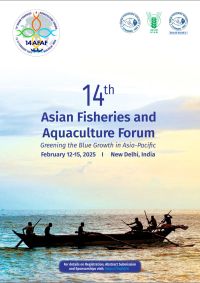
14th Asian fisheries and Aquaculture Forum: Early bird closes 10 November

The 14th Asian Fisheries and Aquaculture Forum (14AFAF) will be held from 12-15 February 2025 in New Delhi, India. Submission of abstracts has been extended until 5 November, and early bird registration closes on 10 November, so get in quick!

The forum is a scientific meeting organised by the Asian Fisheries Society (AFS) once every three years to understand the global trends and address issues and challenges faced by the fisheries and aquaculture sector. The main purpose of this Forum is to provide an international platform for eminent scientists, young researchers, and other stakeholders across the globe to share their research experiences and innovative ideas. By facilitating the exchange of diverse range of knowledge and expertise, the Forum with the Theme ‘Greening the Blue Growth in Asia-Pacific’ aims to address key issues towards developing sustainable fisheries and aquaculture.

Reported Aquatic Animal Diseases in the Asia-Pacific Region during the First Quarter of 2024

With the implementation of the new aquatic animal disease reporting in the Asia Pacific region from January 2021, and in lieu of the published QAAD Reports (last issue published was 4th quarter of 2020), NACA is publishing reported aquatic animal diseases submitted by countries in the Asia-Pacific region. This report covers the first quarter of 2024 and the original and updated reports can be accessed from the QAAD page.

Free seminar: To vaccinate or not to vaccinate, 20 June 2024 (hybrid event)

This event, held jointly via Zoom or in person at FAO Headquarters in Rome, will bring together leading experts to delve into the topic of fish vaccination and new developments regarding shrimp vaccination as a vital biosecurity strategy. Current knowledge will be reviewed, examining obstacles, and uncovering opportunities for vaccine development. Bridging theory with actionable practice, the seminar aims to foster informed decision-making, discussing the potential of vaccination and addressing associated challenges. Building upon the success of the Tilapia Health webinar held in December 2021 and Tilapia health: quo vadis, this conference will be a continuation of impactful discussions, promising a dynamic and enriching experience for all participants.

Reported Aquatic Animal Diseases in the Asia-Pacific Region during the Fourth Quarter of 2023

With the implementation of the new aquatic animal disease reporting in the Asia Pacific region from January 2021, and in lieu of the published QAAD Reports (last issue published was 4th quarter of 2020), NACA is publishing reported aquatic animal diseases submitted by countries in the Asia-Pacific region. This report covers the fourth quarter of 2023 and the original and updated reports can be accessed from the QAAD page.

Reported Aquatic Animal Diseases in the Asia-Pacific Region during the Third Quarter of 2023

With the implementation of the new aquatic animal disease reporting in the Asia Pacific region from January 2021, and in lieu of the published QAAD Reports (last issue published was 4th quarter of 2020), NACA is publishing reported aquatic animal diseases submitted by countries in the Asia-Pacific region. This report covers the third quarter of 2023 and the original and updated reports can be accessed from the QAAD page

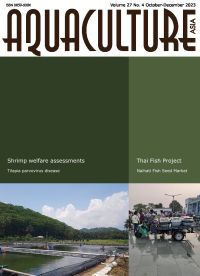
Aquaculture Asia Magazine, October-December 2023

In this issue:

  • How welfare assessments of farmed white leg shrimp (Penaeus vannamei) can benefit the whole industry
  • Thai Fish Project: A path towards a sustainable aquaculture
  • Nationally-recognised ornamental fish breeder Kripan Sarkar - a man to remember
  • Tilapia parvovirus disease: An emerging threat for the tilapia aquaculture industry
  • Naihati fish seed market as state-of-the-art for sustainable support services to fish growers, buyers and traders
  • NACA Newsletter

Thai Fish Project: A path towards a sustainable aquaculture

The Thai Fish Project began in 2019, and involves around 200 research members and multiple institutions in Thailand and Japan. The project aims to promote domestication and wise use of two Thai native aquatic species, namely the Asian sea bass Lates calcarifer and banana shrimp Penaeus merguiensis through increasing productivity, reducing the impact of infectious diseases, and preserving genetic resources. The project also encompasses several specific research topics to ensure that it comprehensively addresses the concerns on safeguarding the food security and enhancing the environmental sustainability as much as possible. This article describes the main research activities, outputs and future expectations of the Thai Fish Project.

How welfare assessments of farmed white leg shrimp (Penaeus vannamei) can benefit the whole industry

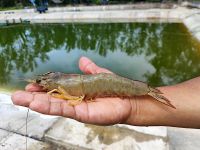
The welfare of decapod crustaceans, the largest group of farmed animals worldwide, is gaining prominence in the aquaculture industry. Taking better care of the billions of shrimp farmed annually not only responds to certification standards and consumer demand, it is the right thing to do. Embracing a welfare approach has the potential to address current challenges in shrimp farming by providing insights into farming conditions and animal health, ultimately boosting production performance. Recording welfare data enhances transparency along the supply chain, ensuring that every actor, from hatcheries to shrimp buyers, understands the quality of the breeder, post larvae, or shrimp they purchase. This article also details a free online training course on shrimp welfare created by FAI Farms.

Reported Aquatic Animal Diseases in the Asia-Pacific Region during the Second Quarter of 2023

With the implementation of the new aquatic animal disease reporting in the Asia Pacific region from January 2021, and in lieu of the published QAAD Reports (last issue published was 4th quarter of 2020), NACA is publishing reported aquatic animal diseases submitted by countries in the Asia-Pacific region. This report covers the second quarter of 2023 and the original and updated reports can be accessed from the QAAD page

NACA Newsletter, Vol. XXXVIII, July-September 2023

In this issue:

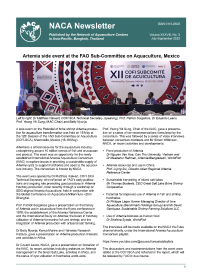
Artemia side event at the FAO Sub-Committee on Aquaculture, Mexico; Great Salt Lake Brine Shrimp Fishery Meets MSC’s Fishery Standard; Reported Aquatic Animal Diseases in the Asia-Pacific Region during the Fourth Quarter of 2022; Report of the 21st Asia Regional Advisory Group on Aquatic Animal Health; Thai Fish Project; NACA participates in Coordinating Working Parties on Fisheries Statistics; NACA signs MOU with Cagayan Valley R&D Consortium; Shrimp Summit, 24-26 July, Ho Chi Minh City, Vietnam.

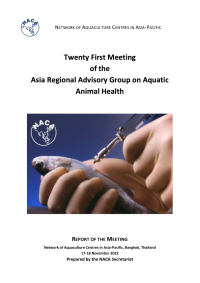
Report of the 21st Asia Regional Advisory Group on Aquatic Animal Health

This report summaries the proceedings of the 21st meeting of the Regional Advisory Group on Aquatic Animal Health, held 17-18 November 2022. The role of the group is to review trends in disease and emerging threats in the region, identify developments in global disease issues and standards, to evaluate the Quarterly Aquatic Animal Disease Reporting Program and to provide guidance on regional strategies to improve aquatic animal health management.

Shrimp Summit, 24-26 July, Ho Chi Minh City, Vietnam

The 2023 Shrimp Summit will convene the global seafood value chain to address the critical challlenges of Asia’s shrimp-farming sector, from stagnant production to growers’ livelihoods, with a cross-topic focus on sustainability and climate change. The Summit is presented by The Center for Responsible Seafood (TCRS) and co-hosted by the Global Seafood Alliance. The format of the 2023 Shrimp Summit will allow the industry to develop a common understanding of issues, address key challenges through discussion and work toward consensus and actionable solutions. This in-person and virtual event will feature discussions, relevant content and informative webinars before, during and after the event in the TCRS Online Community. Access to the online community is included with event registration.

13th Asia-Pacific Marine Biotechnology Conference, 2-6 October 2023, Australia

The 13th APMBC and 5th ANZMBS conference are combining to engage marine biotechnologists, industry, investors, and policy makers in current marine biotechnology research, and industry development in the Asia-Pacific region. The conference will be held from 2-6 October 2023 in Adelaide, Australia. This provides a great opportunity to participate in the growth and future development of the marine biotechnology industry in the region and globally. A key objective of the joint Conference is to encourage academic-industry partnerships across the region. Abstract submissions and early bird registrations are now open!

NACA Newsletter, Vol. XXXVIII, April-June 2023

In this issue:

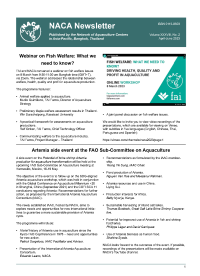
Webinar on fish welfare: What we need to know? Artemia side event at the FAO Sub-Committee on Aquaculture; Handbook for Artemia pond culture in Bangladesh; NACA YouTube channel: @aquacultureasia; Reported aquatic animal diseases in the Asia-Pacific region during the third quarter of 2022; 13th Asia-Pacific Marine Biotechnology Conference, 2-6 October 2023, Australia; Global Seafood Trade Fair, 28-30 June, Guangzhou, China.

Reported Aquatic Animal Diseases in the Asia-Pacific Region during the Third Quarter of 2022

With the implementation of the new aquatic animal disease reporting in the Asia Pacific region from January 2021, and in lieu of the published QAAD Reports (last issue published was 4th quarter of 2020), NACA is publishing reported aquatic animal diseases submitted by countries in the Asia-Pacific region.  This report covers the third quarter of 2022 and the original and updated reports can be accessed at the QAAD page