Shrimp

Information relating to the aquaculture of marine shrimp.

Creative Commons Attribution.

Related

Species / commodity tags

Major farmed commodity or species groups.

In this collection

Wenzhou virus 8 (WZV8) diagnosis by unique inclusions in shrimp hepatopancreatic E-cells and a molecular detection method

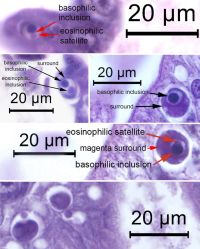
To assist shrimp pathologists worldwide we are providing here photomicrographs of unique basophilic inclusions that are produced by Wenzhou shrimp virus 8 (WZV8),  discovered in 2015 by Li et. al. We designed PCR primers and in situ hybridization probes for detection of WZV8. Subsequent ISH assays with shrimp RT-PCR positive for WZV8 samples indicate unique inclusions described herein as linked to WZV8 in H&E stained tissues. Going back over our previous histological reports and archived slides, we have found the unique WZV8 inclusions in E-cells of normal shrimp samples from several shrimp farming countries in Austral-Asia since at least 2008, and more recently in samples of P. vannamei from the Americas. We urge shrimp pathologists to review their records and specimens for the presence of WZV8 E-cell inclusions described herein to provide data on the global prevalence and impact of WZV8-like infections.

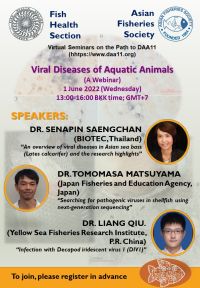
Free FHS Webinar: Viral Diseases of Aquatic Animals

The Fish Health Section of the Asian Fisheries Society is inviting you to a Zoom Webinar on Viral Diseases of Aquatic Animals, 1 June at 13:00 Bangkok time (GMT +7).

Participation is free but advance registration is required.

Twentieth Meeting of the Asia Regional Advisory Group on Aquatic Animal Health

This report summaries the proceedings of the 20th meeting of the Regional Advisory Group on Aquatic Animal Health, held 4-5 November 2021. The meeting discussed: Progress on NACA’s Asia Regional Aquatic Animal Health Program; updates from the OIE Aquatic Animal Health Standards Commission; aquaculture biosecurity; Progressive Management Pathway for Improving Aquaculture Biosecurity activities relevant to Asia; a systematic approach for quantifying biosecurity measures in aquaculture; aquatic animal health strategy; updates on the OIE Regional Collaboration Framework on Aquatic Animal Health; and updates on the QAAD Reporting and Disease List.

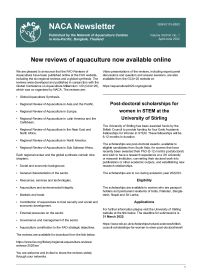
NACA Newsletter, Vol. XXXVII, April-June 2022

In this issue:

New reviews of aquaculture now available online; Post-doctoral scholarships for women in STEM at the University of Stirling; Research breakthrough seen to curb shortage of "poor man's fish"; Free online aquaculture courses; Fishing for life 2022: South and South-East Asian Conference on Small Scale Fisheries and Aquaculture; Reported Aquatic Animal Diseases in the Asia-Pacific Region during the Third Quarter of 2021; Shrimp 2022: INFOFISH World Shrimp Trade Conference and Exhibition; Tuskfish CMS v2.0.3 available.

FAO Reviews of Aquaculture now available online

We are pleased to announce that the FAO Reviews of Aquaculture have been published online at the FAO website, including the six Regional Reviews and a Global Synthesis, which were developed and published in conjunction with the Global Conference on Aquaculture Millennium +20 (GCA+20). The publications are linked below. Video presentations of the reviews, including expert panel discussions and question and answer sessions, are also available from the GCA+20 website.

Reported Aquatic Animal Diseases in the Asia-Pacific Region during the First and Second Quarters of 2021

With the implementation of the new aquatic animal disease reporting in the Asia Pacific region from January 2021, and in lieu of the published QAAD Reports (last issue published was 4th quarter of 2020), NACA will be reporting aquatic animal diseases that are occurring or present in the countries of the region, on quarterly basis.  This report covers the first and second quarters of 2021 and the original and updated reports are also available.   

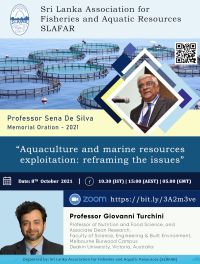
Professor Sena De Silva Memorial Oration, 8 October 2021

Join us on 8 October 2021 for the Professor Sena De Silva Memorial Oration. The topic for the oration is "Aquaculture and marine resources exploitation: reframing the issues", presented by Professor Govanni Turchini of Deakin University and organised by the Sri Lanka Association for Fisheries and Aquatic Resources. The oration will be held at 05:00 GMT (15:00 AEST) via Zoom. To participate, please use the following link: Professor Sena De Silva Memorial Oration 2021.

Webinar: Status of Artemia cyst use in fish and crustacean hatcheries

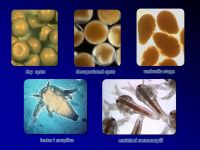
Join us on 2 September at 12 noon GMT for a free webinar on the Status of the use of Artemia cysts in fish and crustacean hatcheries around the world. The webinar is facilitated by the International Artemia Aquaculture Consortium (under formation). The webinar will document differences in practices used by fish and crustacean hatcheries in the use of Artemia cysts for the preparation of live feeds. Speakers include technical experts using Artemia in the production of shrimp, freshwater prawn, mud and mitten crabs, seabass, sabream and other marine fish from Bangladesh, Brazil, China, Ecuador, Greece, India, Spain, and Thailand. Participation is free but registration is required.
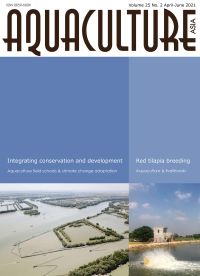
Aquaculture Asia Magazine, April-June 2021

In this issue:

Integrated taxonomy, conservation and sustainable development: Multiple facets of biodiversity; A note on 100th birth anniversary of the late Dr Hiralal Chaudhuri; Aquaculture field schools supporting mangroves for climate change adaptation of Indonesian milkfish-shrimp farmers; An insight to red tilapia breeding and culture: A farmer advisory; Aquaculture for livelihoods and food security in North-western India; NACA Newsletter.

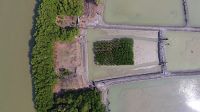
Aquaculture field schools supporting mangroves for climate change adaptation of Indonesian milkfish-shrimp farmers

Over the last five decades, over 30 million people along Java’s north coast have experienced subsidence and subsequent soil erosion. In 2015, Building with Nature Indonesia (BwNI-Demak) started a coastal protection project in 10 communities of nine coastal villages of Demak regency. The protection measures introduced included the use of permeable structures (dams) that successfully capture sediment and support natural recovery of mangroves, and aquaculture field schools, to train small-scale farmers on good aquaculture practices such as low external inputs sustainable aquaculture, associated mangrove aquaculture and multi-trophic srhimp aquaculture.

Integrated taxonomy, conservation and sustainable development: Multiple facets of biodiversity

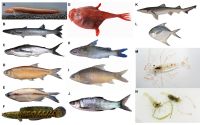
Focussed explorations from the ICAR-National Bureau of Fish Genetic Resources (NBFGR), an organisation mandated for cataloguing of genetic resources of India include surveys of various ecosystems ranging from fauna of deep sea to the high-altitude regions of the Himalaya, falling under diverse biogeographic zones and unexplored regions of the country, including North-eastern India, Western Ghats, Lakshadweep and the Andaman and Nicobar Islands. This article describes the results of these efforts, which include discovery of 14 new fish species and six new distribution records between 2015 to 2020.

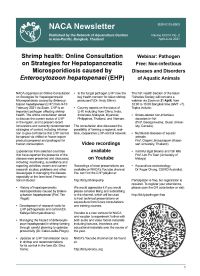
NACA Newsletter, Vol. XXXVI, April-June 2021

In this issue:

Shrimp health: Online Consultation on Strategies for Hepatopancreatic Microsporidiosis caused by Enterocytozoon hepatopenaei (EHP); Webinar: Pathogen Free: Non-infectious Diseases and Disorders of Aquatic Animals; Quarterly Aquatic Animal Disease Report, July-September 2020; Register for the Global Conference on Aquaculture Millennium +20; Scholarship opportunity: Lancang-Mekong Rice-Fish Programme; International Artemia Aquaculture Consortium.

Report of the Nineteenth Meeting of the Asia Regional Advisory Group on Aquatic Animal Health

This report summarises the proceedings of the 19th meeting of the Advisory Group, held 26-27 November 2020 via video conference. The group's role includes reviewing disease trends and emerging threats in the region, identifying developments in global aquatic disease issues and standards, evaluating the Quarterly Aquatic Animal Disease Reporting Programme and providing guidance on regional strategies to improve aquatic animal health management.

Shrimp health: Videos from the EHP consultation now available on Youtube

Video recordings of technical presentations from the Online Consultation on Strategies for Hepatopancreatic Microsporidiosis caused by Enterocytozoon hepatopenaei (9-10 February 2021) are now available for viewing via Youtube. Presentations include information on the history of EHP, development of research tools, transmission route and recommendations for its control on farm.

Please visit NACA's Youtube channel to access the videos. Our Youtube channel is brand new, please consider subscribing for more technical aquaculture videos!

Quarterly Aquatic animal Disease Report, July-September 2020

The 87th edition of the Quarterly Aquatic Animal Disease Report contains information from fifteen governments. The foreword discusses the 19th Meeting of the Asia Regional Advisory Group on Aquatic Animal Health, held 26-27 November 2020.

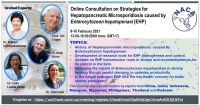
Shrimp health: Online Consultation on Strategies for Hepatopancreatic Microsporidiosis caused by Enterocytozoon hepatopenaei (EHP)

NACA is organising an Online Consultation on Strategies for Hepatopancreatic Microsporidiosis caused by Enterocytozoon hepatopenaei (EHP) from 9-10 February 2021 via Zoom. EHP is an important pathogen affecting shrimp health. The online consultation aims to discuss the current status of EHP in the region, and to present recent innovations and currently recommended strategies of control (including information to give confidence that EHP cannot be spread via chilled or frozen export products prepared and packaged for human consumption). Experiences from selected countries which have reported the presence of the disease will be presented and discussed. Participation is free but registration is required.
Aquaculture Asia Magazine, January-March 2021

In this issue:

Exotic trout fisheries resources and potentialities in Uttarakhand; Scenario of captive production of Clarias magur in India; Strategies to reduce feed cost by improving gut health and nutrient utilisation of fish in aquaculture; Fish pituitary gland collection and supply as a vocation in West Bengal, India; Coral trout Plectropomus leopardus aquaculture research and fingerling production in Indonesia; Smartphone app improving smallholder shrimp farming practices in Bangladesh; NACA Newsletter.

Smartphone app improving smallholder shrimp farming practices in Bangladesh

The Shrimp Farming BD App contains information on improved technologies - from pond preparation through to harvest - and has a calculator that farmers can use to work out the quantities of chemicals, feeds and other inputs they need for their pond. Also incorporated is a Frequently Asked Questions (FAQ) page where users can find answers to common questions with a single click: and they can send specific technical questions to SAFETI specialists online and receive an answer back within hours. The app can also be used to post news messages, and a link to market prices is planned. 

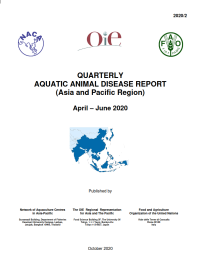
Quarterly Aquatic Animal Disease Report, April-June 2020

The 86th edition of the Quarterly Aquatic Animal Disease Report contains information from fifteen governments. The foreword provides a discussion of a webinar on decapod iridescent virus 1 (DIV1), held on 20 August 2020.

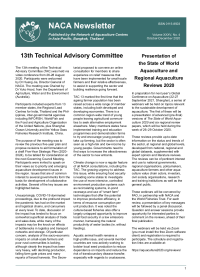
NACA Newsletter, Vol. XXXV No. 4, October-December 2020

In this issue:

13th Technical Advisory Committee; Presentation of the State of World Aquaculture and Regional Aquaculture Reviews 2020; Online training course on mariculture technologies for the Asia-Pacific region; Quarterly Aquatic Animal Disease Report, January-March 2020; Regional Webinar on Infection with Decapod Iridescent Virus 1 (DIV1) and Preparedness for Emerging Shrimp Diseases; China announces import measures to respond to nucleic acid positives of COVID-19 detected from the outer packaging of frozen white leg shrimp from Ecuador.