NACA member governments are: Australia, Bangladesh, Cambodia, China, Hong Kong SAR, India, Indonesia, I.R. Iran, Kingdom of Saudi Arabia, Korea (DPR), Lao PDR, Malaysia, Maldives, Myanmar, Nepal, Pakistan, Philippines, Sri Lanka, Thailand and Vietnam.
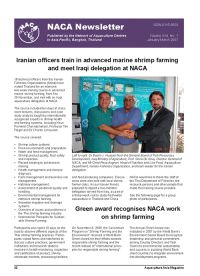
Iranian officers train in advanced marine shrimp farming and meet Iraqi delegation at NACA. Green award recognises NACA work on sustainable shrimp farming. International Principles for Responsible Shrimp Farming now available in Spanish. Building capacity on aquatic animal epidemiology in I.R. Iran. NACA Fisheries Team meets with new Governor of Aceh. Aquaculture Certification: Programme to implement the COFI Sub-Committee on Aquaculture recommendation. Recent Developments in the Aquaculture Feed Industry. Global Advances in the Ecology and Management of Golden Apple Snails. NACA mission to Myanmar. Workshop on Insurance in Aquaculture to be held in Bali, May 2007. Catfish 2007 Vietnam. Tilapia 2007 Kuala Lumpur.
This report, the 34th in the series, contains information about the aquatic animal health status of fourteen states in the Asia-Pacific region. The foreword discusses efforts towards international harmonisation in aquatic animal health standards.
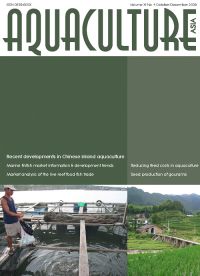
Peter Edwards writes on rural aquaculture: Recent developments in Chinese inland aquaculture. Reducing feed costs in aquaculture: Is the use of mixed feeding schedules the answer for semi-intensive practices? Seed production technology of ornamental gouramis Colisa fasciata and C. lalia under captive conditions. Marine finfish market information and aquaculture development trends in selected locations in Indonesia and Malaysia. Market analysis of the live reef food fish trade.
This report, the 33rd in the series, contains information about the aquatic animal health status of seventeen states in the Asia-Pacific region. The foreword discusses emerging diseases in the region.
This paper provides an overview of seafood consumption production in southeast Asia circa 2006. It forecasts a need for aquaculture to expand area under culture and intensity; highlights the potential for fishmeal to constrain growth, and identifies a trend towards cultivation of high-value species. Sources for the review included a regional synthesis of aquaculture developed for a regional workshop in 2005, a review of marine finfish hatchery development and a regional survey of cage fish culture.
This report, the 32nd in the series, contains information about the aquatic animal health status of fifteen states in the Asia-Pacific region. The foreword discusses regional cooperation for promotion of aquatic animal health management.
This is the proceedings of the workshop on Building capacity to combat impacts of aquatic invasive alien species and associated trans-boundary pathogens in ASEAN countries, held in Penang, Malaysia, on the 12th-16th July 2004. The workshop built on the recommendations from a 2002 workshop organised by the Global Invasive Species Program and a 2003 workshop of countries sharing the Mekong watershed, in promoting awareness, coordination mechanisms and information exchange systems and identifying management and risk mitigation measures.
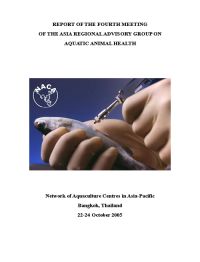
The Asia Regional Advisory Group on Aquatic Animal Health meets annually to discuss regional health issues including emerging disease threats. This report includes a review of regional disease status circa 2005, global and regional disease reporting arrangements, global issues and standards, progress in implementation of the the Regional Technical Guidelines on Health management for the Responsible Movement of Live Aquatic Animals, identification and designation of regional aquatic animal health resources and regional and international cooperation.
This report, the 30th in the series, contains information about the aquatic animal health status of sixteen states in the Asia-Pacific region. The foreword discusses capacity building and harmonisation in aquatic animal health within ASEAN.
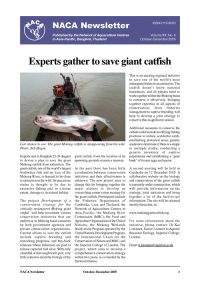
Experts gather to save giant catfish. Workshops on dissemination of better practice models for culture-based fisheries. Dr Chris Baldock, 1947-2005. MAHSEER 2006. MOU signing on conservation of Mahseer in Malaysia and Indonesia. Application of molecular genetics in aquaculture and inland fisheries management. New president of Iran Fisheries Organization. Workshop on the fishery management tool 'EnhanceFish'. Regional Mariculture Development Workshop in China, March 2006. Invitation to apply for position of Director General of NACA. MPEDA expands program on shrimp farmer clubs.
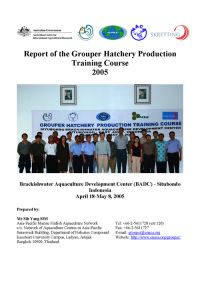
This is the report of the 3rd Regional Grouper Hatchery Production Training Course, which was conducted at the Brackishwater Aquaculture Development Center, Situbondo, East Java, Indonesia from April 18-May 8, 2005. There were a total of 17 participants coming from Australia, Brunei Darussalam, Indonesia, Malaysia, Maldives, Marshall Islands, Singapore, and Vietnam. The training consisted of a mixture of theory, practical and field trips for the participants.
This report, the 29th in the series, contains information about the aquatic animal health status of fourteen states in the Asia-Pacific region. The foreword discusses the outcomes of the fourth meeting of the Asia Regional Advisory Group on Aquatic Animal Health.
The Asia Regional Advisory Group on Aquatic Animal Health meets annually to discuss regional health issues including emerging disease threats. This report includes a review of regional disease status circa 2004, global and regional disease reporting arrangements, global issues and standards, progress in implementation of the the Regional Technical Guidelines on Health management for the Responsible Movement of Live Aquatic Animals, identification and designation of regional aquatic animal health resources and regional and international cooperation.
This report, the 28th in the series, contains information about the aquatic animal health status of seventeen states in the Asia-Pacific region. The foreword discusses the need for improved surveillance and transparent reporting of aquatic animal disease.
This report, the 27th in the series, contains information about the aquatic animal health status of fifteen states in the Asia-Pacific region. The foreword discusses identification of regional expertise in aquatic animal health, in terms of experts, resource centres and reference laboratories.
Tsunami: The long road to recovery. Special Program in Response to the Tsunami. Rebuilding cage aquaculture and eco-tourism at Koh Yao Noi, Thailand. Cash for work, Aceh Indonesia. Assessment of tsunami impacts in Thailand and Indonesia. Consortium to Restore Shattered Livelihoods in Tsunami-devastated Nations. Regional Workshop on Rehabilitation of Fisheries and Aquaculture in Coastal Communities of tsunami affected countries in Asia. Outcomes of Governing Council 16. New grouper feed and marine finfish hatchery guides. Towards a framework for a pro-poor regional strategy for sustainable aquatic resources management in Asia-Pacific. Artificial propagation of indigenous fish species in Sarawak, Malaysia. Inauguration of the National Advisory Committee on Aquatic Animal Health of Viet Nam. Supporting Viet Nam to make an informed decision towards Penaeus vannamei farming. Health group calls for improved surveillance and reporting. Training and study tours in Q1 2005-05-25. TVR 'Ramu' Pillay (1921-2005).
This report, the 26th in the series, contains information about the aquatic animal health status of fifteen states in the Asia-Pacific region. The foreword discusses responsible movement of live aquatic animals in the context of health and quarantine issues.
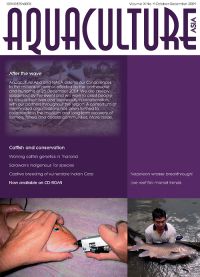
Captive breeding of vulnerable Indian carp Cirrhinus reba for conservation. Conservation of the Asiatic catfish Clarias batrachus through artificial propagation. A perspective on breeding and genetics of walking catfish in Thailand. Decline of wastewater-fed aquaculture in Hanoi. Artificial propagation of indigenous Tor species in Malaysia. Aquaculture of spotted babylon Babylonia areolata. First successful hatchery production of Napoleon wrasse Cheilinus undulatus. Trade and market trends in the live reef fish trade.
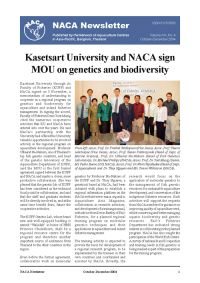
Kasetsart University and NACA sign MOU on genetics. Village shrimp health management project in Andhra Pradesh. A committee to manage fish health in Viet Nam. China to promote healthy shrimp farming. Father of China's shrimp aquaculture. NACA collaboration can extend to west and central Asia, Iran mission suggests. STREAM conducts monitoring & evaluation workshop. STREAM to support aquaculture in western Orissa.
This report, the 25th in the series, contains information about the aquatic animal health status of fifteen states in the Asia-Pacific region. The foreword discusses the outcomes of the third meeting of the Asia Regional Advisory Group on Aquatic Animal Health.