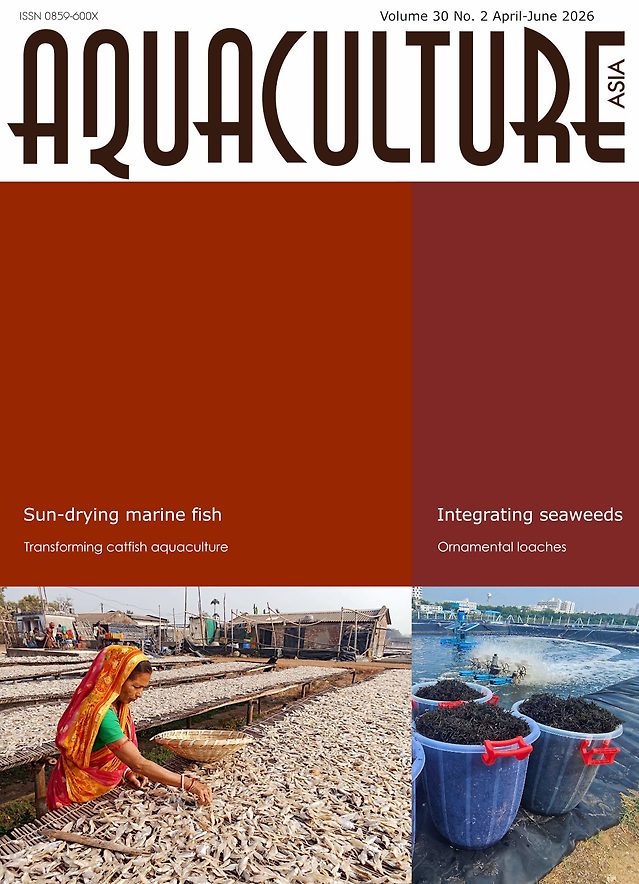
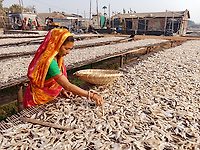
Sun-drying marine fish at Junput-Biramput, Purba Medinipur, West Bengal, India Subrato Ghosh
From coast to pond: Integrating seaweed aquaculture with brackishwater farming systems Aravind R., P. Nila Rekha, R. Jayakumar, J.A.J. Raymond, P.S. Shyne Anand, N.S. Sudheer, R. Saraswathy, S. Aravind Kumar, M. Jayanthi and Kuldeep K. Lal
Tiny guardians of hill streams: Exploring the ornamental loaches of the Western Ghats Abhilash C.P., Saikrishnan K.R., Sarath Varghese, Charan Ravi and V.S. Basheer
Securing the future of the melon barb: Science-based aquaculture for conservation Saikrishnan K.R., Abhilash C.P, Sarath Varghese, Charan Ravi, V.S. Basheer and Kajal Chakrabarty
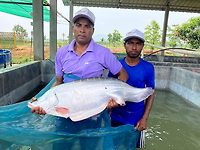
Quietly transforming catfish aquaculture: ICAR-CIFA's seed production journey in India S.K. Sahoo and S.S. Giri
ICAR-CIFA promoting Kalong-Kapili for opening new avenues to strengthen aquaculture in Northeast region of India R.N. Mandal, S. Adhikari, A. Das, F. Hoque, A. Hussan, S. Sarkar, H.K. De and P.K. Sahoo
Aquaculture Asia Magazine is an autonomous publication that gives farmers and scientists in developing countries a voice. Stories concern the small-scale aquaculture prevalent in the region and the circumstances of farmers trying to make ends meet in an increasingly globalised world. We accept articles on any aspect of aquaculture and the related processing, marketing, economic, environmental and social issues. An RSS feed is available if you wish to stay informed of new issues.
27 June 2026 | R.N. Mandal, S. Adhikari, A. Das, F. Hoque, A. Hussan, S. Sarkar, H.K. De and P.K. Sahoo | 300 Downloads | .pdf | 9.88 MB
In Assam and across north-eastern India, the NGO Kalong-Kapili is helping rural families turn unused ponds, wetlands and beels into a source of food and income. Working with ICAR-CIFA, the organisation began in 2007 at Bagibari village and now runs a Field Laboratory and an Aquaculture Field School that train farmers in scientific fish farming, disease management, climate-resilient practices and integrated farming. This article describes how the model has spread to tribal clusters in Borbeel, Lohit and Lower Siang, benefiting hundreds of families through fish farming combined with horticulture, piggery and kitchen gardens.
It also covers Kalong-Kapili's work to empower women through self-help groups, its production of fish seed, and CIFA's outreach scheme reaching forest-dependent communities in West Karbi Anglong. Together these efforts show how aquaculture extension can reduce poverty and malnutrition while building lasting skills in remote regions.
26 June 2026 | S.K. Sahoo and S.S. Giri | 334 Downloads | .pdf | 4.37 MB
For decades, catfish farming in India stayed marginal for one reason: seed. Consumers preferred catfish and paid more for it, yet most indigenous species depended on wild fry collected from rivers and floodplains. Supply was seasonal and unpredictable, so farmers kept returning to reliable carp.
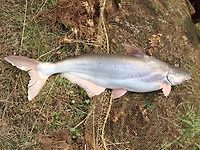
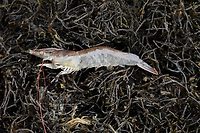
This article traces how ICAR-Central Institute of Freshwater Aquaculture worked over nearly five decades to remove that constraint. Rather than treating breeding as a single step, scientists tackled the whole production system: broodstock nutrition, induced spawning, hatchery design, larval feeding and nursery management. Progress came across species from small bagrid Mystus spp., Rita chrysea, the pabda group Ompok species, the yellow catfish Horabagrus brachysoma, magur Clarias batrachus, singhi Heteropneustes fossilis, Clarias dussumieri, Pangasius pangasius and the predatory, cannibalistic Wallago attu.
The result includes low-cost FRP hatchery units, stage-specific formulated feeds and dependable seed for farmers across many states. It also describes how captive breeding eases pressure on threatened wild stocks and supports conservation alongside aquaculture.
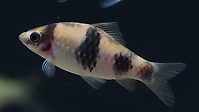
The melon barb (Haludaria fasciata) is a lemon-striped freshwater fish found only in the hill streams of the Western Ghats in Kerala and Tamil Nadu. Prized by the global ornamental fish trade, its wild populations are falling as deforestation, sand mining, and pollution degrade its habitat. This article sets out a science-based method for breeding the species in captivity, from conditioning broodstock on protein-rich diets to managing spawning tanks, larval feeding, and water quality. It also covers the economics: a small hatchery can be set up for a modest sum and produce thousands of juveniles per cycle, giving rural households a supplementary income. By supplying farmed fish to domestic and export markets, hatcheries ease pressure on wild stocks and support brood banks for conservation. The melon barb shows how ornamental aquaculture can link rural livelihoods with the protection of freshwater biodiversity in the Western Ghats.
26 June 2026 | Abhilash C.P., Saikrishnan K.R., Sarath Varghese, Charan Ravi and V.S. Basheer | 298 Downloads | .pdf | 3.32 MB
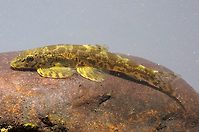
The Western Ghats are home to a distinctive group of small, bottom-dwelling fish: the loaches. Adapted to fast-flowing hill streams, they have elongated bodies, sensitive barbels around the mouth, and cryptic patterns that blend into rock and gravel. The region holds at least 43 loach species across 12 genera, 39 of them endemic, the result of long evolutionary isolation in mountain streams. This article describes their body forms, habitats, feeding habits, and behaviour, and profiles well-known species such as the Zebra loach (Botia striata) and the Zodiac loach (Mesonoemacheilus triangularis), both popular in the global ornamental fish trade. It also outlines the pressures these fish face, including habitat degradation, dam construction, pollution, and unregulated collection. Most Western Ghats loaches still lack legal protection, and the article reviews their conservation status and the measures needed to safeguard them.
25 June 2026 | Aravind R., P. Nila Rekha, R. Jayakumar, J.A.J. Raymond, P.S. Shyne Anand, N.S. Sudheer, R. Saraswathy, S. Aravind Kumar, M. Jayanthi and Kuldeep K. Lal | 247 Downloads | .pdf | 5.38 MB
Seaweed farming in India has long been confined to open coastal waters. But researchers are now proving that commercially valuable species can thrive in brackishwater ponds, lagoons, and tanks, especially when grown alongside shrimp, mud crab, and finfish. This article from ICAR-Central Institute of Brackishwater Aquaculture explains how integrating fast-growing Gracilaria and Ulva species into existing farms turns waste nutrients into a second cash crop, improves water quality, and raises the survival and quality of the animals farmed with them. It covers the most promising species, practical cultivation methods, and real field results: more than a three-fold increase in seaweed biomass, shrimp survival above 95%, and reduced feed conversion ratios. It also looks honestly at the hurdles - seed supply, salinity swings, disease, and pricing - that must be solved to scale up.
Along the coast of Purba Medinipur in West Bengal, sun-dried marine fish - known locally as 'Shutki machh' - has grown from a traditional way of saving surplus catch into a thriving regional business. At the Matsya Khoti of Junput-Biramput village, where commercial drying began some 70-75 years ago, around 550-600 producers now sort, salt, and dry fish on raised bamboo platforms before sending it to markets across north-east India, Nepal, Bhutan, and Bangladesh.
This article takes a close look at how the dried fish trade works: the species and methods, the road transport network, the food culture and recipes carried into West Bengal by refugees, the women whose labour underpins much of the work, and asks what is needed to keep this tradition healthy and sustainable.