Livelihoods, gender and social issues

Aquaculture livelihoods and social issues in rural communities.

Creative Commons Attribution.

Related

Subject tags

A collection of subject tags relating to technical matters.

In this collection

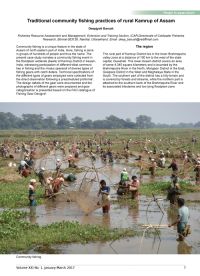
Traditional community fishing practices of rural Kamrup of Assam

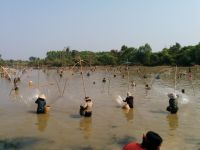
Community fishing is a unique feature in the state of Assam, India. The present case study narrates a community fishing event in the floodplain wetlands (beels) of Kamrup District in Assam, India, witnessing participation of different tribal communities in fishing and the modus operandi of diverse types of fishing gears with catch details. The design details of the gear were documented. The communal fishing practices of local communities are described along with the respective roles of men and women.

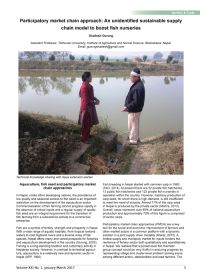
Participatory market chain approach: An unidentified sustainable supply chain model to boost fish nurseries

In Nepal, low quality and seasonal access to fish seed is an important restriction on the development of the aquaculture sector. Commercialisation of fish farming cannot progress rapidly in the absence of critical inputs and a regular supply of quality fish seed is an integral requirement for the transition of fish farming from a subsistence activity to a commercial enterprise. Participatory market chain approaches are a key tool for the social and economic improvement of farmers and market participants.

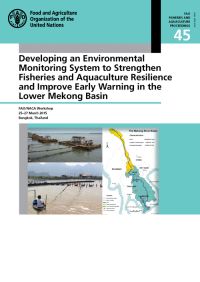
Developing an Environmental Monitoring System to Strengthen Fisheries and Aquaculture Resilience and Improve Early Warning in the Lower Mekong Basin

These are the proceedings of a consultation on the existence and effectiveness of environmental monitoring systems for fisheries and aquaculture in the Lower Mekong basin. The document provides a baseline assessment of environmental monitoring systems in Cambodia, Thailand and Vietnam and the report of a workshop to discuss the assessments findings and future steps towards an improved environmental monitoring and early warning system that will contribute to climate change adaptation in fisheries and aquaculture in the area.

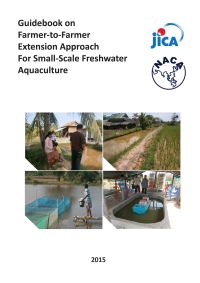
Development of a Guidebook on Farmer-to-Farmer Extension Approaches for Small-scale Aquaculture in the Asia-Pacific Region

The objectives of this project were to i) develop a guidebook in English on "Farmer-to-farmer extension approaches for small-scale aquaculture" and ii) to translate the developed guidebook into selected local dialects in Asia-Pacific and other regions (e.g. Africa). The project made use of the significant results from the JICA projects in Cambodia, Benin and other countries on farmer-to-farmer extension approaches on technology extension for small-scale farmers. The book is available in eleven languages (English, Arabic, Bahasa Indonesia, BurmeseFrenchKhmerLoatian, Malay, NepaliThai and Vietnamese.

Culture-based Fisheries Development in Lao PDR and Cambodia

Culture-based fisheries (CBF) are a useful development strategy for improving the income and food security of rural communities. CBF requires minimal capital outlay, mobilising farming communities to make use of existing small dams and reservoirs for the secondary purpose of foodfish production. The objective of this project is to introduce community-based CBF to Cambodia, and to consolidate the gains of communities that have adopted CBF in Lao PDR.

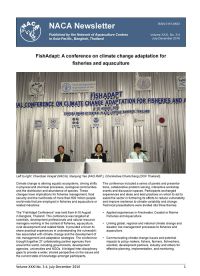
NACA Newsletter, Vol. XXXI, No. 3-4, July-December 2016

In this issue:

FishAdapt: A conference on climate change adaptation for fisheries and aquaculture. 11th Asian Fisheries and Aquaculture Forum convened in Bangkok. A new and improved PCR detection method for Enterocytozoon hepatopenaei (EHP) based on a gene encoding a spore wall protein. Radio interview on NACA's mission and role in regional food security. Quarterly Aquatic Animal Disease Report, Q1 2016. Guidebook on farmer-to-farmer extension approach for small-scale freshwater aquaculture. New NACA website in the works.

Final Draft Code of Practice for Trans-boundary Movement of Aquatic Organisms in the Lower Mekong Basin

This Code of Practice is prepared to promote or ensure compliance to World Trade Organisation-Sanitary and Phytosanitary measures for the movement of live aquatic organisms in the Lower Mekong Basin. The goals of the Code are to achieve environmental protection and management, biodiversity conservation as well as prevention of spread of disease epizootics. Most of the points listed in this Code are based on the inputs of MRC Member Countries.

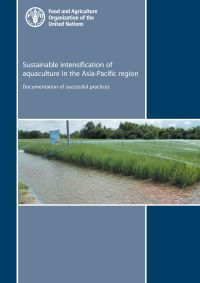
Sustainable intensification of aquaculture in the Asia-Pacific region: Documentation of successful practices

This publication is the major output of a regional programme jointly implemented by FAO and NACA in 2015 to document and disseminate successful practices that contribute to the sustainable intensification of aquaculture in the Asia-Pacific region. Twelve practices are described that contribute to at least one of the following: Improved production and resource use efficiency (land, water, feed, energy); improved environmental benefits; strengthened economic viability and farmers' resilience; and improved social acceptance and equity.

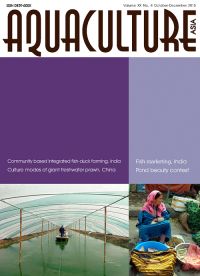
Aquaculture Asia Magazine, October-December 2015

In this issue:

Aquaculture feed supply chain attracting scrutiny. Pond beauty contest, Ram Kumar and social development. Culture modes of giant freshwater prawn in Yangtze River Delta for early harvest. Fish marketing in Kashmir, India - a case study of Srinagar. Community-based integrated fish-duck farming: A boon for rural development in agro-climatic conditions of Assam, India. Gastropod and bivalve fishery of Kakinada Bay, Andhra Pradesh, India: Management and conservation issues.

Regional workshop documents sustainable intensification practices in aquaculture

Due to the world’s rapidly growing population, which is expected to peak somewhere around 9.5 billion, food production will need to be massively increased over the next few decades. This increase must be achieved without further degrading the environment. The unit environmental footprint of food production must be significantly reduced from where it is today. This concept, termed sustainable intensification, applies as much to aquaculture as it does to other agricultural sectors.

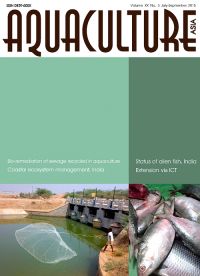
Aquaculture Asia Magazine, July-September 2015

In this issue:

Changes to the magazine and website. Status of alien fish species farming and it's implications for Andhra Pradesh, India. Bridging the research-extension-farmer-input and market linkage gap in coastal aquaculture through application of ICT. Bio-remediation of domestic sewerage recycled in aquaculture: A Central Institute of Freshwater Aquaculture model. Role of family farming in marine and coastal ecosystem management in India. Conservation of fish genetic resources: An introduction to the state fishes of India.

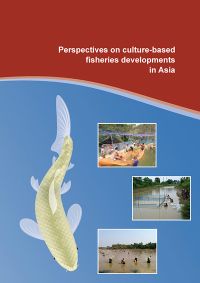
Perspectives on culture-based fisheries developments in Asia

This book is the proceedings of the “Regional Consultation on Culture-Based Fisheries Development in Asia”, held in Siem Reap, Cambodia, 21-23rd of October 2014, under the auspices of the Australian Centre for International Agricultural Research (ACIAR), the Mekong River Commission (MRC) and the Network of Aquaculture Centres in Asia-Pacific (NACA). The consultation was jointly organised by NACA and the Fisheries Administration of the Royal Government of Cambodia.

AFSPAN Final Technical Report now available

The objectives of the Aquaculture for Food Security, Poverty Alleviation and Nutrition (AFSPAN) project were to strengthen the knowledge base and develop new and more rigorous methodologies of quantifying the contribution of aquaculture to combat hunger and poverty, thus providing the evidence upon which sound strategies, policies and research programs can be developed to support the sustainable expansion of aquaculture to maximise its impact on food and nutrition security and poverty alleviation.

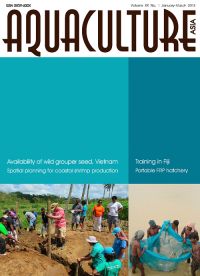
Aquaculture Asia Magazine, January-March 2015

Further training provided to aquaculturists in Fiji. Spatial planning for sustainable coastal shrimp production. Availability of grouper (Serranidae) fingerlings and seed in the coral reef of Son Tra Peninsula, central Viet Nam. Small-scale carp seed production through portable FRP hatchery at Khanguri, Odisha. Regional consultation on culture-based fisheries developments in Asia. Gender Assessment Synthesis Workshop. Broodstock management in aquaculture. Urgent appeal to control spread of the shrimp microsporidian parasite Enterocytozoon hepatopenaei (EHP).

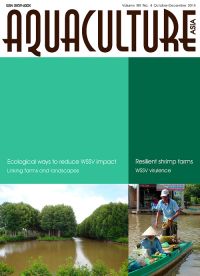
Aquaculture Asia Magazine, October-December 2014

Promising aquaculture practices for sustainable intensification. Culture and breeding of Archcentrus spilurum at Tuticorin District of Tamil Nadu, India. Searching for ecological ways to reduce WSSV impact. Fisheries and aquaculture-based livelihoods prospects in East Kalimantan, Indonesia. Linking farms and landscapes in the governance of sustainable Vietnamese shrimp aquaculture. Resilience of shrimp farming based livelihoods in the Mekong Delta, Vietnam. Farming system affects the virulence of white spot syndrome virus (WSSV) in penaeid shrimp.

Proceedings of the International Symposium on Small-scale Freshwater Aquaculture Extension

The main objective of this symposium is to provide a venue for information sharing on extension of small-scale aquaculture, specifically targeted to those individuals and relevant organizations involved in various aquaculture development projects. The symposium will also assess and present the effectiveness of “farmer-to-farmer extension” approach in the implementation of relevant aquaculture development projects in the region. The symposium was organised for stakeholders in JICA-assisted projects in SE Asia and Africa.

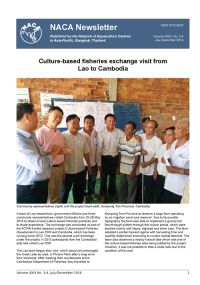
NACA Newsletter, Volume XXIX, No. 3-4, July-December 2014

In this issue:

Culture-based fisheries exchange visit from Lao to Cambodia. National Fish Day, Cambodia. WAS Adelaide: Special Session on Regional Cooperation for Improved Biosecurity. Inbreeding and disease in tropical shrimp aquaculture: a reappraisal and caution. Shrimp EMS/AHPND Special Session at DAA9. 2nd International Symposium on Aquaculture and Fisheries Education. Report on Sustainable Fisheries and Aquaculture for Food Security and Nutrition.

Culture-based fisheries development in Lao PDR and Cambodia proceeding well

Under the ACIAR-funded project Culture-based fisheries development in Lao PDR and Cambodia, a monitoring team recently visited both countries to observe progress by participating community groups and to provide guidance for the next stocking season. The project is working with rural villages to implement culture-based fisheries as a community activity, where the work, management and benefits are shared by local residents.

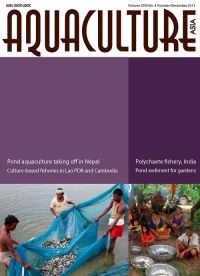
Aquaculture Asia Magazine, October-December 2013

In this issue:

Special session on regional cooperation for improved biosecurity. Pond aquaculture taking off in Nepal. Introduction of culture-based fishery practices in small water bodies in Cambodia: Issues and strategies. A case study on polychaete fishery by the Irular tribal fishing community on the Tamil Nadu coast. Use of pangasius pond sediment for rooftop bag gardening: Potential for rural-urban integrated agriculture-horticulture. Culture-based fisheries exchanges between Lao PDR and Cambodia.

Artisinal tropical aquaculture in a genetic plunge towards extinction

Artisanal shrimp aquaculture is in a disease-induced crisis of lost production. The immediate cause is biological: rising levels of inbreeding and a strong, positive relationship between inbreeding and disease. The root cause is social: a nexus of human behavior in which breeders protect their intellectual property by generating inbreeding, local hatcheries sell copied, inbred shrimp, and farmers suffer the consequences.