Shrimp

Information relating to the aquaculture of marine shrimp.

Creative Commons Attribution.

Related

Species / commodity tags

Major farmed commodity or species groups.

In this collection

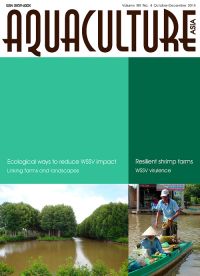
Aquaculture Asia Magazine, October-December 2014

Promising aquaculture practices for sustainable intensification. Culture and breeding of Archcentrus spilurum at Tuticorin District of Tamil Nadu, India. Searching for ecological ways to reduce WSSV impact. Fisheries and aquaculture-based livelihoods prospects in East Kalimantan, Indonesia. Linking farms and landscapes in the governance of sustainable Vietnamese shrimp aquaculture. Resilience of shrimp farming based livelihoods in the Mekong Delta, Vietnam. Farming system affects the virulence of white spot syndrome virus (WSSV) in penaeid shrimp.

Aquaculture Asia Magazine, July-September 2014

In this issue:

Labour issues in the fishing and aquaculture industries. Commercial tilapia farming at take-off point in Fiji. Tank based captive breeding and seed production of the pearlspot (Etroplus suratensis). Cage culture of pearlspot in Kerala, India. Culture-based fisheries exchange visit from Lao PDR to Cambodia. National Fish Day, Cambodia. WAS Adelaide: Special Session on Regional Cooperation for Improved Biosecurity. Inbreeding and disease in tropical shrimp aquaculture: A reappraisal and caution.

NACA Newsletter, Volume XXIX, No. 3-4, July-December 2014

In this issue:

Culture-based fisheries exchange visit from Lao to Cambodia. National Fish Day, Cambodia. WAS Adelaide: Special Session on Regional Cooperation for Improved Biosecurity. Inbreeding and disease in tropical shrimp aquaculture: a reappraisal and caution. Shrimp EMS/AHPND Special Session at DAA9. 2nd International Symposium on Aquaculture and Fisheries Education. Report on Sustainable Fisheries and Aquaculture for Food Security and Nutrition.

Acute Hepatopancreatic Necrosis Disease Card (updated June 2014)

Acute hepatopancreatic necrosis disease (AHPND) has recently been found to be caused by a pathogenic strain of Vibrio parahaemolyticus. This updated disease card provides a summary and guidance on disease signs at the pond level, at the animal level by histopathology, molecular diagnostic tools, host range, presence in Asia-Pacific, prevention and control and links to further information.

A new and improved PCR method for detection of AHPND bacteria

We describe a new method for detecting isolates of Vibrio parahaemolyticus that cause acute hepatopancreatic necrosis disease (AHPND). This method is based on the gene sequence of a protein discovered in a sub-fraction of cell-free culture broth from isolates of V. parhaemolyticus that cause AHPND, but not from V. parahaemolyticus or other bacteria that do not cause AHPND. This cell-free preparation caused the typical signs of acute AHPND when administered to shrimp by reverse gavage. 

Inbreeding and disease in tropical shrimp aquaculture: a reappraisal and caution

The disease crisis facing shrimp aquaculture may be propelled, in part, by an interaction between management practices that cause inbreeding, and the amplification by inbreeding of susceptibility to disease and environmental stresses. The study describes and numerically simulates gene flow from Penaeus (Litopenaeus) vannamei hatcheries that employ a ‘Breeder Lock’ to discourage use of their PL as breeders, through ‘copy hatcheries’ that breed the locked PL, to inbred shrimp in farm ponds. 

AHPND detection discussion group established

A Google Group on AHPND detection has been established to promote communication about the two AHPND detection methods (AP1 and AP2) that Dr Chu-Fang Lo and Dr Tim Flegel announced on 24 December 2013. The purpose of the group is to allow people using the methods to send in their comments and experiences about use of these two methods and other methods that might be developed.

Aquaculture Asia Magazine, April-June 2014

In this issue:

Integrated rice/crayfish farming in Hubei Province, China. Improvement of seaweed Kappaphycus alvarezii culture production by reducing grazing by rabbit fish (Siganus spp.). Exploring the fisheries of Wular Lake, Kashmir, India. Golden mahseer Tor putitora - a possible candidate species for hill aquaculture. Free primers for specific detection of bacterial isolates that cause acute hepatopancreatic necrosis disease. Special session on regional cooperation for improved biosecurity. AHPND detection discussion group established.

NACA Newsletter, Volume XXIX, No. 2, April-June 2014

In this issue:

25th NACA Governing Council held in Vientiane, Lao PDR. Dr Cherdsak Viripat elected as next Director General of NACA. 9th Symposium on Diseases in Asian Aquaculture 24-28 November 2014, Vietnam. NACA to convene the 11th AFS Asian Fisheries and Aquaculture Forum. Free primers for specific detection of bacterial isolates that cause acute hepatopancreatic necrosis disease. World Aquaculture Adelaide 2014: Special session on regional cooperation for improved biosecurity. AHPND detection discussion group established. OIE Regional Workshop on Emerging Aquatic Animal Disease Response, in collaboration with NACA, Bali, Indonesia. United Kingdom - Southeast Asia Workshop on Sustainable Aquaculture.

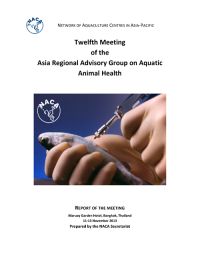
Report of the twelfth meeting of the Asia Regional Advisory Group on Aquatic Animal Health, 11-13 November 2013

The Asia Regional Advisory Group on Aquatic Animal Health meets annually to discuss regional health issues including emerging disease threats. This report includes a review of regional disease status circa 2013, global and regional disease reporting arrangements, global issues and standards, progress in implementation of the the Regional Technical Guidelines on Health management for the Responsible Movement of Live Aquatic Animals, identification and designation of regional aquatic animal health resources and regional and international cooperation.

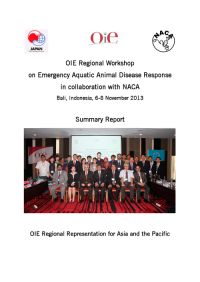
OIE Regional Workshop on Emergency Aquatic Animal Disease Response in Collaboration with NACA: Summary report

The workshop was held in Bali, Indonesia from 6 to 8 November 2013. The programme included reports on current aquatic animal disease situations in selected countries and presentations on the national aquatic animal health programmes of China, Japan and Korea. In addition, case studies on the molluscan diseases, shrimp diseases and finfish diseases were presented to facilitate the subsequent discussion on emergency response of those diseases in the national and regional level.

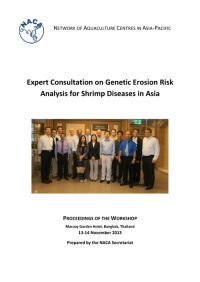
Proceedings of the Expert Consultation on Genetic Erosion Risk Analysis for Shrimp Diseases in Asia, 13-14 November 2013

Shrimp aquaculture in tropical regions is facing a disease-induced catastrophe of lost production. There is reason to believe that current (poor) broodstock management practices may induce genetic erosion that increases susceptibility to disease and vulnerability to epizootics. The basic tenet for this consultation is that an important aggravating factor in the disease crisis is an agro-economic system that locks shrimp breeders, hatcheries and farmers into behaviour that induces high levels of inbreeding.

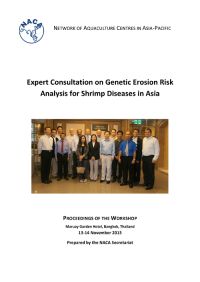
Expert consultation on genetic erosion risk analysis for shrimp diseases in Asia

Shrimp aquaculture in tropical regions is facing a disease-induced catastrophe of lost production. There is reason to believe that current broodstock management practices may induce genetic erosion that increases susceptibility to disease and vulnerability to epizootics. The basic tenet for this Expert Consultation is that an important aggravating factor in the disease crisis is an agro-economic system that locks shrimp breeders, hatcheries and farmers into behaviour that induces high levels of inbreeding.

Free release of primers for specific detection of bacterial isolates that cause acute hepatopancreatic necrosis disease (AHPND)

Efforts to control AHPND have been hampered by the lack of a specific and rapid detection method that could be used to determine the reservoirs of the causative bacterial isolates, to insure their absence in shrimp broodstock and post larvae, to monitor shrimp during cultivation and to aid research on possible control measures. Our two groups have been conducting cooperative research on possible PCR methods to detect isolates of AHPND bacteria.

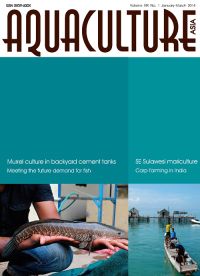
Aquaculture Asia Magazine, January-March 2014

In this issue:

Towards meeting future demand for fish: Aquaculture in inland or marine land or water-based systems? Status of carp farming in India. Recent trends in mariculture in southeast Sulawesi, Indonesia. Murrel (snakehead) culture in backyard cement tanks: A breakthrough and a success story. Mobile telephony - ICT eneabled fisheries extension service for sustainable shrimp farming. International Symposium on Small-scale Freshwater Aquaculture Extension. Report on early mortality syndrome / acute hepatopancreatic necrosis syndrome of shrimp.

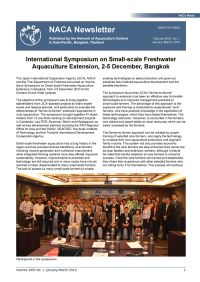
NACA Newsletter, Volume XXIX, No. 1, January-March 2014

In this issue:

International Symposium on Small-scale Freshwater Aquaculture Extension, 2-5 December, Bangkok. 12th Meeting of the Asia Regional Advisory Group on Aquatic Animal Health. National Workshop on EMS/AHPND of Cultured Shrimp held in India. Report on early mortality syndrome / acute hepatopancreatic necrosis syndrome of shrimp. Sustaining Ethical Aquaculture Trade Newsletter. India and the AFSPAN Project. Report on AFSPAN Chilean survey. Feeding and feed management of Indian major carps in Andhra Pradesh.

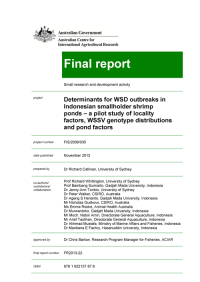
Determinants for WSD outbreaks in Indonesian smallholder shrimp ponds

This study was designed to improve our understanding of the main causal pathways for white spot disease (WSD) in a representative, 50-pond shrimp farming system in South Sulawesi, Indonesia. The longitudinal observational study focused on recording the occurrence of different genotypes of the causal infectious agent, white spot syndrome virus (WSSV), in selected components of the system across time, and looking for relationships with pond outcomes, particularly WSD occurrence.

 

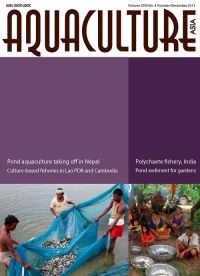
Aquaculture Asia Magazine, October-December 2013

In this issue:

Special session on regional cooperation for improved biosecurity. Pond aquaculture taking off in Nepal. Introduction of culture-based fishery practices in small water bodies in Cambodia: Issues and strategies. A case study on polychaete fishery by the Irular tribal fishing community on the Tamil Nadu coast. Use of pangasius pond sediment for rooftop bag gardening: Potential for rural-urban integrated agriculture-horticulture. Culture-based fisheries exchanges between Lao PDR and Cambodia.

NACA Newsletter, Volume XXVIII, No. 4, October-December 2013

In this issue:

Culture-based fisheries development in Lao PDR and Cambodia proceeding well. National aquatic animal disease surveillance programme launched in India. Report on early mortality syndrome / acute hepatopancreatic necrosis syndrome of shrimp. International Symposium on Small-scale Freshwater Aquaculture Extension, 2-5 December, Bangkok. 'Perfect' food for 'perfect' prawns. Aquaculture without Frontiers Special Session. We asked CSIRO: Gold Coast Tiger Prawns. Understanding the sex of salmon. Overcoming smallholder challenges with biotechnology. Coordinated efforts in aquaculture needed to meet global demand. FAO e-book collection for tablets and e-readers.

FAO / MARD Technical Workshop on Early Mortality Syndrome or Acute Hepatopancreatic Necrosis Syndrome of Cultured Shrimp

This report is the proceedings of a workshop held under the FAO technical cooperation project Emergency assistance to control the spread of an unknown disease affecting shrimps held in Hanoi, Viet Nam from 25 to 27 June 2013. The workshop reviewed recent investigations into the cause of acute hepatopancreatic necrosis syndrome, believed to related to a strain of Vibrio parahaemolyticus and drew a number of recommendations on specific and generic actions and measures for reducing the risk of AHPND.