Shrimp

Information relating to the aquaculture of marine shrimp.

Creative Commons Attribution.

Related

Species / commodity tags

Major farmed commodity or species groups.

In this collection

Shrimp farming in Rushan County, China (abstract)

This case study is based on a farm survey of 41 farms out of the total 340 farms in the Rushan County. The results presented in this paper highlight two main problems. The first issue revolves around labor cost statistics. The value of labor cost during the culture period forms a larger than proportionate ratio of total variable cost. The second problem lies in the high fixed cost incurred by rehabilitated farms.

Shrimp aquaculture management in Bangladesh (abstract)

This case study is based on review of existing publications/reports and stakeholder consultations. It is divided into three main sections, namely: 1) Background review on shrimp aquaculture in Bangladesh. 2) Results from a case study of farm management practices, hatcheries and wild shrimp fry collection and 3) Results from a case study on the social aspects of shrimp aquaculture, based on detailed local level studies in the Khulna region.

The environmental management of shrimp farming in Australia

In Australia, strict Commonwealth and state environmental regulations have constrained development of shrimp farming. A high level of resources, relative to the size and value of the industry, has been devoted to collaborative research on the environmental management of shrimp farming in Australia. The research findings are being used to provide a scientific basis for discharge license requirements and are incorporated into an advanced geographic information and decision support system in order to improve site selection and aquaculture planning.

Thematic review on management strategies for major diseases in shrimp aquaculture

This document presents the report of the Expert Workshop on Management Strategies for Major Diseases in Shrimp Aquaculture. The report includes summaries of fifteen national review papers on the history and current national status of major shrimp diseases, including their socioeconomic impacts and an evaluation of the successes and failures of state and private sector interventions to solve major disease problems and to develop more sustainable shrimp culture industries, and four thematic reviews.

Thematic review on coastal wetland habitats and shrimp aquaculture

This review documents the status of shrimp aquaculture in relation to mangrove forest ecosystems. The environmental, social and economic impacts of shrimp farming are discussed, with examples covering both the negative and positive aspects of the sector. The review considers interventions and other activities to improve the sustainability of shrimp farming in the context of coastal zone management and the protection of mangrove ecosystems. The effectiveness of these interventions is considered in the light of experience based on case studies.

Thematic review of feeds and feed management practices in shrimp aquaculture

This paper reviews feeds and feed management practice in shrimp aquaculture and assesses the trends and environmental implications of feed use. Particular attention is given to the use of fish meal in shrimp diets and water pollution caused by feeds. The review identifies practices at farm, manufacturing and ecosystem levels that can reduce environmental impacts associated with the use of shrimp feeds. Trends in the use of alternative ingredients to replace fish meal are also considered.

Codes of practice and conduct for marine shrimp aquaculture

The rapid expansion of marine shrimp aquaculture in many tropical developing countries has proceeded without effective environmental regulation. Most countries with shrimp farming do not have an established regulatory apparatus to monitor and enforce environmental and socioeconomic standards. Therefore, voluntary codes of conduct are a possibility for improving overall management and possibly profitability of the marine shrimp aquaculture industry until effective governmental regulation is implemented. This paper reviews the status of existing codes of conduct for shrimp farming.

Coastal water quality monitoring in shrimp farming areas: An example from Honduras

Various substances in shrimp farm ponds can contaminate waters, including nutrients, metabolic wastes, veterinary chemicals, and suspended soil particles from erosion. This report discusses ways to monitor these aspects of water quality, which is important from two standpoints for shrimp farmers. Incoming water used top supply shrimp ponds must be healthful and free of toxins to protect the growing shrimp, and effluent must be clean enough to avoid harming aquatic ecosystems and water quality standards downstream.

The integration of mangrove and shrimp farming: A case study on the Caribbean coast of Colombia

Shrimp aquaculture has been accused of threatening mangrove forests worldwide. Mangrove and shrimp ponds are known to have mutually supportive functions. Mangrove wetlands can treat effluents from shrimp ponds effectively by removing suspended solids and nutrients. This activity can be expected, in turn, to enhance mangrove productivity. This report describes an integrated mangrove wetland–shrimp farm operating in Colombia since 1996. At this site, shrimp farm effluent is recirculated through an 120 ha mangrove area.

The adoption of good management practices by the shrimp industry on the Caribbean coast of Colombia

This report discusses the recent history of shrimp aquaculture along the Caribbean coast of Colombia, with a focus on effective management practices that have been implemented since the mid-1990s. While the primary reason for using different practices has been preventing outbreaks of shrimp diseases, many such practices provide environmental benefits as well. Examples include reducing the use of water and ensuring that effluent entering natural water bodies is at least as clean as the intake water.

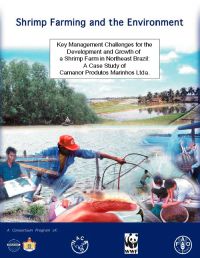
Key management challenges for the development and growth of a shrimp farm in northeast Brazil: A case study of Camanor Produtos Marinhos Ltda.

This case study discusses the main lessons for management practices learned at the shrimp farm Camanor, in Rio Grande do Norte, Brazil. Since it was founded in 1982, the farm has yielded data that allow the lessons and insights to be drawn. This case documents the most important lessons learned by Camanor during the past 18 years. The most important challenges before the shrimp aquaculture industry involve developing better practices and implementing industry wide standards that are more sustainable.

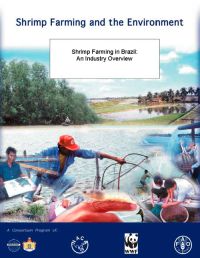
Shrimp farming in Brazil: An industry overview

The purpose of this study is to assess the development of the shrimp farming industry in Brazil, identifying past obstacles and key incentives for its expansion. The shrimp industry has taken longer to develop in Brazil than in other countries. Despite favorable conditions, it is only recently that successful efforts are consolidating. This report analyzes the main factors that have inhibited the development of the industry and describes the sector's current characteristics.

Shrimp Health Management Extension Manual

This extension manual summarises farm level risk factors and practical management practices that can be used to reduce risks of shrimp disease outbreaks and improve farm production. The recommendations are based on a study conducted in Andhra Pradesh, India. The publication is therefore of particular relevance to Andhra Pradesh, but many recommendations are still of use to farmers from other areas.

Asia Diagnostic Guide to Aquatic Animal Diseases

The most comprehensive aquatic disease guide ever published in the region. It covers economically significant diseases of molluscs, fish and crustaceans. Contains information on laboratory and diagnostic techniques, causative agents and distribution, host range, clinical aspects, screening methods, diagnostic procedures, modes of transmission, control measures. Includes contact details for technical support services throughout the region and national health coordinators.
Report of the third meeting of the Asia Regional Advisory Group on Aquatic Animal Health, 23-25 November 2004

The Asia Regional Advisory Group on Aquatic Animal Health meets annually to discuss regional health issues including emerging disease threats. This report includes a review of regional disease status circa 2004, global and regional disease reporting arrangements, global issues and standards, progress in implementation of the the Regional Technical Guidelines on Health management for the Responsible Movement of Live Aquatic Animals, identification and designation of regional aquatic animal health resources and regional and international cooperation.

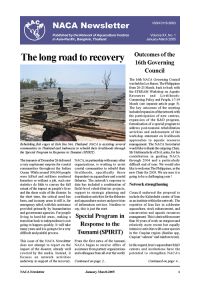
NACA Newsletter Volume XX, No. 1, January-March 2005

In this issue:

Tsunami: The long road to recovery. Special Program in Response to the Tsunami. Rebuilding cage aquaculture and eco-tourism at Koh Yao Noi, Thailand. Cash for work, Aceh Indonesia. Assessment of tsunami impacts in Thailand and Indonesia. Consortium to Restore Shattered Livelihoods in Tsunami-devastated Nations. Regional Workshop on Rehabilitation of Fisheries and Aquaculture in Coastal Communities of tsunami affected countries in Asia. Outcomes of Governing Council 16. New grouper feed and marine finfish hatchery guides. Towards a framework for a pro-poor regional strategy for sustainable aquatic resources management in Asia-Pacific. Artificial propagation of indigenous fish species in Sarawak, Malaysia. Inauguration of the National Advisory Committee on Aquatic Animal Health of Viet Nam. Supporting Viet Nam to make an informed decision towards Penaeus vannamei farming. Health group calls for improved surveillance and reporting. Training and study tours in Q1 2005-05-25. TVR 'Ramu' Pillay (1921-2005).

Report on indigenous participation in aquaculture - the Pacific experience, Sydney, Australia, 27-28 September 2004

The workshop Indigenous Participation in Aquaculture – the Pacific Experience was held as a day-and-a-half session in the Australasian Aquaculture 2004, Sydney, 27–28 September 2004. The workshop promoted exchange of information and experiences between researchers, government representatives and industry involved in aquaculture development in the Pacific. The workshop recognised the increasing interest in aquaculture as an industry that can provide benefits for indigenous communities in Australia as well as the Pacific Islands.

An improved traditional shrimp culture technique for increasing pond yield

A series of research studies were conducted to refine existing traditional culture practices for the tiger shrimp, Penaeus monodon. Natural food produced in a shrimp pond through fertilisation is not fully consumed in the first two months at a stocking rate of 5,000 postlarvae per hectare. Natural food produced by organic and inorganic fertilisation using the traditional practice can sustain an optimal growth of shrimp at a density of 20,000 postlarvae per hectare for a period of 60 days.

A prototype warm water shrimp hatchery

A successful hatchery usually depends on a number of conditions; among the more important ones are right choice of site, effectiveness and efficiency of operational management. The present technology series attempts to describe the prototype warm water shrimp hatchery established and operated by SEAFDEC Aquaculture Department in collaboration with FAO since 1982. The techniques used in the operation of the hatchery have been refined, repeatedly tested and are now packaged for further testing in different environmental conditions elsewhere in the Philippines and other tropical countries.

Aquaculture Asia Magazine, October-December 2004

In this issue:

Captive breeding of vulnerable Indian carp Cirrhinus reba for conservation. Conservation of the Asiatic catfish Clarias batrachus through artificial propagation. A perspective on breeding and genetics of walking catfish in Thailand. Decline of wastewater-fed aquaculture in Hanoi. Artificial propagation of indigenous Tor species in Malaysia. Aquaculture of spotted babylon Babylonia areolata. First successful hatchery production of Napoleon wrasse Cheilinus undulatus. Trade and market trends in the live reef fish trade.